Compressor package control
Open suction and recycle, start unloaded, prove rotor speed and place the machine on line without bypassing process permissives.
A hands-on controls lab for compressor packages and process utilities. Learners program permissive startup, unload/recycle operation, speed proof, discharge isolation, fire-and-gas demand, high-pressure ESD and blowdown against pressure and rotor dynamics.
Live training model
Gas Compressor ESD & Blowdown
Unloaded compressor startup with recycle-to-discharge transition
Continuous rotor-speed and discharge-pressure simulation
Latched ESD from fire-and-gas, safety, lubrication or high-high pressure
Isolation and blowdown behavior graded under real upset sequences
What technicians actually practice
Every flagship combines PLC logic, dynamic machine state, failure conditions and deterministic grading. Learners must make the process safe—not just energise a coil.
Open suction and recycle, start unloaded, prove rotor speed and place the machine on line without bypassing process permissives.
A fire-and-gas or high-pressure demand latches shutdown, isolates running paths and opens emergency depressurisation.
The boiler startup lab covers purge proof, pilot and ignition timing, flame confirmation, main fuel admission and flame-loss trip.
Flushing valves, chemical dosing, analog pressure scaling, level alarms and pump alternation build the reusable controls behind pipeline auxiliaries.
Scenario library
Start on recycle, prove speed, build discharge pressure, respond to fire-and-gas and depressurise after ESD.
Prove purge air, time pilot ignition, confirm flame and latch a safe trip on flame or water loss.
Coordinate timed valve paths and prove each transition before advancing the sequence.
Scale analog demand, command proportional dosing and alarm abnormal process response.
Convert a transmitter signal into engineering units and validate its operating range.
Preserve the initiating alarm and coordinate shutdown logic through a process upset.
Reuse compressor, burner, pump, valve, transmitter, pipe-rack, vessel, spill-control, HMI and safety components, each with shared motion, I/O and fault contracts.
Public viewer is free. Guided 3D starts on Basic; composing and saving custom 3D scenes is Pro.
151 real-time factory components
Load the interactive viewer when you are ready to orbit the models.
Loads 3D only after your click
Training outcomes
Assignments can grade normal operation, unsafe demands, boundary conditions and recovery behavior against the same machine model.
Scope, stated plainly
This is controls training software, not a safety-certified SIS, compressor performance tool or digital twin of a production facility. It cannot establish SIL, validate cause-and-effect, replace API/IEC engineering, or control field equipment.
Related training solutions
Pilot with your standards
Use the existing labs immediately, then map assignments and pass criteria to the equipment, failure modes and competencies your team owns.
Competency and practice field guide
Direct answer
The learner can trace a request or process deviation through instruments, PLC or RTU logic, equipment response, alarm evidence and controlled recovery.
Written for operators, instrument technicians, controls learners and maintenance teams studying remote assets, separators, pumps, compressors, valves, alarms and shutdown boundaries.
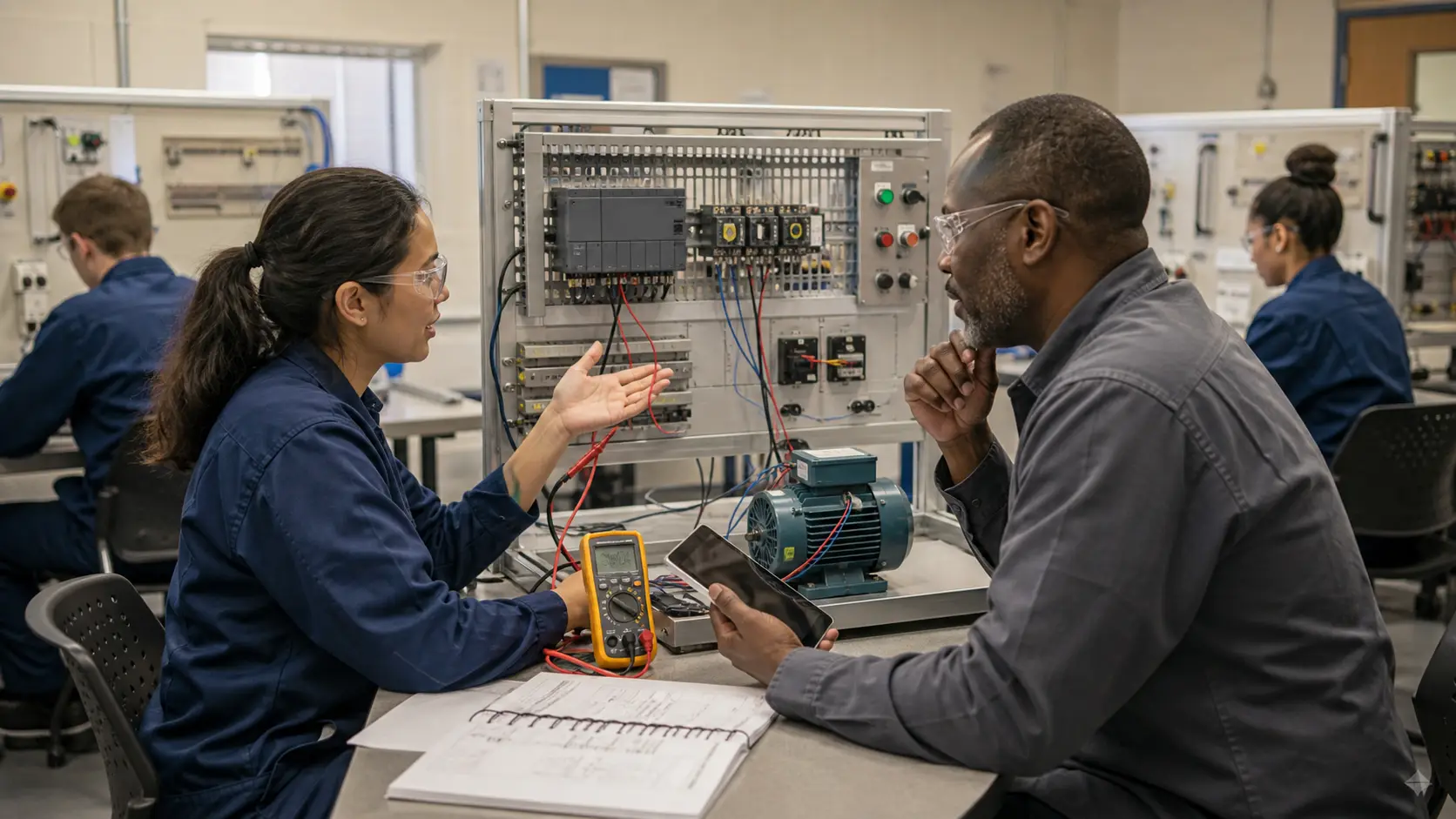
Process objective, fluid and pressure context, instruments, control valves, pumps or compressors, permissives, trips, alarms, remote links, history, operating modes and shutdown layers.
Process condition through sensor and transmitter, PLC or RTU input, control or sequence decision, final element, process response, alarm and retained evidence.
One start, stabilized operation, orderly stop and recovery scenario run from a known process state.
Bad transmitter, stuck valve, high pressure, low flow, equipment trip, communication loss, stale data, conflicting mode and power return.
A process, instrument, signal, permissive, control, equipment, communications, alarm or operator-response mismatch.
The case reviewed against process design, hazard analysis, cause-and-effect records and current site procedures.
Prioritize instrumentation, permissives and trips, valve and rotating-equipment control, RTUs and communications, alarm response, history, restart and clear process-safety boundaries.
It can support bounded control and diagnostic practice, but actual hazards, chemistry, equipment, emergency response and authorization require site-specific qualified training.