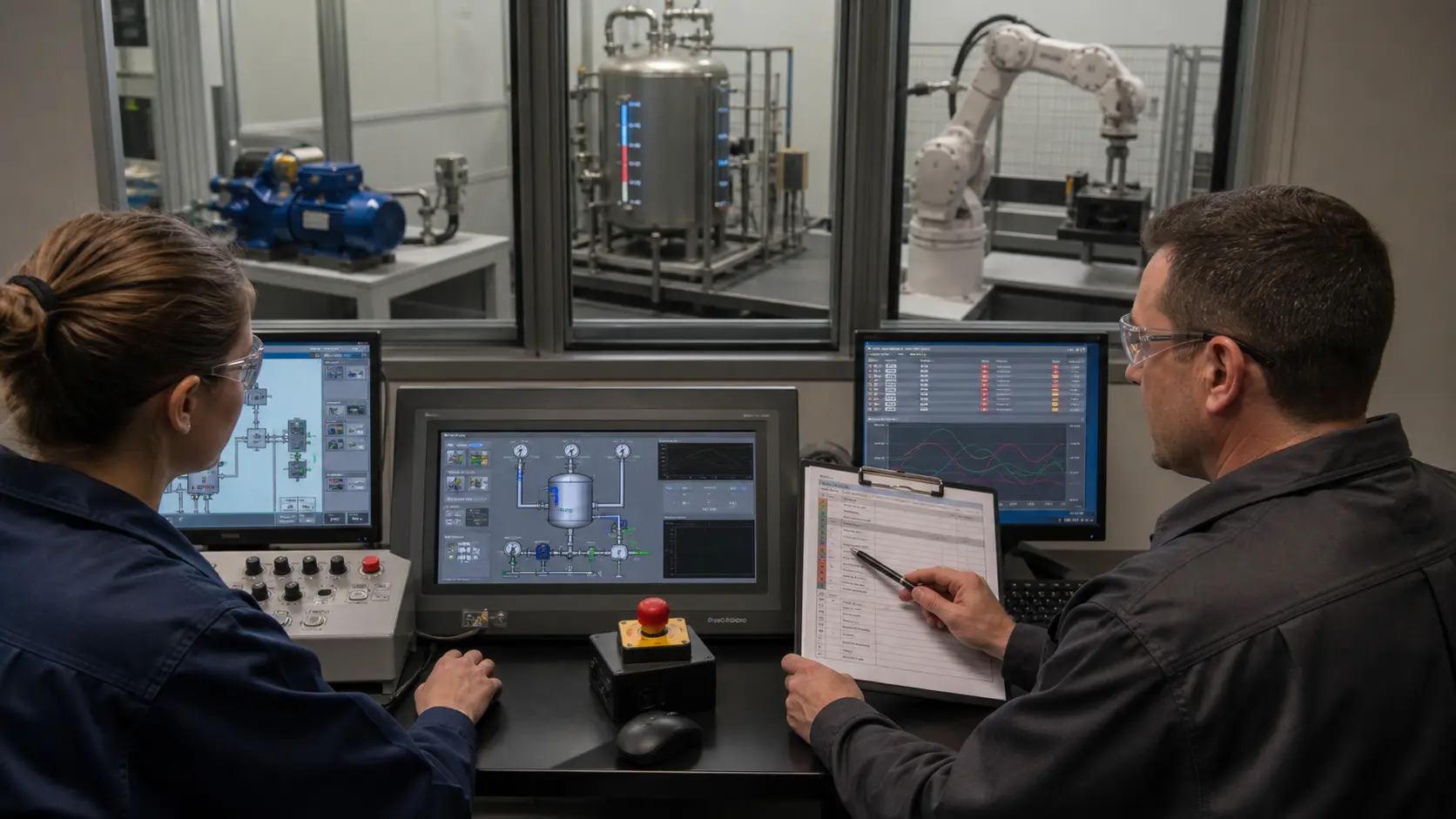







Every project on this page is a live, browser-runnable PLC simulation — auto-graded, portfolio-certifiable, and zero install. Twenty projects curated from the full 130+ scenario catalogue, grouped from beginner to advanced.
Join 800+ learners practicing PLC programming
Beginner projects are free. Create a free account to start immediately.

What to look for
A static circuit diagram in a textbook describes a PLC program. A simulation lets you run it, break it, and fix it. The difference between reading about a seal-in circuit and actually writing one — watching the motor stay running after you release the Start button — is the difference between knowing a concept and understanding it.
Good PLC projects for learning have three properties: they are grounded in a real industrial machine so the context makes sense; they isolate one or two core patterns so the learning objective is clear; and they are challenging enough that you have to think, not just copy. Every project on this page was selected against those criteria from the live catalogue.
Six projects that establish the core patterns every PLC programmer needs. No prior experience required — each builds on the last. Estimated 8–30 minutes each. All free to start.
The canonical first PLC project. A green Start pushbutton energises the motor output; the output latches itself through a parallel seal-in contact; a red Stop NC contact breaks the circuit. Every industrial control panel contains this circuit in some form.
Skills practised:
Why it matters: You will build the muscle memory of seal-in logic — the pattern that appears in nearly every motor, valve, and conveyor control circuit you will ever write.
Three outputs — Green, Yellow, Red — cycle in a timed sequence using chained TON timers. Each timer's done bit advances the sequence to the next light and resets the previous. A 4-way junction extension is available for intermediate practice.
Skills practised:
Why it matters: Timer chaining is the foundation of almost every sequenced machine cycle: conveyor start delays, dwell times, rinse holds. This project teaches the pattern in the simplest possible context.
A remote trigger toggles the door between Open, Closing, and Opening states. Limit switches at top and bottom mark travel complete. An obstacle sensor mid-travel triggers an automatic reversal — the safety case that every real garage door installer must handle.
Skills practised:
Why it matters: State machines are how complex machine behaviour is organised in industry. This project introduces the pattern at a scale where the states are obvious and the transitions are physical.
An emergency stop button cuts all machine outputs and latches a fault coil. The machine cannot restart until an operator manually acknowledges the fault with a dedicated reset pushbutton. This is a deliberate, non-latching restart requirement.
Skills practised:
Why it matters: E-stop and fault-reset patterns appear in every machine safety circuit. Getting the latching and reset logic right from the beginning prevents dangerous auto-restarts on real equipment.
A three-phase motor reverses direction by swapping two supply phases via separate Forward and Reverse contactors. The critical safety requirement: both contactors must never energise simultaneously. The circuit uses both electrical and PLC software interlocks.
Skills practised:
Why it matters: The forward/reverse interlock is one of the most common motor control patterns in manufacturing — conveyors, hoists, traversing axes. The interlock technique transfers directly to any dual-output exclusion requirement.
A selector switch puts the drive into Jog mode or Run mode. In Jog mode the motor runs only while the Jog button is held — releasing it stops the motor immediately with no latch. In Run mode the motor seals in normally. The two modes are mutually exclusive.
Skills practised:
Why it matters: Jog mode is standard on virtually all conveyors and machine tools for positioning and maintenance. Understanding the selector-switch interlock approach is immediately transferable.
Six projects that combine multiple patterns from the beginner level into more realistic machine challenges. These are the projects that distinguish someone who has practised from someone who has only read. Basic or Pro plan.
Products travel on a conveyor past a photoelectric sensor. A counter tallies the count. Every fifth item triggers a diverter solenoid to route the product to a secondary lane. The diverter must fire at the right moment relative to item position — a timing coordination challenge.
Skills practised:
Why it matters: Counter-driven diversion is the backbone of sorting machines, batch accumulation, and lane merging. This scenario teaches the sensor-counter-actuator timing relationship that every material handling engineer uses.
A large motor starts in star configuration (reduced voltage) for a timed period then transfers to delta (full voltage). Three contactors — Main, Star, and Delta — must sequence precisely, with star and delta interlocked against simultaneous energisation and a transition time between star-drop and delta-pick to prevent voltage spikes.
Skills practised:
Why it matters: Star-delta starting is ubiquitous in pump, compressor, and fan drives above 15 kW. The sequencing and interlock technique applies directly to any multi-step soft-start scenario.
A tank is kept between a low and high level setpoint using a fill valve and two level switches. Hysteresis prevents valve chatter at the boundary. High-level and low-level alarms latch separately and require acknowledgement. An alternation logic rotates between two fill pumps for even wear.
Skills practised:
Why it matters: Tank level control with hysteresis and alarm latching appears in water treatment, food processing, and chemical plants. The alternation pattern transfers to any duty/standby equipment configuration.
An entry sensor and exit sensor each feed a counter that tracks occupancy. The entry gate opens only if occupancy is below capacity. A one-shot triggers on each vehicle detection edge to avoid double-counting slow entries. The full/available display updates in real time.
Skills practised:
Why it matters: Edge detection with up/down counters appears in occupancy management, batch counting, and queue control. This project exercises all three techniques in a scenario with an immediately obvious physical analogue.
A pneumatic pick-and-place arm extends, picks a part under vacuum, transfers it, places it, and retracts. Each step waits for a position or pressure confirm before advancing. A part-absent detect at pick triggers a fault cycle instead of a placement cycle.
Skills practised:
Why it matters: Multi-axis step-and-wait sequencing is the fundamental structure of every robot, assembly machine, and material transfer mechanism. Learning to interlock steps on confirms rather than timers is the industry standard approach.
A mixing vessel sequences through Fill A, Fill B, Mix, Heat, Hold, Drain, and Clean phases. Each phase has entry conditions, timed durations, and exit transitions. A batch ID tracks the current recipe and the fault state captures which phase failed if the sequence is interrupted.
Skills practised:
Why it matters: Recipe-based batch sequencing is the standard approach in food, pharma, and chemical production. This scenario teaches the state machine structure that scales from a 4-phase mixer to a 40-phase reactor.
Five projects at capstone and final year difficulty — state machines with safety permissive chains, closed-loop analog control, and multi-zone line coordination. Each produces a verifiable completion certificate. Pro plan.
A three-floor lift handles simultaneous floor calls with nearest-floor priority. The hoist motor has separate up and down contactors with electrical interlock. Door sequencing includes photo-eye obstruction reversal and a close-force timeout. An overload switch holds the cab at floor until weight is reduced.
Skills practised:
Why it matters: The elevator is the classic complex state machine project for PLC education — it combines call priority, motor direction control, door I/O, and multiple independent safety conditions in one coherent machine.
A full beverage bottling line: unscrambler, rinse station, filler carousel, capper, labeler, and case packer. Each zone has its own conveyor drive. Back-pressure sensors coordinate flow between zones — the filler pauses when the capper queue is full; the unscrambler pauses when the rinse queue backs up.
Skills practised:
Why it matters: Multi-zone line coordination with back-pressure logic is the architecture of every continuous production line. This project teaches the zone-handshake technique that transfers directly to automotive, packaging, and food line work.
A process heater is controlled by a PID loop reading a thermocouple analog input and driving a proportional control valve output. Proportional, integral, and derivative gains are tunable live. A setpoint ramp prevents thermal shock on cold startup. High and low deviation alarms monitor loop health.
Skills practised:
Why it matters: PID temperature control is the most common closed-loop application in process industries — ovens, reactors, extruders, heat exchangers. Understanding how to tune and monitor a PID loop is a prerequisite for any process control role.
Clean-In-Place sequencing for a food or beverage vessel: pre-rinse, caustic wash, intermediate rinse, acid wash, final rinse, and air blow phases. Each phase uses timed valve sequences. A phase-failed state captures which step was interrupted and the sequence can be resumed or restarted from that point.
Skills practised:
Why it matters: CIP sequencing is mandatory in food, dairy, and pharma plants. The fault-resume pattern — knowing which phase failed and picking up from that point — is an advanced technique that distinguishes competent automation engineers.
A combustion boiler sequences through a mandatory purge cycle, pilot light ignition, flame prove, and main burner on — each step gated by a safety permissive interlock. A flame failure at any point forces a lockout that requires manual reset after a post-purge. This is a classic burner management sequence.
Skills practised:
Why it matters: Burner management sequencing is one of the most safety-critical PLC applications. The permissive-gate, flame-prove, and lockout-reset pattern applies to any fired equipment from boilers to kilns to thermal oxidisers.
Why this platform
A PLC project list that links to circuit diagrams and PDF solutions teaches you to recognise answers. Running a project in a live simulation teaches you to build them. The grader tests every output condition — not just whether your motor runs, but whether your interlock blocks the reverse contactor, whether your timer chain advances correctly, whether your fault latch requires a manual reset.
Submit your solution and get a pass/fail with plain-English descriptions of each test case. You cannot fool the grader with a half-working program — either the interlock blocks the unsafe state or it does not.
Every completed scenario earns a verifiable certificate with your name, the scenario title, your grade, and a URL that employers and lecturers can verify. Pro Certificate Pack bundles them into a portfolio.
Every project runs in your browser. No PLC hardware, no Windows-only vendor software, no USB licence dongle. Chrome, Firefox, Edge, or Safari on Mac, Windows, Linux, or Chromebook.
Keep exploring
Free account. Browser-based. Six beginner projects free to start — no credit card.
Every project is a live simulation — not a screenshot, not a diagram. Real scan cycle, real grader.