Startup and shutdown
Practise the permissives and sequence dependencies behind tank, batch, burner and compressor operation.
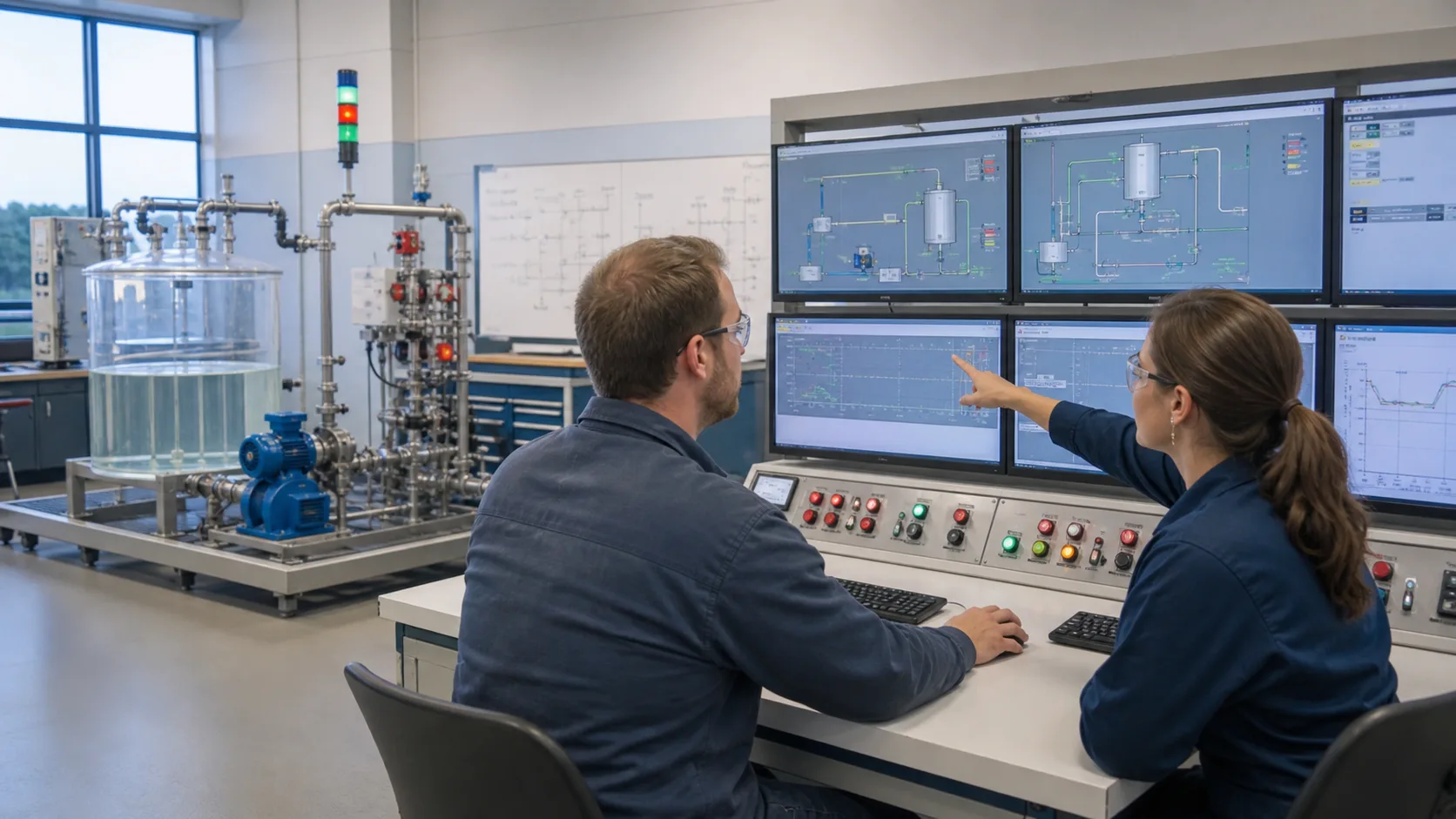
Let operators and technicians observe how permissives, alarms, sequence state and physical process variables interact across tanks, batches, boilers, pumps and compressor packages.
Dynamic process training model
Tank Fill Station
Live level, temperature, pressure, speed and sequence state
Normal starts plus interlock, alarm and shutdown demands
Repeatable first-out, deviation and reset behavior
PLC logic visible for operator–maintenance cross-training
Operator-response practice
Levels, temperatures, speeds, pressure, hold time and alarms evolve during the exercise. Learners can repeat starts, trips and recoveries without placing a live process at risk.
Practise the permissives and sequence dependencies behind tank, batch, burner and compressor operation.
Observe first-out, deviation, high-high and fault-latch behavior rather than acknowledging disconnected alarm cards.
Work with continuously changing levels, temperatures, pressures, rotor speeds and equipment states.
Show operators why the PLC holds a step and show technicians what the operator sees during the same upset.
Scenario library
Operate and troubleshoot a dynamic vessel with level switches, pumps, drain demand and alarm behavior.
Follow fill, heat, mix and discharge states while permissives govern every transition.
Rehearse purge, ignition, flame proof and trip behavior through a complete burner start.
Observe recycle startup, pressure response, shutdown isolation and blowdown.
Identify the initiating process condition through a multi-alarm upset.
Coordinate recipe release, temperature hold, sign-off, deviation and record completion.
Training outcomes
Assignments can grade normal operation, unsafe demands, boundary conditions and recovery behavior against the same machine model.
Scope, stated plainly
This is a PLC-process learning environment, not a high-fidelity distributed-control-system operator training simulator. It does not reproduce a site control room, plant-wide thermodynamics, instructor station, production graphics database or facility-specific operating procedures.
Related training solutions
Pilot with your standards
Use the existing labs immediately, then map assignments and pass criteria to the equipment, failure modes and competencies your team owns.
Runnable simulator field guide
Direct answer
The operator can recognize process state, execute a written operating sequence, respond to an alarm and prove stable recovery without relying on memorized clicks.
Written for process operators, instructors and controls teams rehearsing startup, normal running, abnormal response, shutdown and handover on a dynamic training model.
The process objective, equipment, operating envelope, initial inventory, permissives, alarms, trips, roles and written procedure.
Operator actions through controller commands, valves, pumps and dynamic process values to independent status and trend evidence.
Cold start, steady operation, controlled rate change and planned shutdown from defined initial conditions.
Late feedback, high or low inventory, utility loss, alarm flood, trip, restart and shift handover.
An operator action, permissive, control loop, actuator, instrument or process-response mismatch.
The scenario aligned to site procedures, instructor objectives and controlled production-system evidence.
Build each scenario around a decision, not a screen tour. The initial state should state tank inventory, line-up, utilities, controller mode, active overrides and equipment availability. The trainee then receives the same information a real operator would have and must choose actions that keep the process inside the declared envelope.
Alarm training is strongest when the first alarm, consequence alarms and process trend can be reviewed after the run. A score should distinguish detecting the abnormal condition, selecting the correct response, avoiding a harmful action and restoring a stable state. Acknowledgement alone is not recovery, and silence is not proof that the initiating cause is gone.
It is a dynamic practice environment that lets an operator execute procedures and observe process, alarm and equipment response without disturbing a production plant. Fidelity and qualification scope must be stated explicitly.
No. The useful model is mapped to approved procedures and instructor objectives; it does not authorize actions or establish the actual plant response.