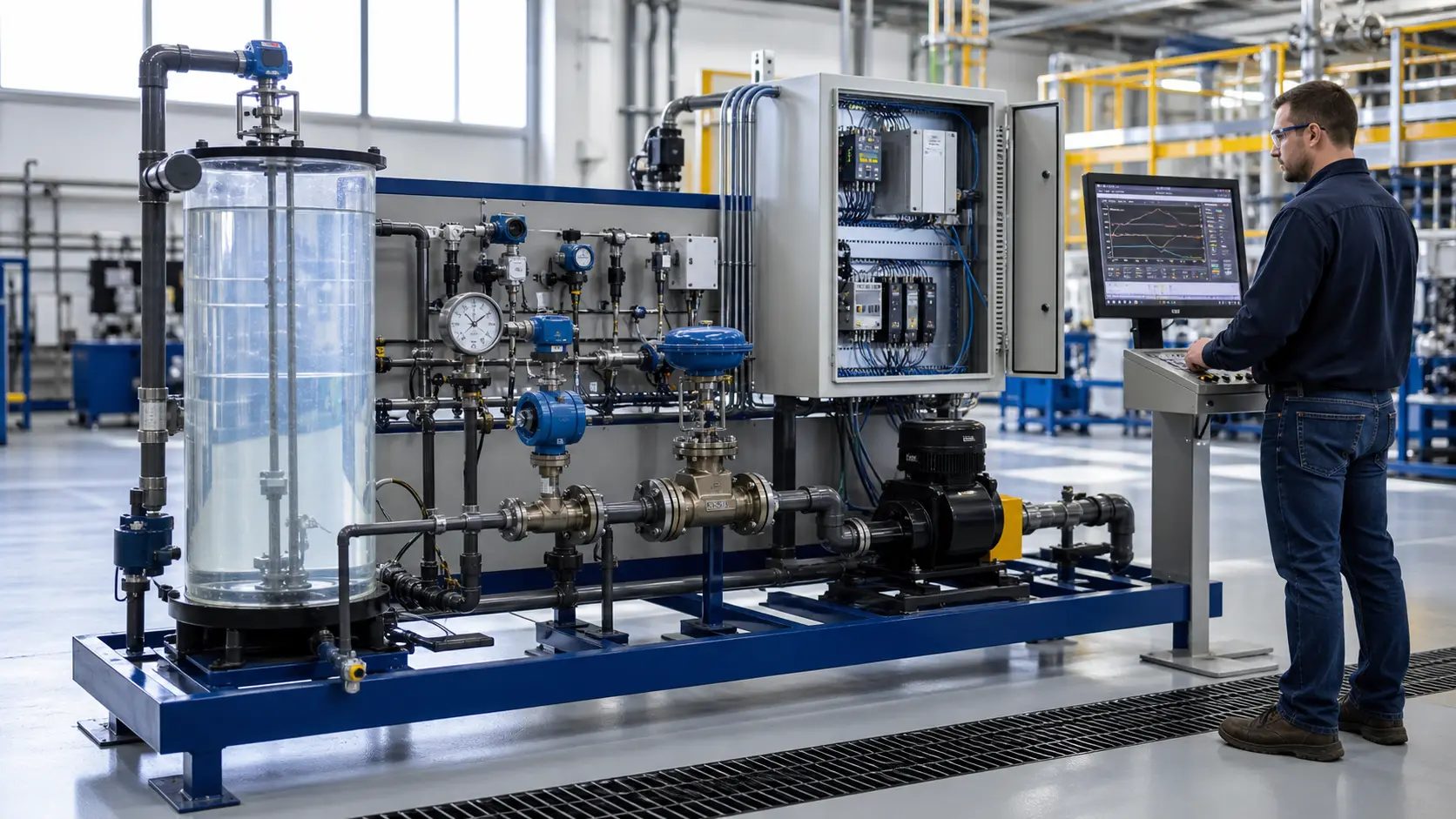
Automation Technician Training Your Team Can Practise Every Week
Build the PLC, HMI, SCADA and troubleshooting skills an automation technician uses on shift. Assign repeatable browser scenarios, review the evidence, and keep practice available after the course instead of relying on one week off-site.
What vendor training and ad-hoc upskilling get wrong
Cost per head that doesn't scale with headcount
External vendor courses charge flat per-attendee fees regardless of how many technicians you send. Whether you send two or ten, the per-person rate stays high. There is no volume discount for the maintenance team that needs ongoing upskilling, not just a one-off course.
Generic curriculum, not your plant's configuration
Vendor training labs teach the vendor's flagship hardware in a vendor-controlled environment. Your plant may run Siemens on the utilities, Allen-Bradley on the production line, and Mitsubishi on a legacy conveyor. No single vendor course covers your actual environment.
No track record of individual competency
An attendance certificate is not a competency record. When a safety incident occurs, thin documentation of what each technician actually knows and can do creates liability exposure. There is no objective record of individual skill level.
New hire onboarding is slow and inconsistent
New technicians shadow senior staff until they are deemed ready. That process depends entirely on senior bandwidth, which varies, and produces uneven baselines across a team. There is no structured curriculum and no way to verify a new hire's starting level.
Apprenticeship and learnership programs lack structured PLC content
MerSETA learnerships and apprenticeship programs leave PLC content in an awkward gap: too technical for classroom theory, too risky for live equipment. There is no structured, scaffolded PLC curriculum that sits between classroom and the plant floor.
The solution
What the Teams plan provides for employers
Nine dialects — train on what your plant actually runs
Siemens, Allen-Bradley, Mitsubishi, Omron, KEYENCE KV, Schneider, Delta, IEC 61131-3, and Instruction List — all in one platform on one subscription. When you commission a new line from a different vendor, your team can begin practicing that vendor's dialect before the equipment arrives on site.
40+ industrial fault scenarios that reflect real maintenance situations
Motor start-stop, tank level control, conveyor sequencing, and PID loops sit alongside dedicated fault-injection scenarios that simulate the kind of failures a maintenance technician encounters in the field. It is repeatable fault-finding practice without taking live equipment offline.
Structured learning paths for onboarding and upskilling tiers
The admin console lets you build a new-hire onboarding path — foundational lesson sequence through to fault diagnosis on your primary dialect — and a separate advanced path for technicians being considered for promotion. Different paths for different roles, same platform.
Interview preparation tracks for internal promotion assessments
Six structured interview preparation tracks give technicians practice on technical questions with a target duration and countdown. Provides an objective basis for technical competency conversations during promotion assessments — more defensible than informal evaluation.
Progress reporting without a separate HR system
Exportable cohort and individual reports show completion status and progress. CSV-compatible output can be incorporated into existing HR and L&D tracking. The platform does not auto-generate SETA documentation — it produces supporting evidence for your existing process.
Sandbox mode for engineers developing plant-specific programs
Senior engineers can prototype ladder logic for new equipment or control modifications before touching live plant. Working through the logic in a safe environment before commissioning reduces errors and saves time during actual installation.
Building the program
What makes a good industrial automation training program?
A good industrial automation training program has four parts: a structured learning path from fundamentals to fault-finding, auto-graded hands-on assessment rather than just videos, per-technician progress tracking your L&D team can export, and completion certificates a third party can verify. This platform provides all four in the browser — no travel, no vendor lab.
The same four parts apply whether you are formalising an automation technician training program online for a maintenance department or building a PLC online training program for new hires — the delivery is the browser either way, so night-shift technicians and multi-site teams train on the same material without scheduling a classroom.
A structured path, not a course dump
The admin console’s path builder sequences lessons and scenarios — including your own org-private scenarios — into an ordered route from first principles to fault diagnosis, assigned per role or per site.
Auto-graded, hands-on assessment
Every scenario submission is run against test cases and marked pass/fail the moment a technician hits Run. Watching a video proves attendance; passing a graded fault-finding scenario proves competency.
Progress tracking per technician
The team dashboard shows each member’s lessons completed, scenarios completed, total attempts and last-active date, with team-level rollups — and reports export for your existing L&D tracking.
Certificates anyone can verify
Completion certificates carry a public verification page at /verify — an auditor, a client, or HR can confirm a certificate is genuine in seconds, without contacting us.
What your engineers practice
Real maintenance skills, built and graded — not just watched
The scenarios below mirror the situations a maintenance technician actually meets on the plant floor — motor control, seal-in interlocks, timed sequencing, and logical fault diagnosis — built and auto-graded in the browser. No live equipment to take offline, no travel, no vendor lab. The closest thing to hands-on fault-finding that does not stop production.
Runs in any browser — a work terminal, a home laptop, or a night-shift tablet.Motor start-stop control — the bread-and-butter circuit every technician must own.Seal-in / latching logic — the hold circuit behind most plant motor controls.Timers — the sequencing logic behind conveyor and process control faults.Structured fault-finding — diagnosis by logical elimination, the core maintenance skill.Reading and editing rungs — the everyday skill behind every online edit.Nine PLC learning dialects — train for a mixed-vendor plant on one platform.The HMI / SCADA layer — connecting logic faults to operator-facing alarms.
Pilot outcomes
What a team pilot should prove before you buy
Activation: can invited technicians reach a graded pass without installation, licence-server work, or booking time on shared equipment?
Evidence: can the manager see participation, attempts, completions, and last activity clearly enough to decide whether a wider rollout is justified?
Pricing
Per-seat pricing — and seats are reassignable
Team size
Annual cost
Per engineer / month
5 engineers
$995 / yr
$16.58
20 engineers
$3,980 / yr
$16.58
Vendor course figures are illustrative estimates only. Verify against current market rates before using in internal business cases. See full pricing →
24/7 browser access with no booking system required. Engineers can log in from a work terminal, a home laptop, or a tablet during a night shift. No shared machine, no license seat conflict, no scheduling overhead.
The platform broadly maps to N3-N6 Industrial Electronics content areas. It does not automatically generate SETA learnership portfolios or MerSETA unit standard sign-offs. The platform produces supporting evidence — activity records, completion timestamps, portfolio PDFs — that your registered assessor can incorporate into your existing learnership documentation process.
Nine dialects: IEC 61131-3, Allen-Bradley, Siemens, Mitsubishi, Omron, KEYENCE KV, Schneider, Delta, and Instruction List. If your plant runs a mix of brands — which is typical in South African mining and manufacturing — a single subscription covers training across all of them without separate vendor licenses.
Individual engineer accounts revert to the free tier and keep their personal progress history. Organization paths and custom scenarios remain attached to the organization but paid team access ends. Contact support before cancellation when you need a copy of organisation-owned material or reporting data.
The platform provides supporting evidence — completion records, timestamps, portfolio PDFs — not a substitute for a registered assessor's sign-off. SETA compliance documentation requires an accredited assessor. The platform supports that process; it does not replace it.
No. There is no author-only seat type. Every Pro seat includes full access to all platform features, including sandbox mode and the org-private scenario builder. If a senior engineer is building scenarios and not using the learning content, they still require a Pro seat.
Yes. A single organization account covers all sites and business units. The seat pool is shared across the account, learners can be grouped by site or role, and learning paths can be assigned per group. Reporting is consolidated at the account level and filterable by group.
Four things: a structured learning path from fundamentals to fault-finding, auto-graded hands-on assessment rather than just videos, per-technician progress tracking your L&D team can export, and completion certificates a third party can verify. This platform provides all four in the browser, which is what makes it work as an automation technician training program run online — night-shift technicians and multi-site teams train on the same material, and certificates are publicly verifiable at plcsimulationsoftware.com/verify.
Vendor courses and video platforms like SolisPLC, WorkForge and RealPars are strong on instruction, but they are passive — they teach concepts on video and most do not include a place to write and test logic. Engineers who only watch can describe a circuit but struggle to build it under pressure. Our platform is the hands-on half: a browser-based simulator where engineers write ladder logic against injected faults and get auto-graded, with cohort reporting for L&D. Many teams pair a video course with graded practice here.
No. It runs in any modern browser — work terminals, home laptops, tablets, Chromebooks, Macs, or Linux. There is nothing for IT to install per machine, no Windows-only dependency, and no license server. An engineer can practice from the plant floor or from home on the same account.
Start building competency inside your organization.
Create a free team account. No travel budget. No vendor license. Every technician practices on the dialects your plant actually runs.
Use a real cohort before making a purchasing decision. Send your work email and organization; we’ll reply with a pilot plan and only ask for the details relevant to your setup.
Job-readiness and assessment field guide
PLC simulator for employers: readiness checklist
Direct answer
The employer can map job tasks to bounded simulator exercises and interpret the evidence without treating completion as full occupational competence.
Written for maintenance managers, controls leads, recruiters and training teams evaluating candidates or developing technicians.
Job requirement through representative task, controlled attempt, observable system result, explanation, assessor review and development decision.
NODE 03observable
03
Core exercise
One normal programming or diagnostic task completed independently and defended against a changed case.
NODE 04observable
04
Stretch case
Unfamiliar interface, ambiguous requirement, time pressure, hidden fault, restart, partial success, coaching and accessibility need.
NODE 05observable
05
Troubleshooting
A knowledge, reasoning, interface, measurement, safety, communication, transfer or assessment-design gap.
NODE 06observable
06
Portfolio evidence
Simulator results combined with structured interview and supervised target-equipment evidence.
Answer surface / 07
Q01
How can employers use a PLC simulator in hiring?
Use a short job-related task with declared criteria, observe reasoning and recovery, then combine the result with structured interviews and supervised physical evidence.
Q02
Does passing a simulator test prove a technician is competent?
It proves only the bounded behaviors and explanations assessed. Job authorization and physical competence require additional evidence.
Watch the real browser product respond to the task on this page, then try the same practical workflow yourself. No slides, concept mockups, install, or credit card.