Searching plc training near me almost always means one of three things:
- You want a classroom experience — a building, an instructor, other students.
- You need vendor-specific hardware time that's not easy to simulate.
- You're not sure whether remote learning can teach you this skill.
This post answers all three, ranks the local and online options honestly, and suggests a hybrid stack that beats both pure plays for most learners in 2026.
The five questions that decide your answer
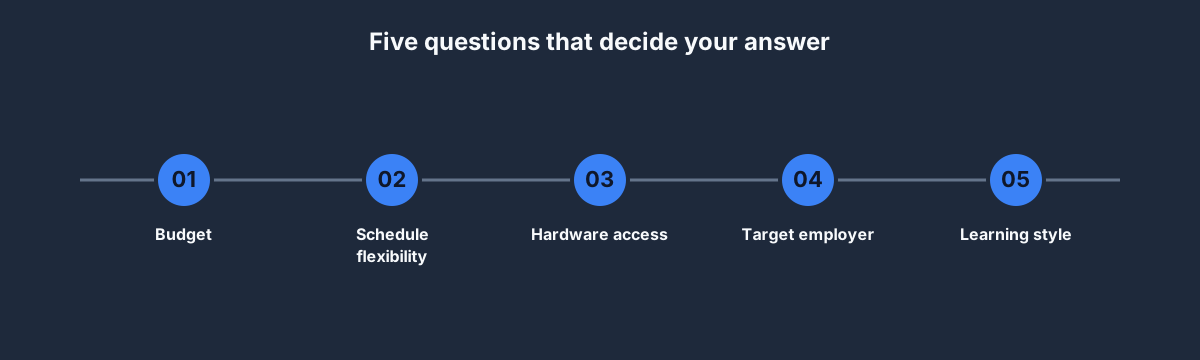
Before you pay for anything, answer these:
- What's your budget? If under USD 500, online wins outright — local classes start around USD 1,500. If above USD 3,000 and your employer pays, local or vendor classroom makes sense.
- How flexible is your schedule? If you can't reliably attend the same 6–9 PM slot for 12 weeks, a local evening course is a lottery ticket. Online self-paced is the only format that survives shift work or parenting.
- Do you need specific vendor hardware? If the job you're aiming at demands hands-on Studio 5000 or TIA Portal in the interview, plan for at least one vendor-run classroom. Online covers the code fluently but not the IDE chrome.
- Which employer is hiring where you live? If every local ad says "Rockwell required," take one Rockwell course. If they're spread across vendors, online dialect-agnostic training wins.
- How do you learn best? Some people thrive on instructor-led cohorts. Others find their progress doubles when they can re-watch and retry. Be honest about which category you fall in.
No single answer wins all five. Your stack probably combines options.
What "local" actually offers in 2026
Three realistic local paths:
Community college / technical school
Typically a 40-hour "Introduction to PLC Programming" or similar. USD 1,500–2,500 in North America, often subsidised for residents. Weekly evening classes across a semester.
- Pros: instructor access, local peer network, printed certificate that looks good on a regional CV, some programs include real SLC 500 or CompactLogix hardware.
- Cons: pace is set for the slowest student, curricula are often 5+ years out of date, missing a class kills continuity.
Vendor classroom (Rockwell CCP, Siemens ST-PRO, Omron NJ, etc.)
5-day intensive at a vendor's training center or a certified third party. USD 2,000–3,500 for the class, sometimes bundled with hardware.
- Pros: current curriculum, real hardware, vendor-issued certificate that's recognized at the vendor's customers, immersion pace.
- Cons: expensive out of pocket, only one vendor, usually requires travel.
Private technical institute
USD 800–2,000 for a short course, quality wildly variable. Some are excellent; many are not. Check reviews and ask for course completion outcomes before paying.
- Pros: typically faster than a college semester, often evening or weekend schedule.
- Cons: no regulation on quality; certificates have low signal.
What "online" actually offers in 2026
Three realistic online paths:
Graded simulators with auto-test cases
Our Pro plan and a small handful of competitors. USD 99–500/year. You write real code, it's tested against assertions, you get a portfolio PDF per scenario.
- Pros: cheapest way to build real skill, retry until it clicks, multi-dialect, no install, no schedule. Portfolio is verifiable.
- Cons: no instructor to answer "why is my rung behaving weird" in real time (though hints help), no physical hardware.
Video academies (RealPars, Pluralsight, Udemy)
USD 0–300/year. You watch, occasionally take a multiple-choice quiz, get a completion certificate.
- Pros: cheap or free, good for orientation and specific-topic reference.
- Cons: no graded skill assessment, certificates have near-zero signal.
Vendor online academies (Rockwell Learning Services, Siemens SIOS, Inductive Ignition University)
Free or low cost, vendor-issued, vendor-specific. Mixed production values.
- Pros: authoritative on their vendor's products, free for many courses, respected credentials in-ecosystem.
- Cons: single-vendor, uneven coverage of fundamentals.
Local vs online, side by side
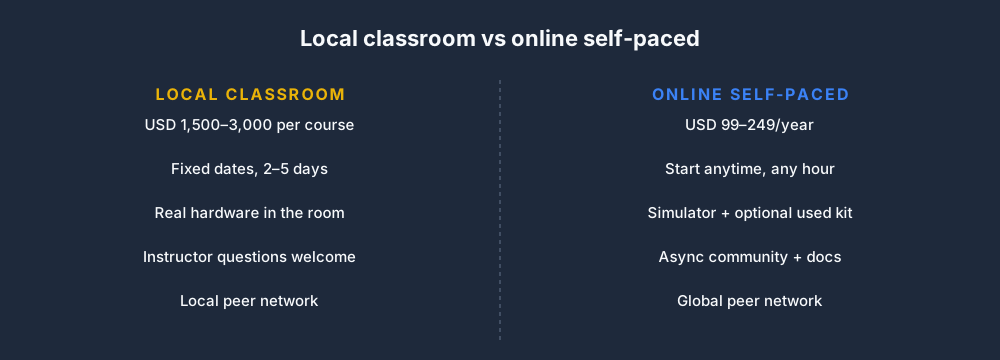
The common trade-off: classroom buys you a room, an instructor, and hardware time. Online buys you depth, repetition, and a portfolio.
If you treat them as either/or, classroom wins on vendor-specific hire-ability and online wins on skill-per-dollar. The honest answer is neither on its own is optimal — the winning stack combines them.
The hybrid stack most people should actually buy

For someone self-funding toward their first PLC job in 2026:
- Online graded simulator for 80% of your learning time. Our Basic or Pro plan. Twelve weeks of real code.
- Used hardware starter kit — USD 150–300 on eBay for a CompactLogix L30ER or an S7-1200 1211C. Used for the last four weeks to get IDE fluent.
- YouTube — RealPars and LearnChannel-TV for orientation and quick debugging lookups.
- One vendor classroom — if and only if an employer is paying, or a targeted job requires the specific certificate.
- Public portfolio — the thing a hiring manager actually evaluates. Our simulator produces PDFs; GitHub holds the code.
Total cost with no vendor classroom: USD 250–500 one-time, USD 99–249/year ongoing. With one vendor classroom on top: add USD 2,000–3,000, usually recoverable from the salary bump in your first year.
Who should go local-only
- Students in a funded program. If your education system is paying, take it.
- Engineers switching from adjacent fields whose employer sends them. The classroom pace accelerates acclimation.
- People who've tried self-paced and stalled. Classroom accountability is a real productivity tool for some learners.
Who should go online-only
- Budget-constrained career switchers. The math is brutal otherwise.
- Anyone with inflexible schedules. Shift workers, parents, multi-jobbers.
- People targeting multi-vendor work. The platform lets you compare transferable patterns across nine learning dialects without claiming full vendor-runtime emulation.
- Remote learners in regions with weak local options. Most of the world, honestly.
FAQ
Is online PLC training as good as a classroom?
For skill-building: yes, often better. For vendor-specific certificates: no, classroom still wins. The right answer is usually both, sequenced — online first, classroom later if the target job requires it.
Can I get a PLC job with only online training?
Yes, if your portfolio is solid. Hiring managers in 2026 increasingly weigh verifiable project evidence above classroom certificates.
How much does local PLC training cost?
USD 800–3,500 per course in most of North America and Europe. Subsidies exist for community-college programs in some regions.
Are there free local PLC courses?
Rarely. Some regional economic-development grants fund short courses; some vocational schools have sliding-scale fees. Check your regional employment services for "upskilling" grants.
What about PLC training coaching centers near me?
Variable quality. Check reviews, ask about graded assessments, demand to see what certificate is issued and who recognizes it. Our certifications post has the broader guidance.
Where to start
- Open the simulator's free tier. 20 minutes tells you if self-paced ladder-logic work fits your brain.
- If it does: follow the 12-week course plan and add a local class only if the target job explicitly requires it.
- If it doesn't: enroll at a local community college or equivalent for structured classroom pace, then use the simulator as supplementary practice.
Either works. The worst answer is "I'll sign up for a local class and hope it happens" — momentum is the scarcest resource. Start now.