Sequence verification
Prove each state transition from real feedback rather than advancing a timer-only demo sequence.
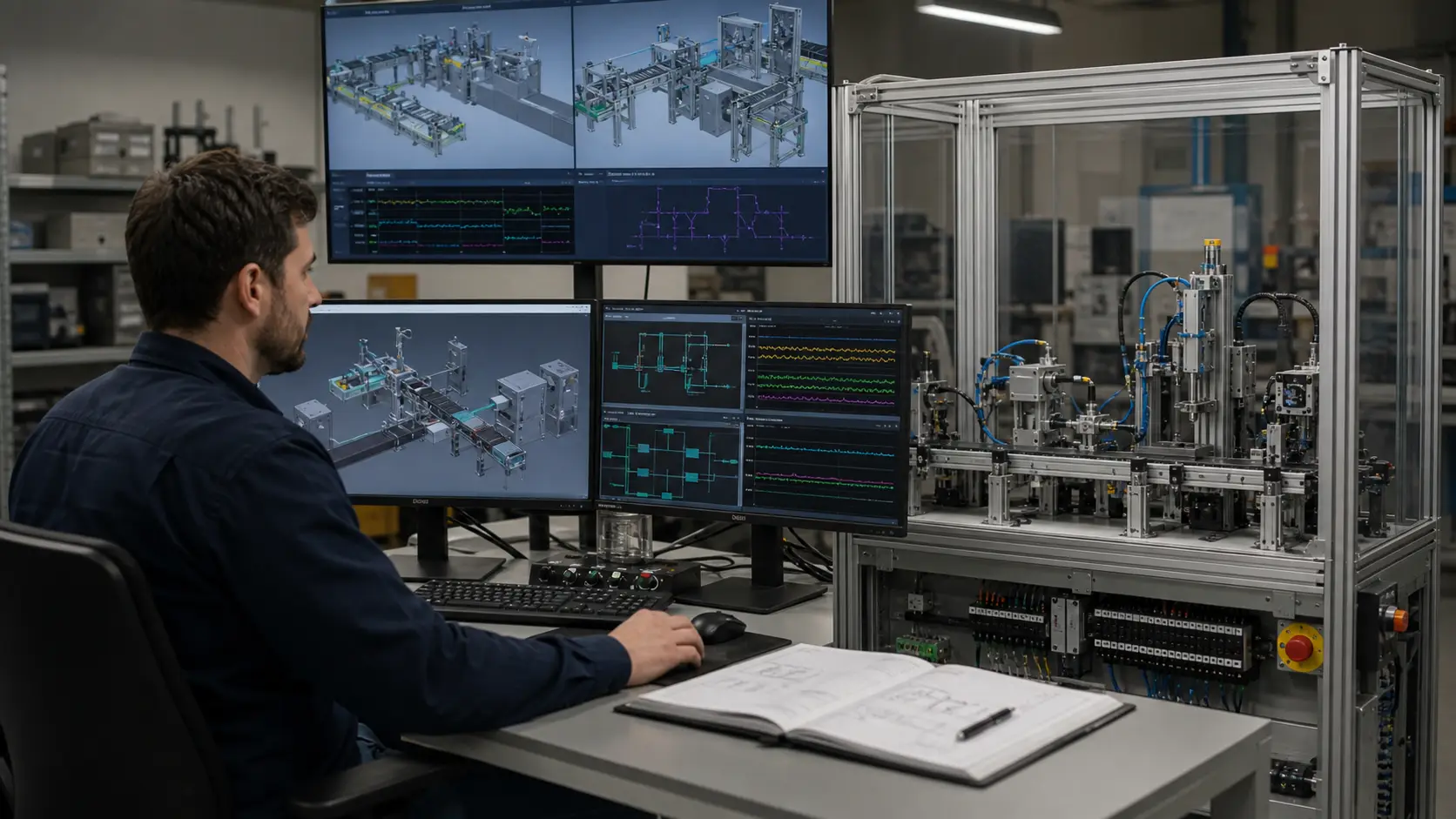
Practise the commissioning mindset by running PLC logic against animated machine models, forcing edge cases and proving interlocks before accepting a sequence as complete.
Software-in-the-loop training model
Bottling Line Commissioning
PLC logic executed against animated machine physics
Machine requirements, I/O lists and explicit pass criteria
Normal-cycle, unsafe-state, timeout and recovery test cases
Conveyors, packaging, robot handshakes, weld cells and safety
Commissioning test discipline
Learners turn a machine brief into logic, watch the simulated equipment respond, then run deterministic normal and abnormal cases—the core reasoning pattern behind virtual commissioning.
Prove each state transition from real feedback rather than advancing a timer-only demo sequence.
Commission PLC-to-robot ready, busy, complete, fault and reset behavior across repeatable cycles.
Exercise jam, missing proof, safety demand, timeout and repeated-cycle cases before calling the logic robust.
Use authored test cases and canonical solutions to define an observable acceptance standard for each training machine.
Scenario library
Coordinate multiple stations, product state and fault recovery through a complete line sequence.
Prove ready, start, busy, complete and fault transitions across repeated robot cycles.
Sequence clamp, weld, release and fault states with safety and completion feedback.
Verify counts, product grouping, pusher timing and jam recovery.
Test photo-eye timing, item tracking, diversion and repeated product flow.
Exercise ordering, timing, fault latch and recovery around a guarded material transfer.
The Pro 3D Sandbox adds reusable scene composition, connection snapping, PLC-driven motion, failure injection and saved layouts while preserving the clear boundary from production commissioning.
Public viewer is free. Guided 3D starts on Basic; composing and saving custom 3D scenes is Pro.
151 real-time factory components
Load the interactive viewer when you are ready to orbit the models.
Loads 3D only after your click
Training outcomes
Assignments can grade normal operation, unsafe demands, boundary conditions and recovery behavior against the same machine model.
Scope, stated plainly
This teaches virtual-commissioning methods; it is not production virtual-commissioning software. It cannot import a TIA Portal or Studio 5000 project, connect to a real PLC emulator, ingest CAD, model collision or cycle time accurately, or validate a customer machine digital twin.
Related training solutions
Compare browser and installed PLC simulators before choosing a practice environment.
Explore solutionExplore packaging-specific sequencing and reject logic.
Explore solutionUse the same process models for startup and upset-response practice.
Explore solutionPilot with your standards
Use the existing labs immediately, then map assignments and pass criteria to the equipment, failure modes and competencies your team owns.
Competency and practice field guide
Direct answer
The learner can define an I/O contract, initialize the model, execute normal and abnormal cases and distinguish model success from target commissioning.
Written for controls engineers, integrators, technicians and instructors learning how to connect control code to a bounded machine or process model before site work.
Machine requirements, model scope, coordinate and unit conventions, PLC connection, I/O ownership, initial state, timing, physics, faults, acceptance cases, versioning and handover.
Requirement through PLC logic, mapped I/O, simulation state, physical-model response, feedback, trace, defect record and changed regression case.
One complete automatic cycle, stop, reset and recovery repeated from a controlled initial state.
Invalid initial state, sensor timing, actuator jam, communication loss, collision, product variation, cycle interruption, version drift and restart.
A requirement, mapping, state, timing, physics, asset, communication, control or evidence mismatch.
Virtual results reconciled with drawings and repeated during supervised target hardware and site commissioning.
It teaches how to connect control logic to a machine model, manage initial state and I/O contracts, run acceptance cases and investigate mismatches before site commissioning.
No. It can strengthen preparation and regression coverage, while actual hardware, installation, safety and production conditions still need witnessed tests.