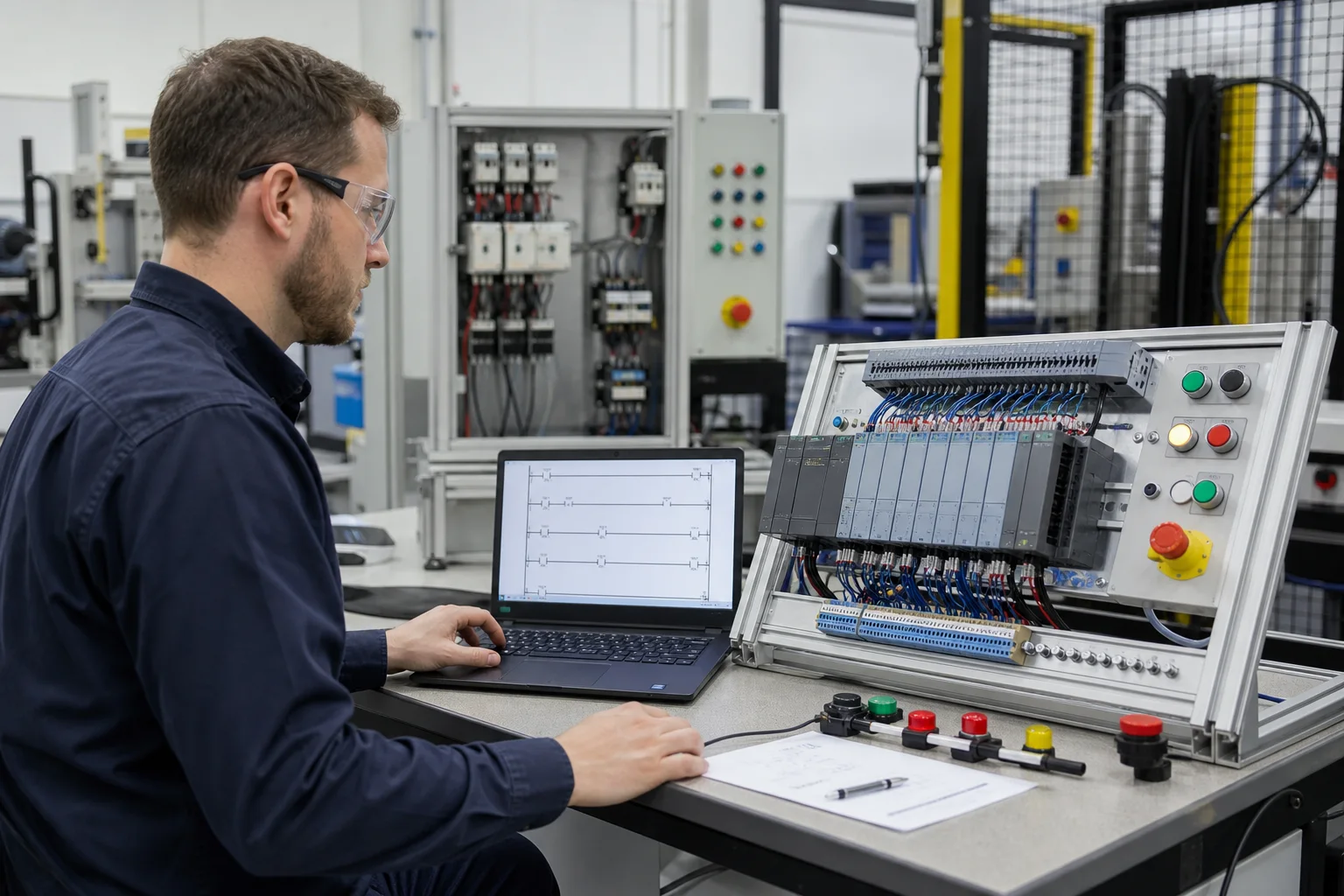
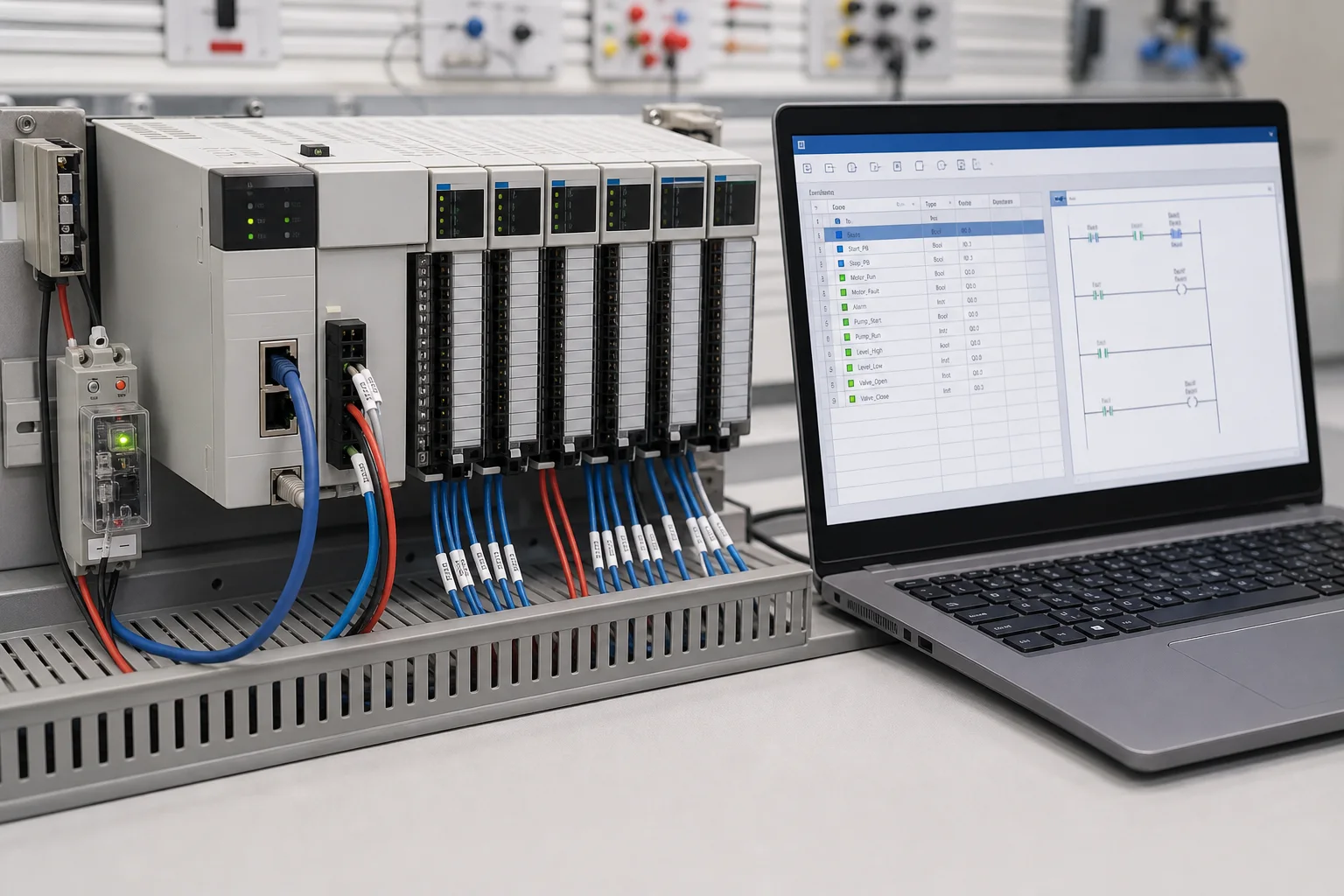
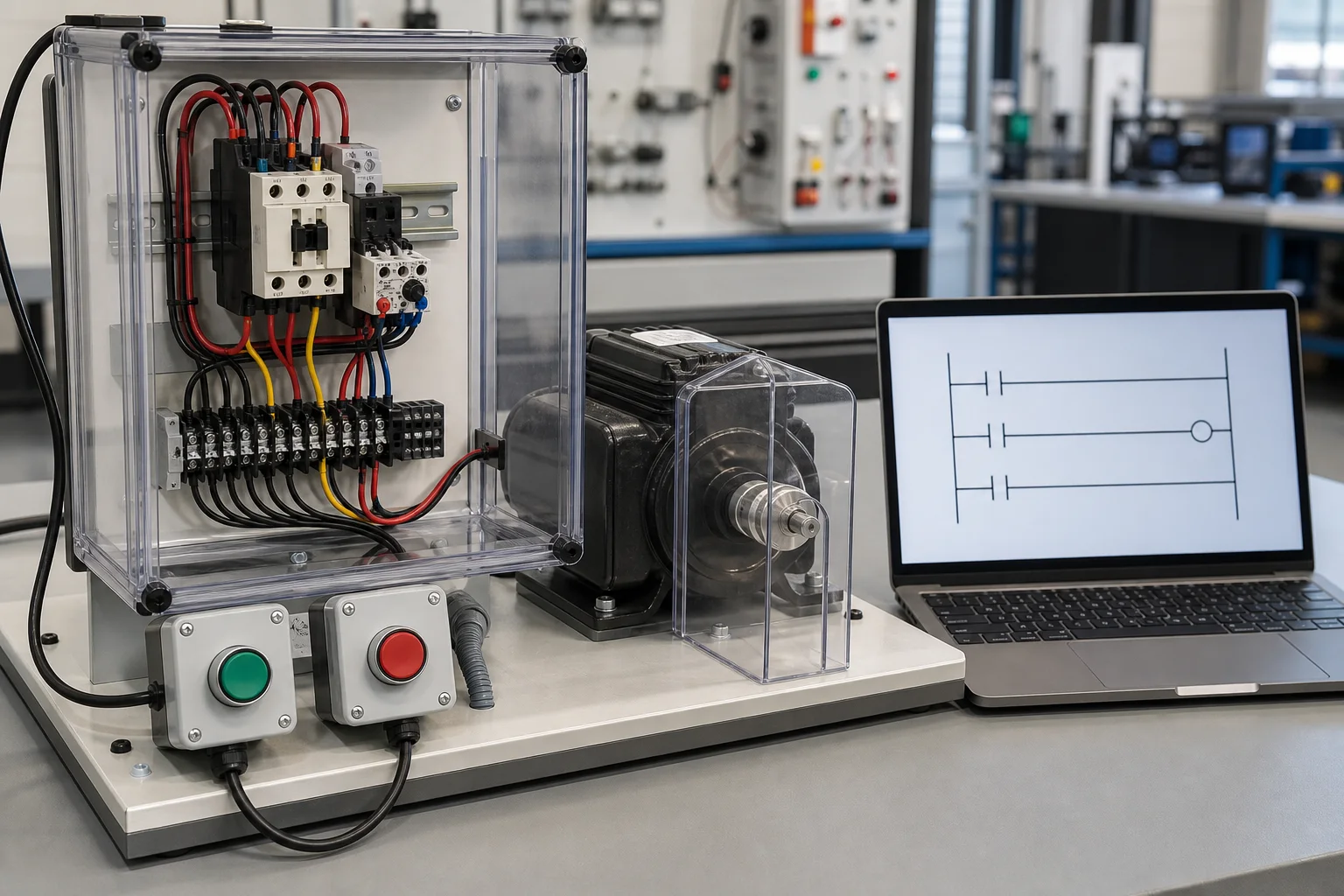
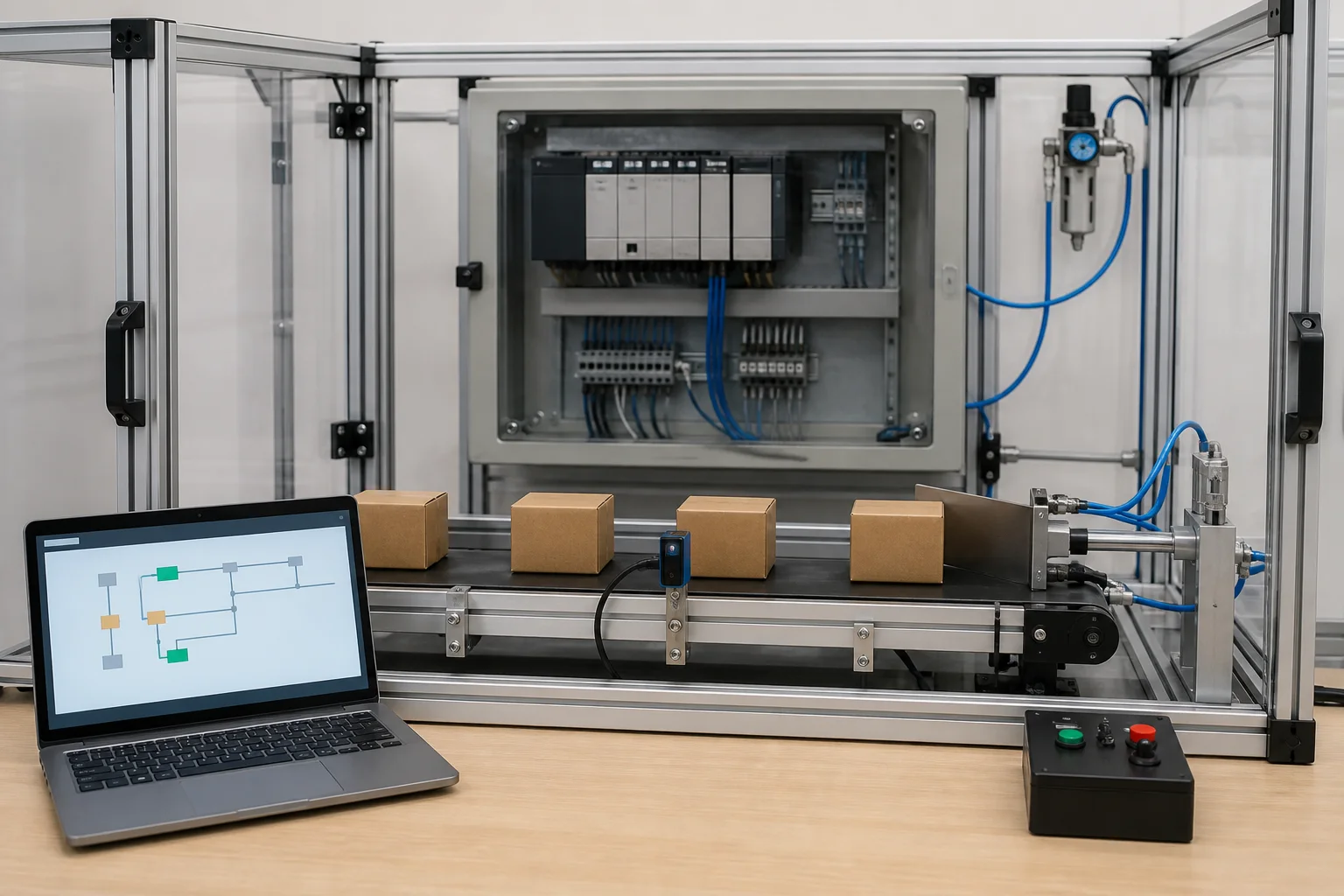
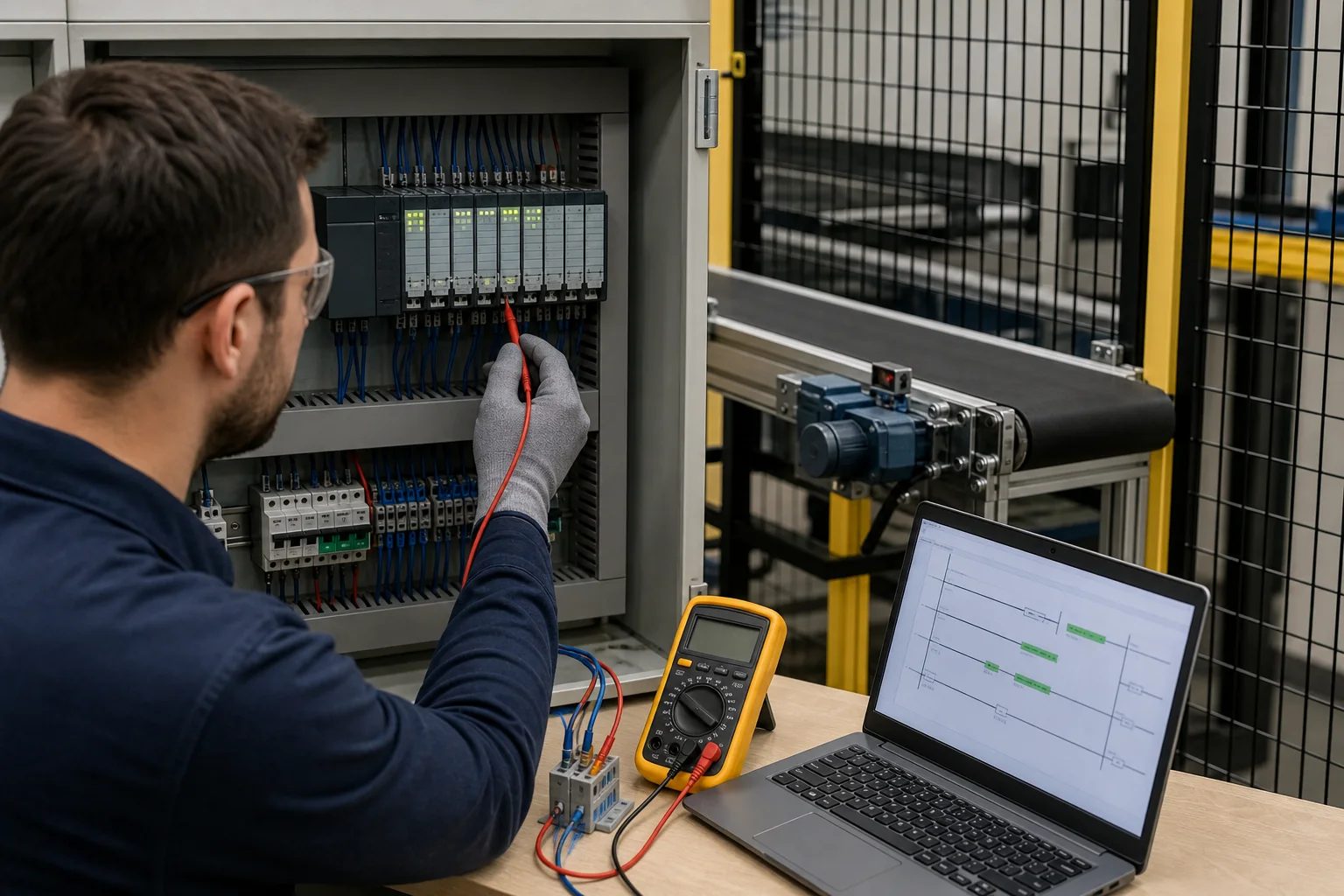
Real machine physics
Every scenario simulates real equipment. Tanks fill, motors spin, valves modulate — driven by your actual ladder logic.
Write Allen-Bradley-style ladder logic, run it against simulated machines, and get graded instantly — all in a browser tab. No Studio 5000 licence. No install. No credit card.
Join 700+ learners practicing PLC programming
Allen-Bradley-style ladder logic, simulated in your browser.
A browser tab that behaves like a real PLC bench — without the hardware budget.

Every scenario simulates real equipment. Tanks fill, motors spin, valves modulate — driven by your actual ladder logic.

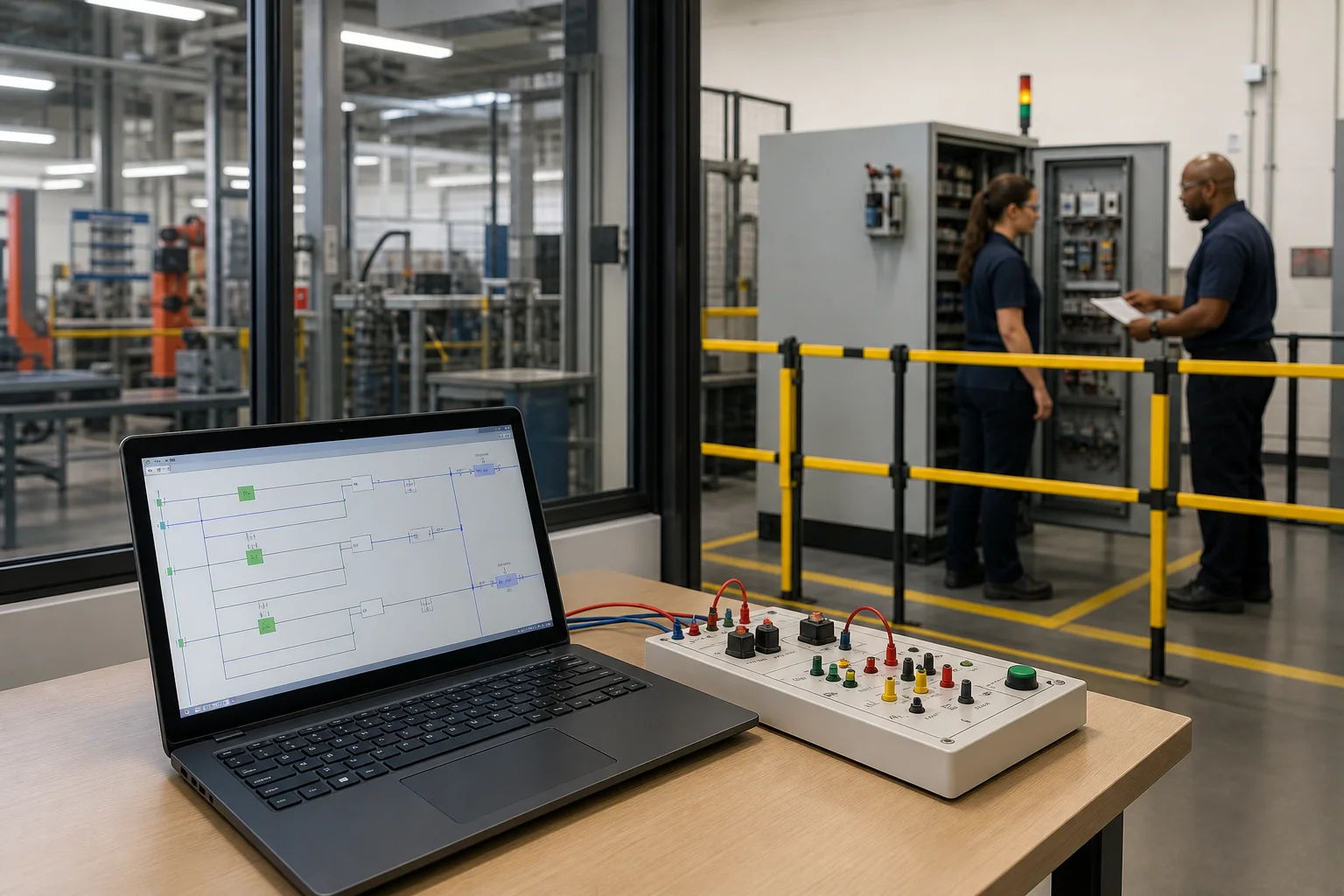
Toggle inputs by hand to see how the PLC responds. No wiring, no hardware — just click and learn.

Pass an interview track and earn a downloadable PDF certificate. Pro users get solution walk-throughs with expert commentary on every scenario.
Allen-Bradley is the dominant PLC brand in North American discrete manufacturing. Walk into an automotive stamping plant, a packaging line, or a food and beverage facility in the US or Canada, and the controllers are overwhelmingly ControlLogix or CompactLogix. A controls engineer who cannot read and write AB-style ladder logic is working with one hand behind their back, regardless of what their home plant runs. AB PLC training is not optional for anyone targeting North American industry.
This AB plc training covers what a controls technician or junior engineer actually needs on the job: AB RSLogix-style ladder syntax including XIC, XIO, OTE, OTL, OTU, and ONS; both file-based addressing (N7:0, I:0/0) and tag-style naming for ControlLogix; AB-style TON / TOF / RTO timers; CTU / CTD counters; comparison and math instructions; and PID control at a functional level.
We teach the dialect and the patterns. The scenario physics is generic — motors, conveyors, tanks, packaging machines — which is exactly how real AB training works. A motor start/stop is a motor start/stop whether it runs on a ControlLogix L83 or a MicroLogix 1100. Switch dialect at any time and the same code logic is expressed in AB or IEC syntax so you can see the direct mapping between the two.
Four steps from zero to interview-ready. Each step links to the relevant part of the platform.
Ladder logic basics that apply across every dialect: scan cycle, contacts, coils, normally-open vs normally-closed logic, E-stop principles. Start with the structured lesson library before touching AB-specific syntax.
Switch any scenario to the Allen-Bradley dialect and study the instruction names: XIC / XIO / OTE, the TON timer structure, bit- and word-level file-based addressing, aliasing, and how ControlLogix organises programs into Main, Sub, and Event routines.
Work through the eight scenarios below in Allen-Bradley dialect. Each one maps directly to the types of machine logic an AB programmer encounters in the field. All forty scenarios accept AB syntax — the eight listed here are the highest-value starting points.
AB-heavy plants test for seal-in rungs, E-stop circuits, timer sequencing, and counter logic under time pressure. The interview prep section runs timed scenario challenges against common AB interview topics and issues a PDF certificate on completion.
Every scenario runs in Allen-Bradley dialect. Set the dialect toolbar to AB and your editor reflects the instruction set you will use in Studio 5000. Full list at /scenarios.
Three-wire control with seal-in rung, E-stop, and thermal overload interlock.
XIC, XIO, OTE — the first rung every AB programmer writes.
Four-phase signal with TON timer chain and all-red safety phase.
Classic AB TON timer sequencing. Free without an account.
Photo-eye sort station with part counter, reject actuator, and diverter gate.
CTU counter with DN bit — AB bread-and-butter.
Level sensors with hysteresis control and latched high-level alarm.
OTL / OTU latch pattern used in most AB alarm rungs.
Closed-loop control of a heated vessel with tuning feedback.
AB PID instruction concepts — output, setpoint, gains.
Indexing conveyor with filler, capper, and reject interlocks.
Multi-rung sequencer — common in food and beverage AB installations.
Contactor interlock, direction feedback, and timer-enforced delay.
OTL / OTU direction latching with TON interlock delay.
Reduced-voltage motor starting sequence with timing and contactor interlocks.
TON timer-sequenced contactor switching — classic AB motor control.
Understanding the hardware landscape helps you write better logic. These concepts are covered in the lessons and referenced throughout the scenarios.
Tag-based addressing, routine structure (Main, Sub, Event), and the Studio 5000 Logix Designer IDE. The platform most AB PLC training courses target for new installations.
File-based addressing conventions (I:0/0, O:0/0, B3, N7, T4, C5). The SLC-500 / MicroLogix style you still encounter on legacy equipment and in RSLogix 500.
The shift from SLC-500 file-based addressing to ControlLogix tag-based naming is one of the most common points of confusion in AB training. Both styles are supported in this simulator.
RSLogix 500 targets the MicroLogix / SLC-500 family. Studio 5000 Logix Designer targets ControlLogix / CompactLogix. Different IDEs, different project formats — the instruction logic is the same.
Drive commissioning (run/stop commands, speed references, fault handling at the PLC logic level) is covered conceptually. Physical drive configuration requires hardware — we do not simulate PowerFlex drives.
Motion axis concepts, enable/home/move logic at a conceptual level. Servo tuning and coordinated motion require Studio 5000 and real hardware — outside the scope of a browser simulator.
There is no single best option. Each has a legitimate place depending on your goal, budget, and timeline.
| Training option | Cost | Format | Duration | Pros | Cons |
|---|---|---|---|---|---|
| Rockwell official classroom (TechConnect) | $2,000 – $5,000 per course | In-person classroom | 2 – 5 days | Hands-on lab time on real hardware; Rockwell-issued certificate; direct instructor access | Geographically limited to training centres; expensive; you need to book months in advance |
| RealPars AB-focused online courses | $300 – $600 (subscription) | Online video | Self-paced | Good production quality; covers Studio 5000 UI walk-throughs; accessible worldwide | Video-based — limited hands-on execution; no auto-grading against real machine scenarios |
| Community college AB course | $800 – $2,500 per semester | Classroom or hybrid | 1 semester (4 – 5 months) | Lab hardware available; structured curriculum; instructor feedback | Fixed schedule; geographically limited; slower pacing than self-study |
| Udemy AB PLC courses | $20 – $200 (varies widely) | Online video | Self-paced | Low cost; accessible immediately; large catalogue | Quality varies significantly by instructor; no execution or auto-grading |
| This platform (PLC Simulator) | Free tier available | Browser-based, hands-on | Self-paced | Write and execute real AB-style ladder logic; auto-graded scenarios; runs on any OS; no install | No accreditation; no physical hardware; AB dialect is not proprietary Rockwell software |
Cost figures are estimates based on publicly advertised pricing as of 2025–2026. Verify with each provider before enrolling. [ESTIMATE]
The honest answer is: for most entry-level AB roles, no. Hiring managers at manufacturing plants are primarily screening for one thing — can you sit at a machine and make the logic work? A candidate who can walk through a motor sequencing rung in an interview, explain why the seal-in contact is wired the way it is, and debug a timer issue in front of the interviewer will beat a certified candidate who cannot do those things.
That said, certification matters in specific contexts. The ISA CCST (Certified Control Systems Technician) is vendor-neutral and well-regarded in process industries. Rockwell Automation has its own certified-technician paths that involve classroom attendance and a Rockwell-administered exam — worth considering if your employer pays for it or if you are targeting a role where vendors assess your credentials directly. Our PLC technician certificate guide covers the main options in detail.
The fastest path to an AB job is a portfolio of demonstrable skills: a GitHub repository of scenario solutions, a recorded walk-through of a forward/reverse motor rung, and the ability to answer AB-specific interview questions under time pressure. Our interview prep tracks and scenario library are built specifically for that outcome. Use formal certification as a differentiator after you land the role, not as a prerequisite for applying.
You know ladder logic from another platform — Siemens, Codesys, Mitsubishi — and your new plant runs ControlLogix. The instruction names are different, the addressing is different, and Studio 5000 has a licence you do not have at home. This simulator gives you AB reps without the hardware cost. An experienced technician can typically get comfortable with AB syntax in 10–20 hours of targeted practice.
You understand the electrical side — contactors, overloads, motor circuits — and you want to move into PLC programming. Allen-Bradley is the right dialect to learn first if your plant runs Rockwell equipment, because the seal-in rung and the three-wire motor circuit map directly onto concepts you already understand. Start with the Motor Start/Stop scenario in AB dialect and the connection will be immediate.
Automotive, packaging, and food and beverage manufacturing in North America runs predominantly on Allen-Bradley. If your career goal is a controls engineering or technician role in those sectors, ab plc training is not optional — it is the job. This platform lets you build a scenario portfolio and practise interview challenges before you have access to real plant equipment.
No Studio 5000 licence. No Rockwell hardware. No credit card. Open the Motor Start/Stop scenario in AB dialect and write your first XIC rung in under five minutes.
Allen-Bradley, Rockwell, Studio 5000, RSLogix, ControlLogix, CompactLogix, MicroLogix are registered trademarks of Rockwell Automation, Inc. This site is not affiliated with or endorsed by Rockwell Automation.