PLC Simulator
TIA Portal-style dialect

Siemens PLC Training — Free, Online, Hands-On

Practice TIA Portal-style ladder logic and SCL in your browser. 40 auto-graded machine scenarios built for S7-1200 and S7-1500 programming concepts — no TIA Portal licence, no install, no Windows-only restriction.

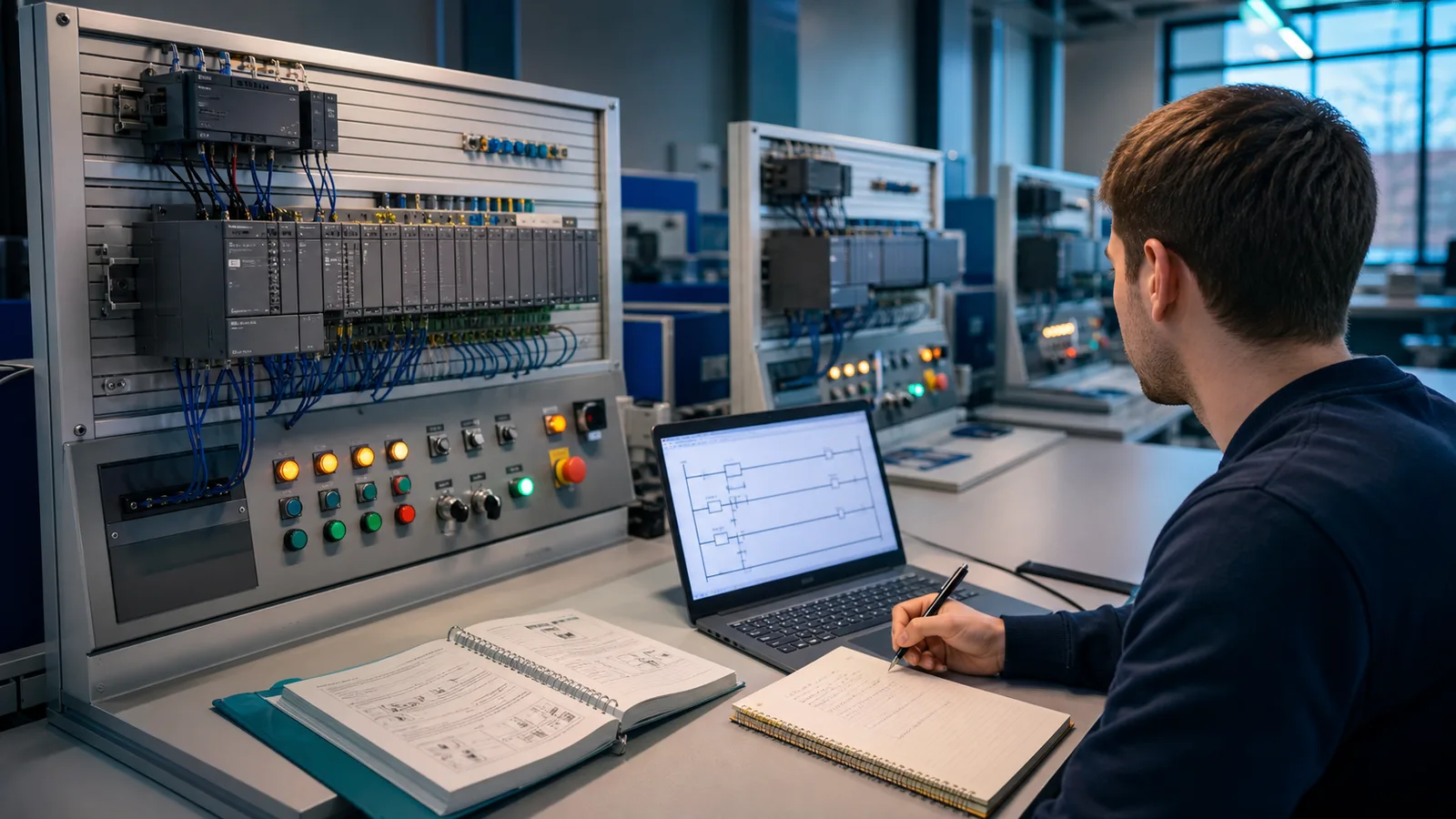
Siemens-style ladder logic, running in your browser.

How it feels

Built to build intuition.

A browser tab that behaves like a real PLC bench — without the hardware budget.

Real machine physics

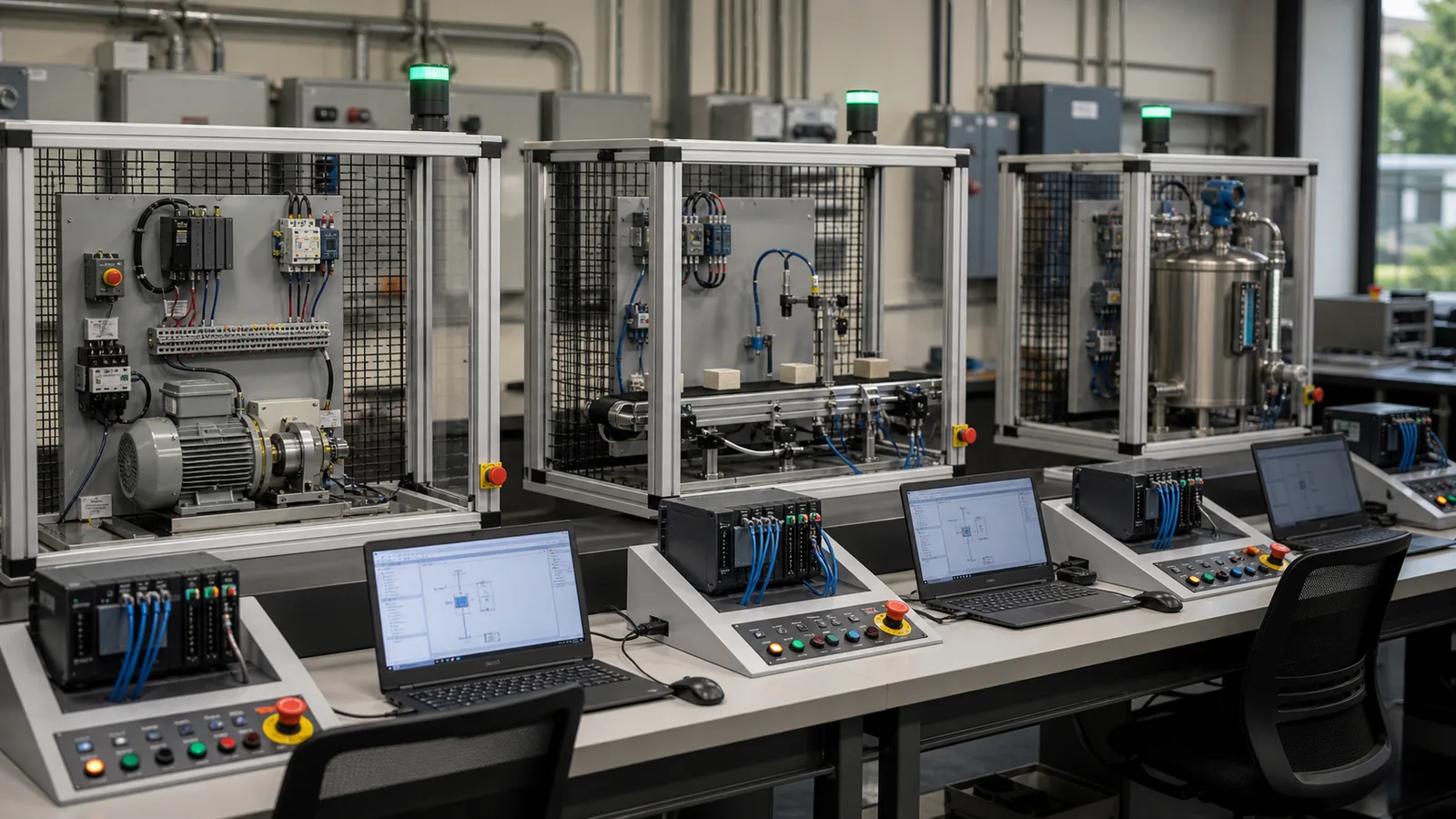
Every scenario simulates real equipment. Tanks fill, motors spin, valves modulate — driven by your actual ladder logic.

Live I/O experimentation

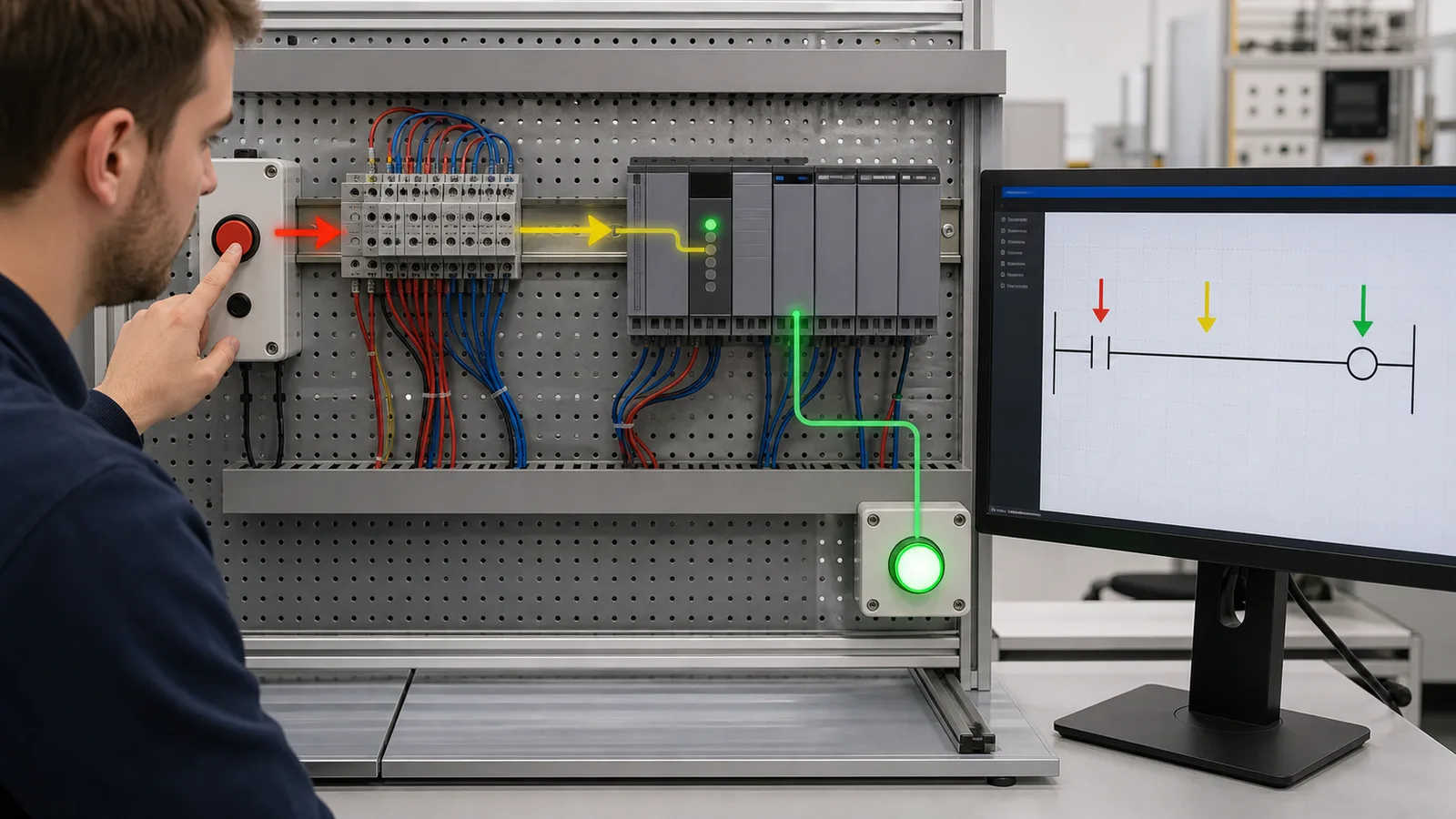
Toggle inputs by hand to see how the PLC responds. No wiring, no hardware — just click and learn.

Certificate-backed interview prep

Pass an interview track and earn a downloadable PDF certificate. Pro users get solution walk-throughs with expert commentary on every scenario.

About this training

What this Siemens PLC training covers

Siemens PLCs — specifically the S7-1200 and S7-1500 series — dominate European manufacturing. Walk onto any automotive plant floor in Germany, a water treatment facility in Scandinavia, or a food and beverage line in France, and the likelihood is that a Siemens controller is running the sequence. In DACH markets, Siemens is not just common; it is often the default specification. Engineers who cannot read TIA Portal code are effectively locked out of a large portion of the European industrial labour market.

TIA Portal (Totally Integrated Automation Portal) is the current Siemens IDE. It is powerful: it handles PLC programming, HMI configuration via WinCC, drive parameterisation, and network configuration in one environment. It is also expensive (licences start in the thousands of euros), Windows-only, and takes a significant amount of time to install and configure before you write a single rung. PLCSIM — Siemens’s own bundled simulator — requires a full TIA Portal installation and licence, which puts it out of reach for students, self-learners, and engineers on locked-down corporate machines.

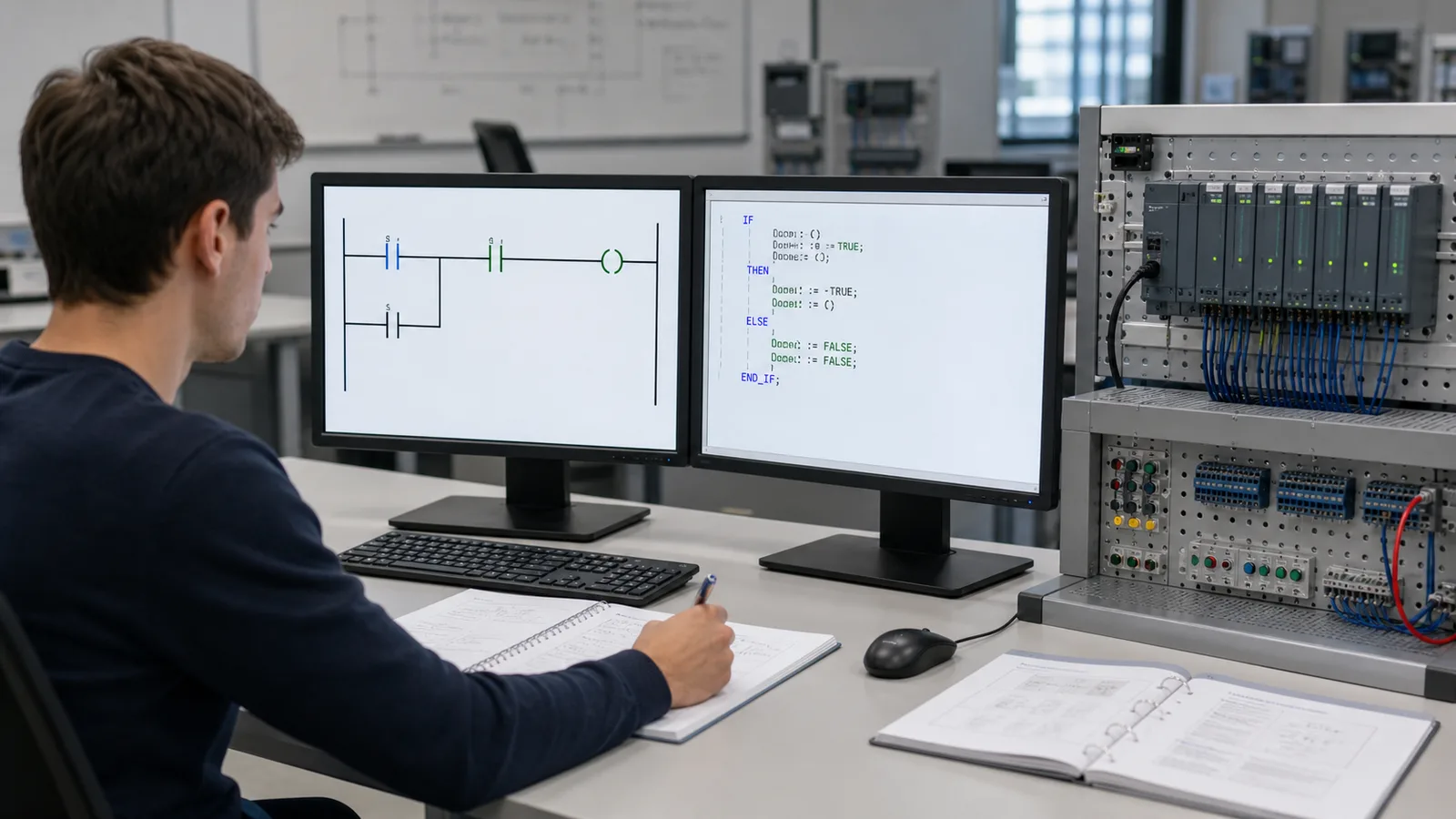
This platform offers a TIA Portal-style dialect covering ladder logic (LAD) and Structured Control Language (SCL — Siemens’s name for IEC 61131-3 Structured Text) inside a browser editor. You work through auto-graded scenarios that mirror real Siemens application domains: process control, HVAC, packaging, conveyor systems, and batch sequencing. The logic you write here — TON timers with T#5s time constants, Set/Reset coils, function block calls with #-prefixed local variables — transfers directly to TIA Portal when you eventually sit in front of it. The transition is natural rather than disorienting.

Learning pathway

Siemens PLC training pathway

Work through the four steps in order, or jump to the step that matches where you are right now.

1

Fundamentals

Ladder logic contacts and coils, scan-cycle mechanics, input/output addressing. Language-neutral concepts that apply to any PLC brand including Siemens.

Start lessons →
2

Siemens-specific syntax

SCL blocks and their structure. Organisation blocks (OB1 for cyclic, OB100 for startup). Function blocks (FB) with instance data blocks (DB). S7-style timers: TON / TOF with T# time constants. Simatic addressing: %I0.0, %Q0.0, %M0.0, #LocalTag.

Siemens simulator →
3

Core scenarios

Work through the Siemens-relevant scenario set below. Each is auto-graded against a physics model. Start with Motor Start/Stop and PID Temperature to cover the two instruction types that appear in almost every Siemens project.

All scenarios →
4

Quiz and interview prep

Consolidate knowledge with structured quizzes covering Siemens-relevant concepts. Then run through interview tracks with a timer to simulate the timed coding exercises that controls-engineering roles in the EU increasingly use.

Coverage

Siemens hardware and concepts covered

Programming concepts are the primary focus. Hardware-level details are covered conceptually where they affect how you write code.

S7-1200

The compact automation workhorse. Suitable for standalone machines, small to medium-sized automation tasks, and distributed I/O via Profinet. The S7-1200 is often the entry point for engineers learning Siemens for the first time. Programming concepts covered here apply directly.

S7-1500

The larger, more capable successor for process-heavy and multi-axis applications. Higher I/O count, faster cycle times, integrated motion control. The same TIA Portal-style dialect applies — S7-1500 adds advanced features but shares the same LAD, FBD, SCL, and STL foundation.

TIA Portal project structure: OB, FB, DB

Organisation blocks (OB1 = cyclic execution, OB100 = startup), function blocks (FB — reusable logic with instance data), and data blocks (DB — structured data storage) are core TIA Portal concepts. The scenarios and lessons introduce these structural patterns without requiring an actual TIA Portal installation.

SCL — Structured Control Language

SCL is Siemens's implementation of IEC 61131-3 Structured Text. Our editor understands IEC ST, which is directly transferable. IF/THEN/ELSE, FOR loops, CASE statements, function block calls — the syntax you write here reads identically in TIA Portal's SCL editor.

WinCC (HMI) — conceptual only

WinCC is Siemens's HMI and SCADA software integrated into TIA Portal. The simulator does not replicate WinCC screens, but scenario descriptions reference the HMI tag structures that a real project would require. Conceptual understanding is sufficient for most entry-level roles.

Profinet and Profibus — conceptual only

Communication protocols are not simulated. However, understanding that Profinet is Siemens's Ethernet-based industrial network (replacing Profibus in most new installations) is relevant context for reading project documentation and attending site commissioning.

Safety Integrated (F-CPUs) — conceptual only

Failsafe CPUs (F-CPU variants of S7-1200/S7-1500) add safety-rated hardware and the STEP 7 Safety programming environment. The simulator covers standard logic, not SIL-rated safety programming, which requires access to certified hardware by definition.

Your options

Comparing Siemens PLC training options

Each approach has genuine strengths. Choose based on where you are in your career, your budget, and what outcome you need.

OptionTypical costFormatAccreditationBest for
SITRAIN (official Siemens)€1,500 – €3,000 per weekClassroom / virtual instructor-ledSiemens-badged certificateHighest quality, hardware access, Siemens-certified instructors. Best for mid-career engineers or where plant standards require official credentials.
UniTrain / LabVolt systems€5,000+ equipment + softwareEducational hardware + software packageVaries by institutionDesigned for technical colleges and apprenticeship programmes (Berufsschule, BTS). Requires lab infrastructure.
RealPars / Udemy Siemens courses€30 – €300Video-based, self-pacedPlatform completion certificateGood for conceptual overview. No interactive coding or auto-graded exercises. Passive learning.
Community college / technical school€800 – €2,500 per semesterClassroom, lab sessionsInstitutional qualificationStructured curriculum with real hardware. Access depends on location. Semester-length commitment.
PLC Simulator (this platform)Free tier availableBrowser-based, self-paced, auto-gradedNo official accreditationBest for building hands-on coding fluency quickly, with no install and no licence. Not a substitute for hardware time or official certification.

SITRAIN cost range is an estimate based on publicly listed course categories [ESTIMATE]. Actual pricing varies by course, region, and delivery format. Verify at siemens.com/sitrain before budgeting.

Certification

Is Siemens certification necessary?

Siemens offers official certification paths through SITRAIN, including Certified Programmer and Certified Service Technician tracks. These are paid, exam-based, and well regarded across European manufacturing — particularly in industries where Siemens has a preferred-supplier relationship with the plant operator.

For entry-level roles, an official Siemens certificate rarely tips a hiring decision. What matters more is whether you can read an existing ladder rung, identify a logic error, and explain your reasoning in an interview. That is a practical skill you can demonstrate through a portfolio of solved scenarios and timed interview exercises — both of which this platform supports.

For mid-career engineers moving into Siemens-heavy plants — particularly automotive Tier 1/2 suppliers or water utilities in Germany — an official SITRAIN certification adds credibility and signals to the employer that you have trained on real hardware with a Siemens-certified instructor. In that context, it is worth the cost. Use this platform to build your foundation before committing to that investment. Showing up to SITRAIN already comfortable with TIA Portal syntax means you spend the week practicing on hardware rather than learning to read the screen.

Audience

Who this Siemens PLC training is for

Controls engineering students and apprentices

Ausbildung (dual-system apprentices), BTS Electrotechnique, HNC Electrical/Electronic, and university mechatronics students in Siemens-heavy regions. You cannot afford a TIA Portal licence. This fills the gap.

Plant engineers in Siemens-standardised industries

Automotive Tier 1 and Tier 2 suppliers, food and beverage processors, water treatment, and HVAC/building automation all run significant proportions of their installed base on Siemens hardware. If your plant just standardised on S7-1500, you need to get up to speed quickly.

International engineers relocating to Europe

Engineers moving from Allen-Bradley-dominant markets (North America, Australia) into European roles often encounter Siemens for the first time on the job. Learning TIA Portal-style syntax before you start reduces the ramp-up period significantly.

Anyone targeting Siemens-dominant verticals

Pharmaceutical manufacturing, energy, chemical processing, and railway automation are all sectors where Siemens PLCs appear regularly regardless of geography. If your target employer uses Siemens, this training is the fastest path to reading their code.

FAQ

Siemens PLC training — frequently asked

Yes. The free tier gives you two full scenarios with no credit card and no time limit. Upgrade to Basic or Pro when you want access to the complete 40-scenario library, interview-timer mode, and all quizzes.

Start Siemens PLC training free.

Two scenarios free. No credit card. No TIA Portal licence. No Windows-only restriction.

Siemens, SIMATIC, TIA Portal, STEP 7, S7-1200, S7-1500, WinCC, Profinet, Profibus, and SITRAIN are registered trademarks of Siemens AG. This site is not affiliated with or endorsed by Siemens AG.