
Runnable simulator field guide
PLC robot handshake scenario: test checklist
Direct answer
The learner can draw the state contract, run a normal transaction and diagnose stale, missing, out-of-order and restart signals.
Written for pLC and robot programmers practicing deterministic cell coordination, ownership, timeouts, aborts and recovery without a physical robot.
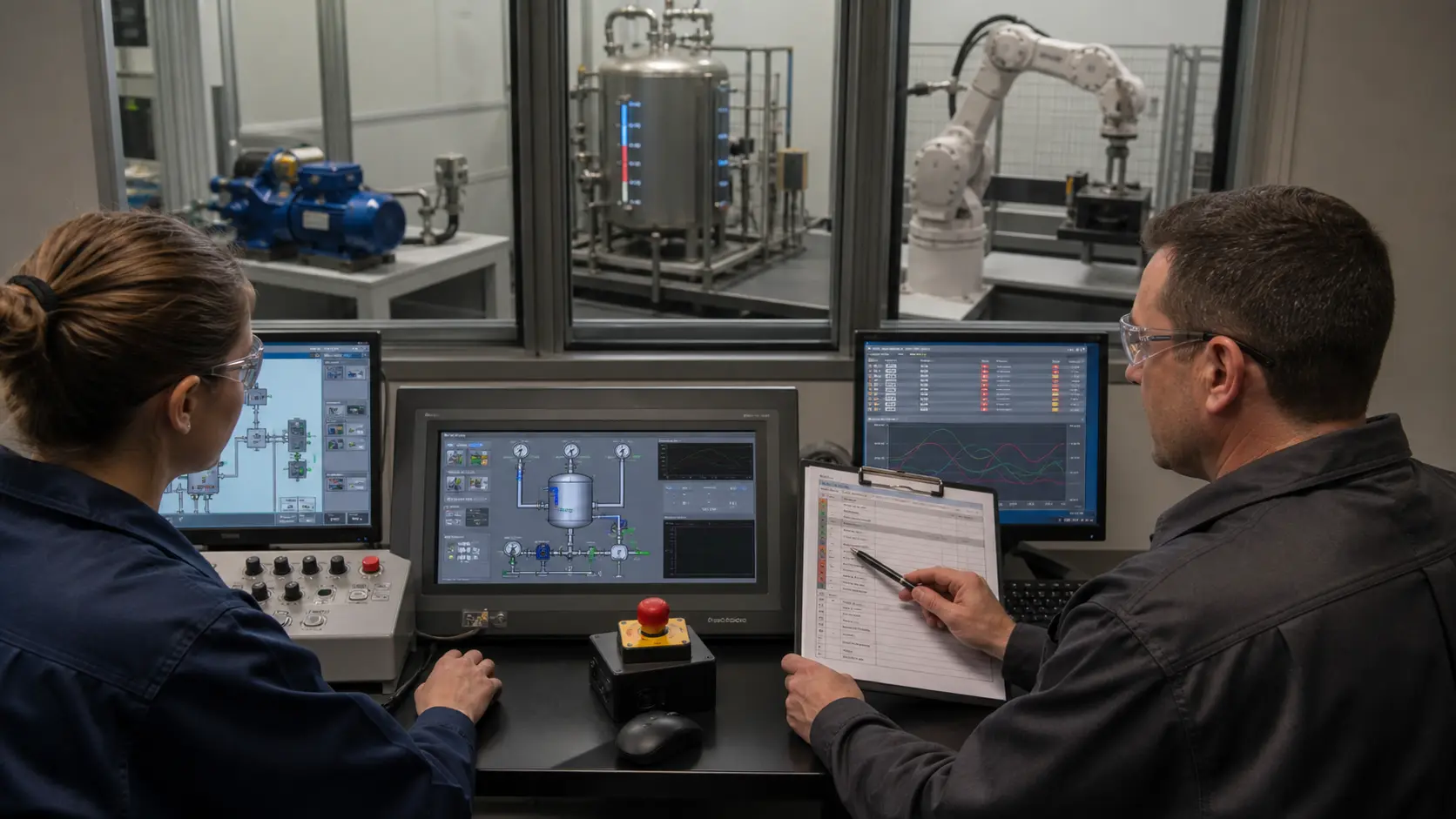
Scenario setup
Cell states, PLC owner, robot owner, request data, ready, acknowledge, busy, complete, fault, timeout, reset, abort and restart policy.
I/O and state map
PLC request and payload through robot acknowledgement and execution states to completion, process feedback and both-side state clearing.
Normal run
Idle, request, acknowledge, busy, complete and return-to-idle sequence repeated with recorded signal timing.
Boundary run
Stale complete, missing ready, delayed acknowledge, changed payload, timeout, abort mid-cycle, fault, power return and one-side reset.
Injected fault
An ownership, state, request-data, signal, timing, execution, feedback, reset or recovery mismatch.
Target check
The contract implemented and validated in official PLC and robot tools and the safeguarded target cell.
What signals are needed for a PLC robot handshake?
A robust contract often includes readiness, request plus data, acknowledge, busy, complete, fault, timeout and explicit clearing or reset rules.
How do you prevent a stale robot-complete signal?
Use state-qualified edges or transaction identity and require both sides to clear and confirm the idle state before accepting a new cycle.