Search allen bradley training (7,500/month) and you'll be funnelled to Rockwell's own CCP-series courses — five days of classroom per level, four levels, roughly USD 8,000–10,000 end to end. That path works if your employer pays. It doesn't work if you're self-funding, on a student budget, or outside North America.
This post is the self-study alternative. By the end of ten weeks you'll understand the Rockwell controller family from MicroLogix to ControlLogix, read XIC / XIO / OTE ladder fluently, know what Studio 5000 does that RSLogix 5000 couldn't, and have a portfolio of passing programs. A hiring manager at a Rockwell shop can verify your competence in ten minutes. They don't need a certificate — they need to see code that runs.
Who this path is for
- Anyone applying to plants that standardized on Rockwell — automotive, oil and gas, large discrete manufacturing, and most of the pharmaceutical industry in North America.
- Engineers bored of vendor-neutral theory who want to see the Rockwell conventions that actually appear on every job spec.
- Career switchers who don't have USD 2,100 per level lying around for the CCP curriculum.
- Students at institutions that teach IEC 61131-3 in the classroom but whose local job market runs exclusively on Rockwell.
This is not a replacement for on-the-job experience. It is the fastest route from "I've never touched Studio 5000" to "I can sit in front of a Rockwell IDE and not be lost."
The Rockwell landscape in 2026
A brief map, because the product line confuses newcomers:
- PLC-5, SLC 500 — legacy. Still in the wild, still maintained, but nobody trains new engineers on them anymore.
- MicroLogix 1000/1100/1400/1500 — the small-to-mid stuff. Programmed with RSLogix Micro, now called Connected Components Workbench.
- CompactLogix, ControlLogix, GuardLogix — the Logix family. Programmed with Studio 5000 Logix Designer, which replaced RSLogix 5000 around 2012. When a job posting says "RSLogix 5000," they almost always mean Studio 5000.
- FactoryTalk View — the HMI / SCADA layer. View ME (Machine Edition) runs on PanelView terminals; View SE (Site Edition) runs on servers.
- EtherNet/IP — Rockwell's fieldbus protocol. Don't confuse with plain Ethernet. It uses CIP (Common Industrial Protocol) under the hood.
If your employer runs Rockwell, at least three of those acronyms will appear in your first week. This course makes sure you've seen all of them before you walk in.
The 10-week self-study path
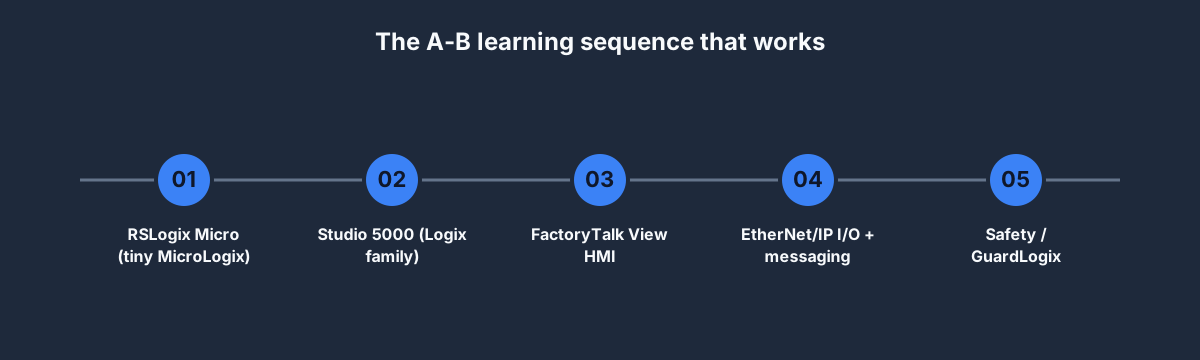
Weeks 1–2: Ladder fundamentals in the Rockwell dialect
Start with ladder logic. If you're already fluent in IEC 61131-3, the translation is almost mechanical (see our dialects post for the full mapping). If you're starting from zero, work through our 12-week PLC course Weeks 1–4 first.
Then switch to Rockwell notation:
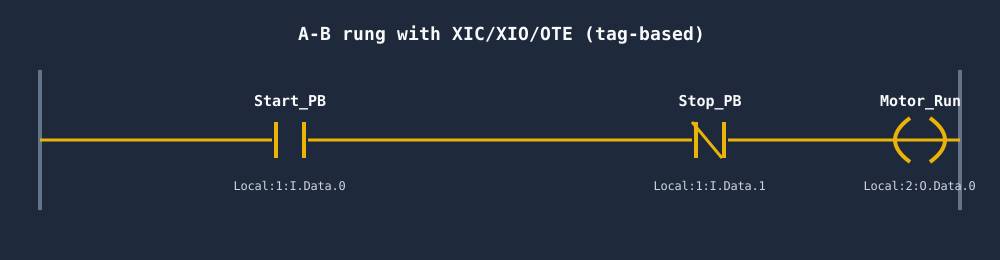
XIC(eXamine If Closed) — ourLDcontactXIO(eXamine If Open) — ourLDNnormally-closed contactOTE(OuTput Energise) — ourSTcoilOTL/OTU— latch / unlatch — ourS/RTON,TOF,RTO— timers with Rockwell-specific behavior
Write ten scenarios in our simulator using the Allen-Bradley dialect toggle. You'll retain the semantics and absorb the syntax.
Weeks 3–4: Tag-based addressing vs legacy file/word
Here's where Rockwell diverges from everyone else. Legacy RSLogix 5 and SLC 500 used file/word/bit addressing: I:1/0, B3:4/2. Studio 5000 uses tag-based addressing: Motor_Run, Local:1:I.Data.0.
Every job posting in 2026 expects tag-based fluency. You'll spend this fortnight getting comfortable with:
- UDTs (User-Defined Types) — structs.
Motoris a UDT withRun,Speed,Faultmembers. - AOIs (Add-On Instructions) — reusable function-block-like abstractions. Rockwell's answer to IEC function blocks.
- Produce/Consume tags — how ControlLogix chassis share data over a backplane.
- Aliases — a tag that points to another tag. Essential for controller-HMI separation.
The best exercise: take a scenario you solved in Week 2 using raw ladder, refactor it using an AOI for the motor start-stop block, and wire the AOI inputs to a UDT. You'll finish with the same program but structured the way a ControlLogix engineer would structure it.
Weeks 5–6: Structured Text, SFC, function blocks
Studio 5000 supports all five IEC 61131-3 languages. Ladder dominates, but ST appears in any project with non-trivial math, SFC shows up in batch-process work, and function blocks are standard for PID and control-loop code.
- ST — Rockwell uses a slightly non-standard syntax (
:=for assignment, mostly compatible with IEC). Our ladder-vs-ST post is the reference. - SFC — sequential function charts. Best for recipe-driven batch processes. Skip if you're aiming at discrete manufacturing roles.
- FBD — function block diagrams. Non-optional for PID loops.
Exercise: port your PID Temperature scenario from ladder to FBD using Rockwell's PIDE function block. Note how the gains map.
Weeks 7–8: FactoryTalk View + EtherNet/IP
Get familiar with the HMI side and the fieldbus.
- FactoryTalk View ME — drag a tag onto a screen, hook up a button, display a value. FactoryTalk's tag browser is the quickest part of Rockwell to learn.
- EtherNet/IP — explicit messaging, implicit (I/O) messaging, CIP class/instance/attribute. You won't configure this on day 1 of a job, but a hiring manager will check you know what CIP means.
If you don't have access to FactoryTalk View (it's not free), watch two YouTube walkthroughs and build the equivalent screen in Ignition Maker (free). The concepts port directly. Our PLC and SCADA training post has the Ignition half.
Weeks 9–10: Safety / GuardLogix (optional)
If you're aiming at a safety specialist role, add two weeks on GuardLogix. Otherwise, skip this and start sending CVs.
- GuardLogix vs ControlLogix — what the safety chassis actually does differently
- Safety AOIs — e-stop monitoring, light-curtain muting, two-hand control
- SIL levels and why they matter
Our safety scenarios (Two-Hand Control, Light Curtain Muting, Safety Mat Monitor, E-Stop & Reset) cover the same patterns vendor-agnostically. Work through them in AB dialect as your GuardLogix rehearsal.
Self-study vs the Rockwell CCP courses
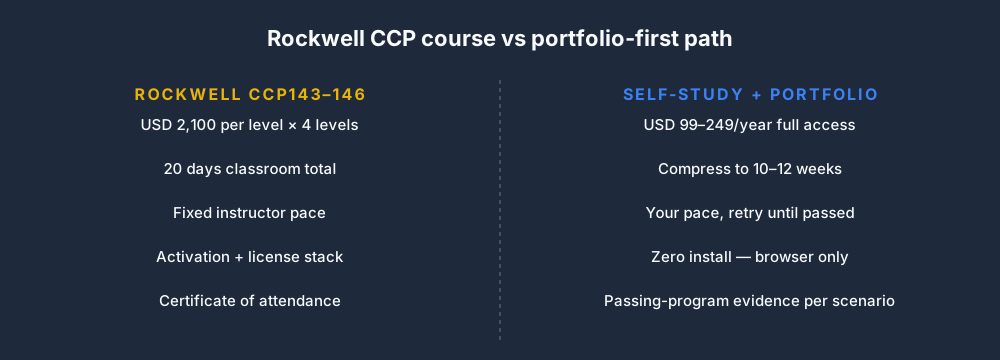
Rockwell's CCP-series classroom courses are genuinely good. If your employer is reimbursing, take them. If you're self-funding, the ROI is weak unless you specifically need:
- A Rockwell-logo certificate on your CV (some job specs require this — most don't)
- A Studio 5000 license included (the courses bundle it)
- Hands-on time with real ControlLogix hardware (simulators don't replicate every quirk)
For everyone else, the USD 10,000 spent on the full CCP stack would be better invested in USD 249 on our Pro plan plus USD 9,750 in your savings account. You won't have a Rockwell-branded certificate — you'll have a portfolio of forty programs that run against auto-graded tests, which hiring managers verify faster and find more credible.
The Studio 5000 workarounds
You can't legally run Studio 5000 without a Rockwell license. Here's what you can do instead:
- Watch the Studio 5000 UI on YouTube. Half a dozen channels walk through every major menu. Two hours of passive watching gets you past "where is the tag browser."
- Use a browser simulator for the semantics. Our Allen-Bradley dialect mode executes XIC / XIO / OTE exactly the way Studio 5000 executes them. You won't learn the IDE chrome, but you'll learn the code.
- Study open-source AOIs. Rockwell-world GitHub has good examples of AOIs that solve real problems — motor starters, PID-with-ramp, sequencer blocks. Read them the way you'd read a textbook.
- Buy an evaluation bundle later. If you land an interview, a USD 200 monthly evaluation license is all you need to demonstrate IDE fluency in a take-home.
Where Rockwell jobs actually are
North American manufacturing leans hard on Rockwell, especially automotive (Tier 1 and Tier 2 suppliers), oil and gas, and pharma. In Europe Siemens dominates, though there are Rockwell pockets. In Asia it's mixed — Mitsubishi, Omron, and Siemens share most of the volume.
If you're targeting North American manufacturing, Rockwell is mandatory. If you're targeting European process industries, Siemens matters more — see our Siemens PLC training post when it lands. If you're targeting global engineering contractors working on EPC projects, learn both.
FAQ
Is Allen-Bradley training free?
Rockwell's own training material is useful for vendor-specific context. For independent browser practice, our free tier includes the first six core learning lessons per dialect plus source-tagged practice records; exact Allen-Bradley-style exercise availability varies by entitlement and rollout.
What is the best Allen-Bradley training online?
Rockwell's CCP-series courses if your employer pays. Our Pro plan if you're self-funding and want graded portfolio evidence. A Udemy course as weekend reading, not as your primary path.
Do I need RSLogix 5000 installed to learn Allen-Bradley?
No. The IDE is a thin layer over the semantics. You can write A-B ladder, test it in a browser simulator, and become competent. Install Studio 5000 on a Windows VM when you have an interview coming up and need to demonstrate IDE comfort.
How long does it take to learn Allen-Bradley PLCs?
10 weeks at 8 hours a week will get you from zero to entry-level employable. 6 weeks if you already know another PLC dialect well. Full mastery — comfortable in ControlLogix, GuardLogix, FactoryTalk, and EtherNet/IP configuration — takes 2–3 years of real project work.
What about RSLogix 500 and MicroLogix?
Learn them last, and only if your target employer actually runs them. Studio 5000 skills transfer down; MicroLogix skills do not transfer up.
Can I get a job with only Allen-Bradley training?
In North American discrete manufacturing, yes. In most other regions or industries, learn at least one second dialect — IEC 61131-3 or Siemens — to widen your options.
Where to start
- Sign up free and open Motor Start/Stop. Toggle to Allen-Bradley dialect.
- Write the rung in XIC / XIO / OTE notation. Watch the test cases pass.
- That moment — where Rockwell syntax stops being an unfamiliar alphabet — is the entry point.
- Come back to the full 10-week plan and work it methodically.
Ten weeks. USD 99–249. A portfolio a North American automotive plant can verify. That's the offer.