TL;DR: SCADA (Supervisory Control and Data Acquisition) is a supervisory software layer that sits above separate PLCs or RTUs, polling their data and presenting it to operators. A DCS (Distributed Control System) is an integrated platform where both the control logic and the supervision layer come from a single vendor — tightly coupled, engineered for continuous process control. SCADA is open and multi-vendor; DCS is integrated and single-vendor. Industries choose based on process type, response time, and site scale.
Both SCADA and DCS are used to monitor and control large industrial processes. But they come from different design philosophies, serve different industries, and behave differently when something goes wrong. Confusing them in a job interview — or on a project specification — is a meaningful mistake.
What SCADA Is
SCADA is a software layer that sits above field devices (PLCs, RTUs, smart instruments) and provides supervisory monitoring, historical data logging, alarm management, and reporting. SCADA does not directly control machines — it reads from and writes to the PLCs that do.
In a SCADA architecture:
- Field devices (PLCs, RTUs) run local control logic independently.
- Communication network (Ethernet, radio, cellular, leased lines) carries data to the SCADA server.
- SCADA server collects, stores, and displays all field data; manages alarms.
- Operator workstations display live and historical views; allow supervisory commands.
SCADA is common in geographically distributed systems: water distribution networks, gas pipelines, electrical grids, oil fields, and wastewater collection systems. The key characteristic is that field devices operate independently — a pump station keeps running whether or not SCADA is reachable. SCADA adds visibility and remote control, not local control.
What a DCS Is
A DCS (Distributed Control System) is a single-vendor integrated platform where the process control logic, the engineering environment, the operator workstation, and the historian all come from one manufacturer and are tightly coupled by design.
In a DCS architecture:
- Controller nodes — distributed across the plant, each handling a section of the process.
- I/O modules — marshalled at each controller node; field instruments hard-wired.
- Process network — a deterministic, proprietary or IEC-standard fieldbus between controllers.
- Operator workstation — runs the vendor's runtime, showing live faceplate views for each loop.
- Engineering station — configures controllers, graphics, alarms, and historian in one environment.
Leading DCS platforms: Emerson DeltaV, Honeywell Experion PKS, ABB System 800xA, Yokogawa CENTUM VP, Siemens SIMATIC PCS 7.
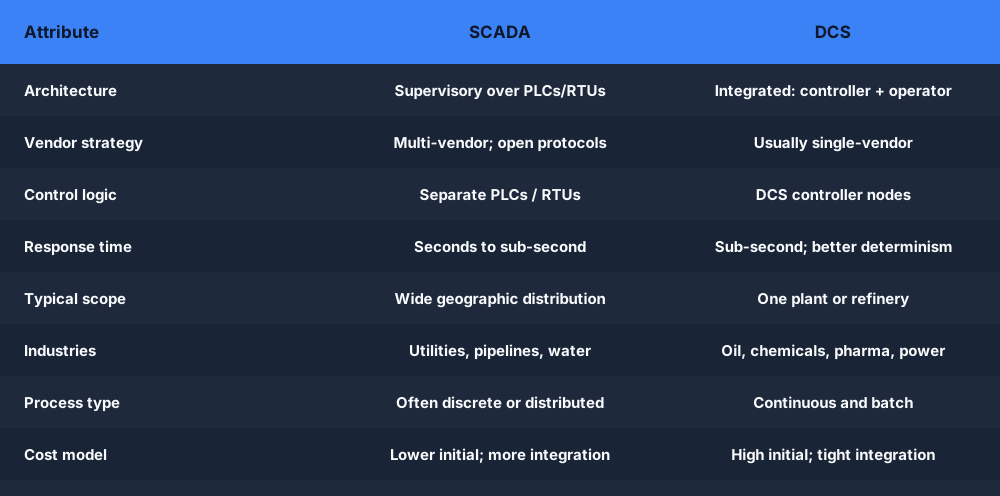
Side-by-Side Comparison
| SCADA | DCS | |
|---|---|---|
| Architecture | Supervisory layer over separate PLCs/RTUs | Integrated: controller + operator station + historian |
| Vendor strategy | Multi-vendor; open protocols | Usually single-vendor; proprietary integration |
| Control logic location | Separate PLCs / RTUs | DCS controller nodes |
| Response time | Seconds to sub-second | Sub-second; better determinism for tight loops |
| Typical scope | Wide geographic distribution | One plant or refinery |
| Industries | Utilities, pipelines, water/gas networks | Oil refining, chemicals, pharma, power generation |
| Process type | Often discrete or batch; works with continuous | Primarily continuous and batch |
| Failure: comms lost? | PLCs run on local logic; SCADA loses visibility | Controller nodes continue; operator loses display |
| Cost | Lower initial; more integration effort | High initial; lower integration effort |
| Scalability | Scale by adding more PLCs to the network | Scale within the DCS footprint |
How the Industries Divide
The split is not absolute, but there is a strong pattern:
DCS dominates:
- Oil refining and petrochemicals — continuous processes where tight control loop integration matters (temperature, pressure, flow interacted via cascade and feedforward control)
- Pharmaceutical manufacturing — batch processes with strict recipe and audit trail requirements
- Power generation — boiler/turbine control requires tight, integrated loop control
- Large chemical plants — complex process interactions that benefit from a unified engineering environment
SCADA dominates:
- Water and wastewater utilities — geographically distributed pump stations, each operating independently
- Gas distribution — remote RTUs at pipeline valve stations, compressors, metering points
- Electrical transmission and distribution — substations across a grid, managed from one control center
- Mining — site-wide monitoring of conveyor systems, crushers, and processing equipment from a central room
The fundamental question is whether the process is geographically distributed (SCADA) or physically centralized but chemically/thermally complex (DCS).
The Convergence
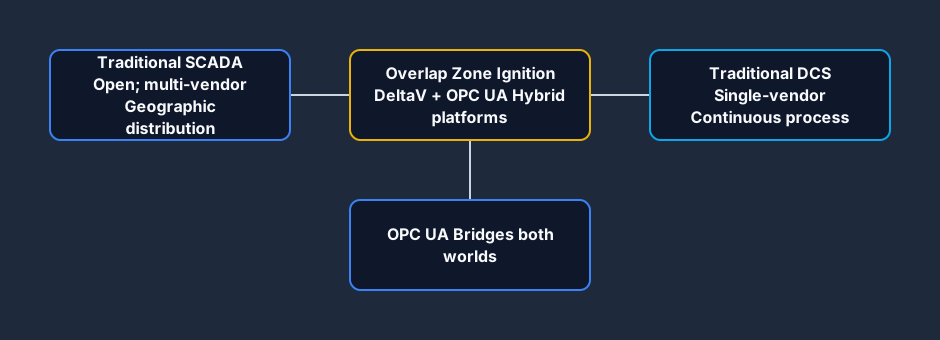
The SCADA/DCS boundary is blurring. Modern platforms like Emerson DeltaV 14 include a SCADA connectivity layer. Ignition (SCADA) can run on distributed servers with millisecond data collection that approaches DCS historian capability. Yokogawa and ABB now offer hybrid platforms.
Meanwhile, high-end Allen-Bradley ControlLogix PLCs with FactoryTalk View SE are architecturally similar to a light DCS for discrete manufacturing. The label matters less than understanding which layer does what.
Real Plant Examples
Ethylene plant (DCS): An Emerson DeltaV system controls hundreds of PID loops — furnace tube temperatures, cracker outlet pressures, separation column levels. Every loop's controller is a DeltaV module. The operator sees faceplate views on DeltaV workstations. An engineer changes a PID tuning parameter in the DeltaV engineering station. Everything is DeltaV — that is the point.
City water network (SCADA): Forty pump stations spread across 200 kilometres of water mains, each with an Allen-Bradley MicroLogix PLC controlling its pumps based on local level switches. A city operations center runs Ignition SCADA, which polls all forty PLCs every five seconds. Operators can see all stations simultaneously, acknowledge alarms, and change remote setpoints. When the SCADA server went down for maintenance last month, every pump station kept running on its local PLC logic. Nobody noticed except the operations center.
Pharmaceutical tableting line (DCS): A Siemens SIMATIC PCS 7 system manages the granulation, drying, blending, and compression steps of a tablet production campaign. Recipe management, batch logging, and 21 CFR Part 11 audit trails are built into the DCS platform. Swapping to a SCADA + PLC architecture would require significant validated integration work to meet the same regulatory requirements.
Common Confusions Cleared Up
"DCS is just an old SCADA." No — they have different design philosophies. SCADA was built around polling distributed field devices over unreliable links (radio, serial, cellular). DCS was built around tight real-time control of continuous processes with deterministic internal networks. The age of the platform has nothing to do with it.
"SCADA is for small sites, DCS is for large sites." Not accurate. Offshore gas platforms (small site) use DCS. Large city water utilities (thousands of points, hundreds of sites) use SCADA. Size is not the distinguishing factor — process type and geographic distribution are.
"You need DCS expertise to work in the oil industry." It helps. But most oil and gas facilities also use PLCs for discrete equipment (compressor controls, fire and gas systems) connected to the DCS or SCADA layer. PLC skills transfer; you just add the DCS layer on top.
Frequently Asked Questions
Q: Is a DCS more reliable than SCADA?
A: A DCS provides better integration reliability because the vendor designs all components to work together and certifies the combination. SCADA reliability depends on the integration quality between the SCADA server and the field PLCs/RTUs it connects to. A well-integrated SCADA system with modern PLCs is highly reliable; a poorly integrated one with proprietary field devices is not.
Q: Can SCADA and DCS coexist on the same plant?
A: Yes, and this is common. A process plant may have a DCS managing the main process units and a SCADA system monitoring utility systems (cooling water, compressed air, site electrical) and providing a plant-wide dashboard that aggregates data from both. They communicate via OPC UA or OPC DA.
Q: What protocol does SCADA use to talk to PLCs?
A: The most common protocols are OPC UA (vendor-neutral, modern), Modbus TCP (widespread, simple), EtherNet/IP (Allen-Bradley), PROFINET (Siemens), and DNP3 (common in utilities and SCADA for substations). OPC UA is increasingly the standard for new SCADA-to-PLC integration because it is vendor-neutral and supports security certificates.
Q: Do I need DCS experience to get a SCADA job?
A: Not necessarily. Most SCADA roles — integrator, operator, maintenance — focus on the SCADA platform (Ignition, WinCC, iFIX) rather than the DCS layer. DCS experience is more important for roles in oil, gas, and chemicals where DCS is the predominant technology. A solid foundation in PLC fundamentals and SCADA basics gives you the underpinning for both.
Whether you are heading towards SCADA or DCS, the control logic foundation starts at the PLC layer. Practice the real-time control side — the motor start-stop scenario and the Modbus register read scenario are free and run in your browser.
