PLC Simulator
Facts 2026-10-25.1
Reviewed 2026-10-25

Compatibility with boundaries

PLC dialect compatibility

Nine learning dialect tracks, their transferable syntax and the vendor-project or firmware behavior they do not reproduce.

9 learning dialect tracks

The dialects teach recognizable syntax and transferable logic patterns. “Compatible” does not mean binary, project-file or firmware compatibility with a vendor engineering suite.

Learning dialectAccepted learning styleWhat transfersWhat is excluded
IEC 61131-3IEC-style declarations, addresses, ladder text and Structured Text expressionsBOOL/data types, contacts, coils, timers, counters, edge blocks and common data operationsNot a conformance-certified IEC implementation and not a replacement for a target IDE/runtime.
Allen-BradleyRSLogix-style XIC, XIO, OTE, OTL/OTU and named timer/counter blocksContact/coil reasoning, latch patterns, presets and I/O-style addressesNo .ACD import/export, Logix firmware, module tree, produced tags or complete instruction set.
Siemens SCLSCL/ST-style assignments, Siemens %I/%Q/%M addresses and supported blocksSCL syntax, symbolic variables, time literals and common logic patternsNo TIA project, OB/FB/DB lifecycle, PLCSIM firmware or hardware configuration emulation.
MitsubishiGX-style LD/LDI/AND/OR/OUT/SET/RST plus T/C and D-register operationsX/Y/M/D device thinking, seal-in logic, basic timers, counters and word operationsNo GX Works project import, special modules, networking setup or full MELSEC instruction catalog.
OmronCX-style LD/LD NOT/AND/OR/OUT/SET/RSET, TIM/CNT and word operationsContact logic, channel/bit ideas, basic timer/counter and data-move patternsNo CX-One/Sysmac project import, task model, motion, EtherCAT setup or complete CJ/NX instruction set.
KEYENCE KVKV-style R/MR/DM devices, contacts, coils, T/C devices and selected arithmetic mnemonicsRelay/device reasoning, inverse contacts, set/reset, timer/counter and data-register patternsNo KV STUDIO project import, special-unit configuration, complete instruction catalog or KV controller firmware.
Schneider UnityUnity/EcoStruxure-oriented IEC and IL-style learning syntaxIEC variables, boolean logic, timer/counter patterns and common data operationsNo .STU/.ZEF import, MAST/FAST task fidelity, hardware catalog or Control Expert runtime.
DeltaDVP/WPLSoft-style LD/LDI/AND/OR/OUT/SET/RST, TMR/CNT and D-register operationsX/Y/M/D addressing, contact/coil logic and basic data instructionsNo WPLSoft/ISPSoft project import, API instruction catalog, special modules or DVP firmware.
Instruction ListLegacy IEC-style stack operations such as LD/LDN, AND/OR, ST, S/R and selected blocksReading and migrating legacy stack-machine logicA legacy-learning surface, not a claim that IL is a current preferred IEC language.

Vendor names describe syntax context, not affiliation

Allen-Bradley, Rockwell Automation, Siemens, Mitsubishi, Omron, Schneider Electric and Delta are the property of their respective owners. PLC Simulation Software is an independent learning product and is not an official vendor emulator or certification provider.

Choose the next tool by the job

01

Learn the pattern

Use this browser simulator for fast practice, feedback and cross-dialect comparison.

02

Build a vendor project

Move to the official vendor IDE and target-specific documentation.

03

Commission a machine

Validate on the intended controller, I/O, network and safety hardware under an approved procedure.

Found a mismatch?

Send the URL, facts version, expected behavior and observed behavior. Product and documentation corrections are reviewed together.

Report a correction

Software evaluation field guide

PLC dialect compatibility documentation: evaluation checklist

Direct answer

The reader can separate supported learning syntax from full project compatibility and identify behavior that must be rebuilt and tested on the target.

Written for pLC learners and maintainers comparing IEC-style, Allen-Bradley, Siemens, Mitsubishi, Omron, Delta and other platform-oriented examples.
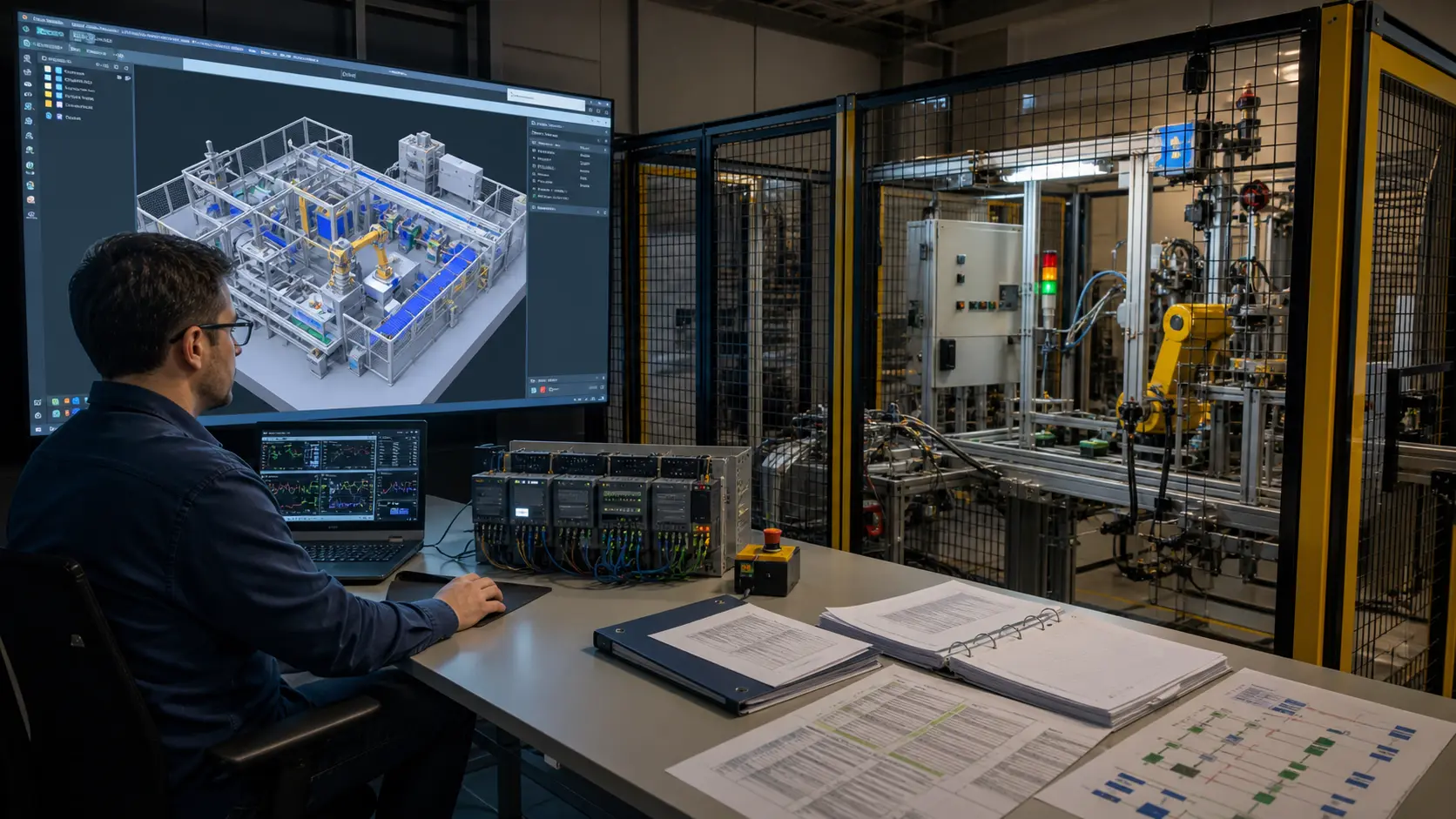
a controls engineer comparing a plant simulation model, physical training cell, PLC evidence and versioned test records while studying cross-vendor PLC syntax and behavior compatibility
System map / 02

NODE 01observable

Requirement

Source and target dialect, language, syntax, address or tag model, instruction parameters, instance state, data types, scan or task execution, restart and project workflow.

NODE 02observable

Test job

Control intent through source representation, supported parser, neutral behavior contract, target representation, compile result and observable machine behavior.

NODE 03observable

Baseline result

One contact-coil, timer, counter and edge case expressed in supported variants and compared by behavior.

NODE 04observable

Stress case

Unsupported mnemonic, parameter order, time literal, data overflow, repeated instance, prescan, retained value, task rate, download and online edit.

NODE 05observable

Failure handling

A syntax, naming, addressing, parameter, instance, type, timing, retention, task or workflow mismatch.

NODE 06observable

Decision record

Each translated behavior recreated, compiled and regression-tested in the official target environment.

Answer surface / 07

What does PLC dialect compatibility mean here?

It means a documented learning subset can express certain transferable behaviors; it does not mean native project or firmware compatibility.

Can PLC code be converted by replacing instruction names?

Not reliably. Parameter order, state instances, data types, execution, reset and restart behavior also need explicit translation and tests.