PLC Simulator
Facts 2026-10-25.1
Reviewed 2026-10-25

Implemented, not aspirational

Supported PLC instruction subset

The tested common runtime, data operations and dialect-specific syntax accepted by the current learning environment.

Common runtime subset

“Supported” means the current parser/runtime path contains an implemented operation and it is covered by repository tests. It does not mean every spelling is accepted in every dialect, nor that vendor status bits and firmware side effects are emulated.

Instruction familyImplemented subsetBoundary
Boolean and rung logicNormally open/closed contacts, AND, OR, NOT, series/parallel logic and output assignmentSpelling and addressing vary by dialect; graphical editing is translated to the common runtime.
Coils and stateOutput energize plus set/reset or latch/unlatch forms where the dialect exposes themVendor retentive-memory and power-cycle behavior is not firmware-emulated.
TimersTON, TOF and TP in the common IEC runtimeNot every vendor parser or renderer exposes every timer form; time advances on the teaching clock.
CountersCTU, CTD and CTUD in the common runtimeVendor mnemonics and reset/load inputs differ. Some mnemonic subsets currently expose CTU only.
EdgesR_TRIG and F_TRIGExecution is deterministic in the browser, not tied to a physical controller task.
Data operationsMOV, ADD, SUB, MUL, DIV and MODAvailable forms depend on the parser; overflow and vendor status-bit behavior are not universally emulated.
ComparisonsEQ, NE, GT, GE, LT and LEThe supported scalar type subset is documented below; vendor-specific compare families are out of scope.
Process controlPID function block in the common runtimeA teaching model for loop behavior, not the proprietary tuning, scheduling or anti-windup behavior of every vendor.

Scalar and block types

Current common AST types:

BOOLINTDINTREALTIMEWORDDWORDTONTOFTPCTUCTDCTUDR_TRIGF_TRIGPID

A precise way to read this list

The common runtime is broader than some vendor-style input parsers. For example, Mitsubishi, Omron and Delta learning syntax currently centers on contacts, coils, TON-style timers, CTU-style counters and basic word operations. Check the dialect matrix before assuming a block is accepted in a particular mnemonic form.

Not represented as “supported”

  • Complete vendor instruction catalogs or firmware quirks
  • Safety signatures, SIL/PL validation or safety-runtime behavior
  • Motion-control axes, servo tuning and vendor motion planners
  • Native vendor project import/export
  • Hardware configuration, module profiles and fieldbus commissioning
  • Real-time task jitter, watchdog behavior or controller performance certification

Found a mismatch?

Send the URL, facts version, expected behavior and observed behavior. Product and documentation corrections are reviewed together.

Report a correction

Technical reference and worked-example guide

Supported PLC instruction reference: field reference

Direct answer

The reader can connect an instruction name to tested operands, state, scan behavior, boundaries and known exclusions before choosing an exercise.

Written for pLC learners, instructors and evaluators checking which contacts, coils, timers, counters, comparisons and data operations the learning runtime supports.
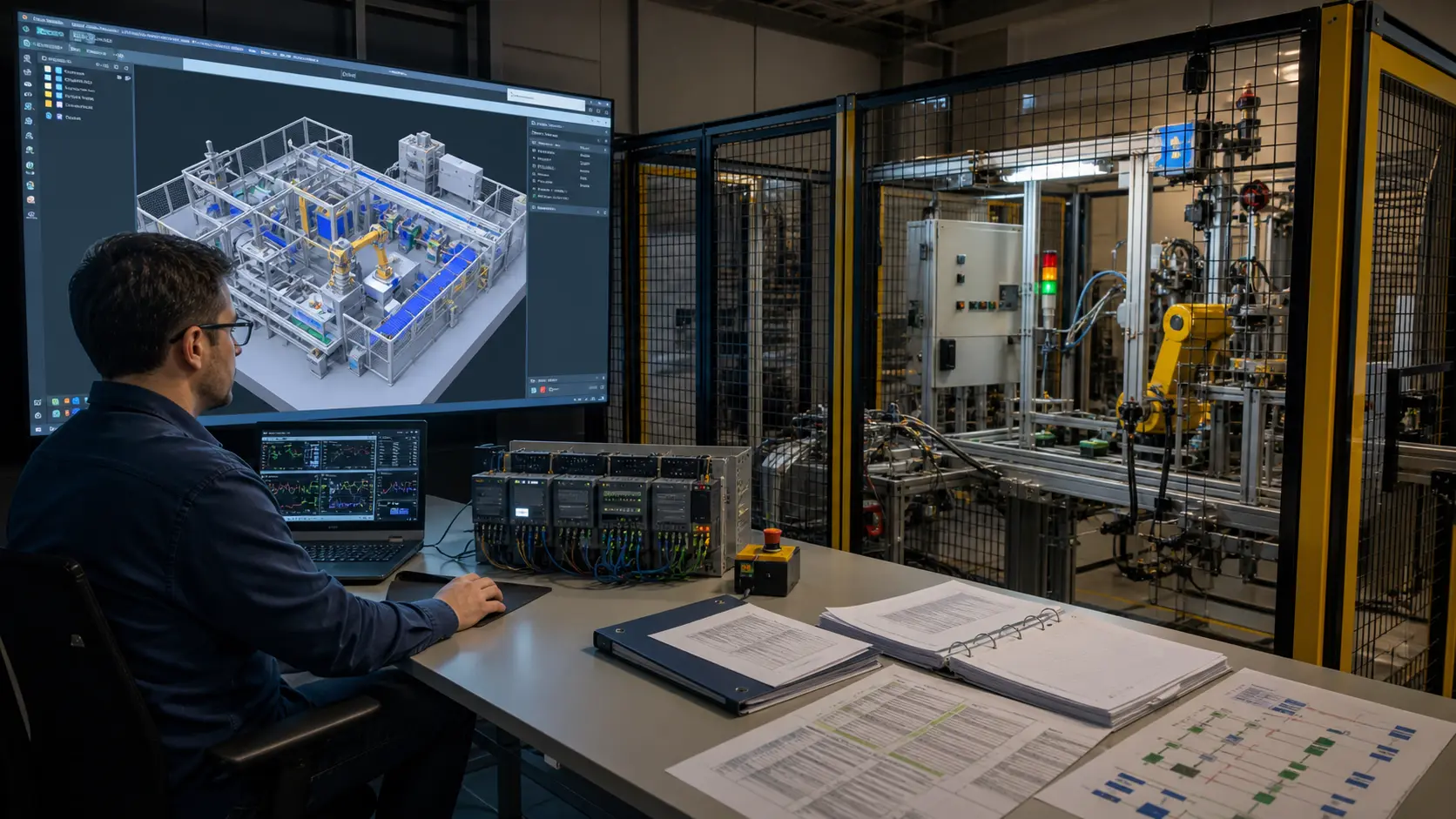
a controls engineer comparing a plant simulation model, physical training cell, PLC evidence and versioned test records while studying verified browser PLC instruction semantics and limits
System map / 02

NODE 01observable

Definition

Language or dialect, instruction identity, operand types, parameters, instance state, evaluation order, time or count base, reset, error behavior and known exclusions.

NODE 02observable

Signal path

Source code or rung through parse, validation, runtime evaluation, stored state, output or result, scenario effect and regression assertion.

NODE 03observable

Worked example

One representative valid example plus false and true transitions executed from a known state.

NODE 04observable

Limits

Missing operand, wrong type, boundary value, repeated call, reset, skipped call, duplicate write, restart and unsupported syntax.

NODE 05observable

Common mistake

A documentation, parser, type, parameter, state, scan-order, reset, error or dialect mismatch.

NODE 06observable

Verification

Support statements pinned to passing tests and target-platform assumptions verified independently.

Answer surface / 07

What PLC instructions does the simulator support?

Use the current published reference for exact language and instruction coverage; do not infer support from a familiar vendor mnemonic alone.

Does a supported timer behave exactly like every PLC timer?

No. Instance state, time base, task scheduling, reset, prescan and retention can vary by platform and must be tested on the target.