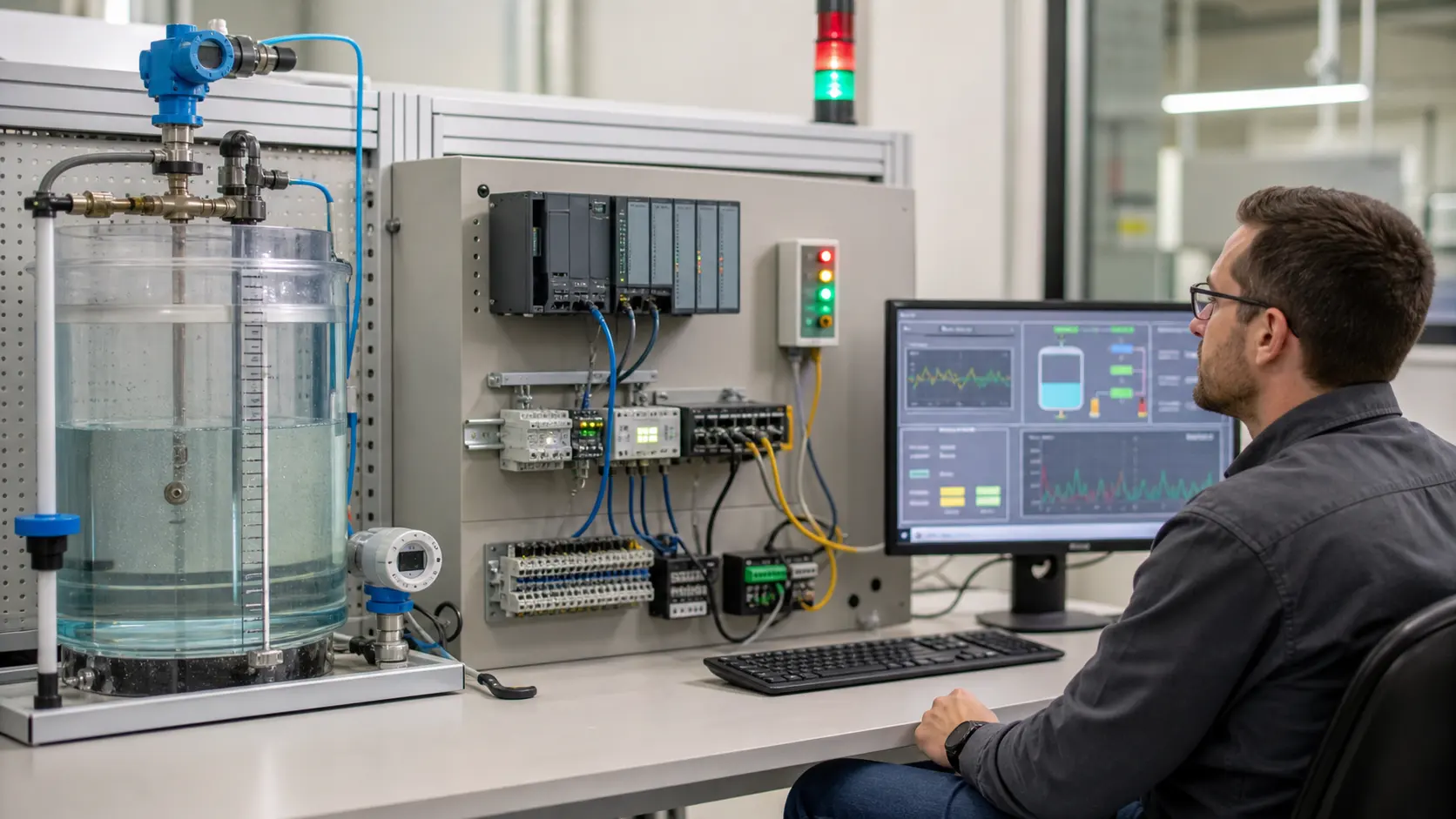
SCADA stands for Supervisory Control And Data Acquisition. In practice it's the software layer that sits above your PLCs and does the jobs a PLC can't — visualization for operators, long-term historian storage, alarm routing, and shift-and-compliance reporting.
If you already know what a PLC is, SCADA is "everything a PLC shouldn't do, but somebody has to." If you don't know what a PLC is, start with our what-is-a-PLC explainer first.
The four jobs a SCADA system does

Every SCADA product (Ignition, Wonderware / AVEVA, FactoryTalk View, iFIX, ScadaBR, OpenSCADA) does some version of four things:
- Visualization. Render dashboards — "here's the tank level, here's the pump status, here's the batch recipe in progress" — for operators to see what's going on right now. Often called the HMI layer.
- Historian. Log tag values over time. "What was Tank 3 level at 0347 yesterday" is a SCADA question, not a PLC question.
- Alarming. Raise alarms when values exceed thresholds, route them to the right operators, track acknowledgement, escalate if ignored.
- Reporting. Generate shift reports, OEE summaries, compliance logs, maintenance schedules. Usually scheduled and emailed automatically.
PLCs don't do any of these. SCADA systems don't do real-time control. Each layer is good at one thing and terrible at the other.
Where SCADA ends and PLC begins
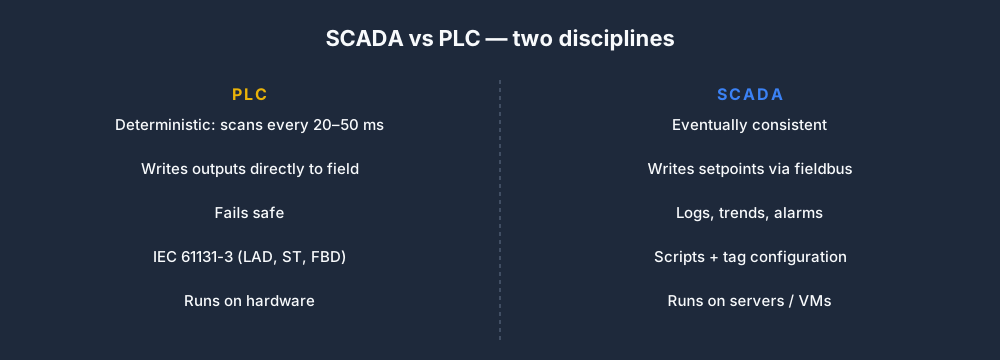
A useful rule of thumb based on latency:
- 20 ms decision → PLC. "Close the emergency-stop loop on a limit switch fault."
- 2 second decision → PLC usually, SCADA can trigger it. "Start the CIP sequence."
- 2 minute decision → SCADA. "Operator, acknowledge the high-temperature alarm before the batch proceeds."
- Daily decision → SCADA. "Generate yesterday's production report and email it to the plant manager."
A PLC program must never rely on SCADA being online. A SCADA screen must never rely on seeing every PLC scan. The fieldbus between them (Modbus TCP, Ethernet/IP, Profinet, OPC UA) is the contract.
The stack, top to bottom
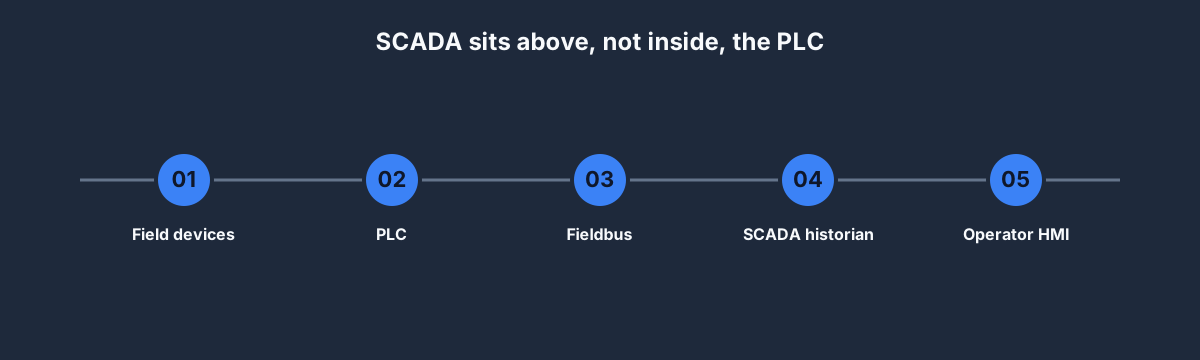
- Operator HMI — the dashboards operators look at. Usually rendered by the SCADA server and streamed to clients.
- SCADA historian — the database that logs tag values. Stores billions of rows across years. Specialized time-series compression.
- Fieldbus — Modbus TCP, Ethernet/IP, Profinet, OPC UA. The protocol the SCADA uses to talk to PLCs.
- PLC — the deterministic controller. Runs the ladder that controls physical machinery.
- Field devices — the actual sensors and actuators.
SCADA is the top three layers. PLC is the bottom two. The fieldbus is the interface.
Named SCADA products
Four you're likely to meet in 2026:
- Ignition (Inductive Automation) — growing fast. Free Maker edition for learning. Best first SCADA to learn on your own.
- AVEVA (ex-Wonderware) InTouch + System Platform — market leader in process industries. Dominant in refineries, pharma, water/wastewater. No free tier.
- FactoryTalk View (Rockwell) — ubiquitous wherever Rockwell PLCs live. Tight integration with Studio 5000.
- Siemens WinCC — the Siemens counterpart, bundled into TIA Portal. Common in European automotive and heavy manufacturing.
Our PLC and SCADA training post has the 16-week plan for learning both together — including an Ignition-based hands-on.
Common confusions
SCADA vs HMI. HMI is the display layer (screens, gauges, buttons for operators). SCADA includes HMI plus historian, alarming, reporting. Every SCADA system has an HMI; not every HMI is a SCADA system. For a deeper comparison of how a PLC and an HMI divide responsibilities, see PLC vs HMI.
SCADA vs DCS. DCS (Distributed Control System) is a similar but older concept used in process industries. The lines are blurring — modern Ignition or AVEVA System Platform is often deployed as what used to be a DCS. Don't obsess over the distinction.
SCADA vs MES. MES (Manufacturing Execution System) is above SCADA. It manages work orders, batches, inventory, quality. SCADA gives MES the tag values; MES decides what to do with them business-wise.
SCADA vs IIoT / cloud. IIoT platforms (AWS IoT, Azure IoT, Cumulocity) are a newer layer that sometimes replaces or complements SCADA. For deterministic plant operation you still need SCADA locally; the IIoT layer tends to be where analytics and AI live.
Is SCADA programming or configuration?
Both, and the mix matters. In Ignition:
- Configuration — tag definitions, screen layouts, alarm thresholds. Done in Designer (Ignition's IDE). 80% of a new engineer's first year.
- Scripting — Python (Jython 2.7 historically, 3.x going forward). Used for custom reports, unusual alarm logic, database integrations.
In FactoryTalk View and WinCC: similar split, different script languages (VBA-like for FactoryTalk, VBS/C# for WinCC).
Who uses SCADA
Every continuous-process industry. Power generation, water and wastewater, oil and gas, mining, food and beverage, pharmaceuticals, pulp and paper. Much of discrete manufacturing uses SCADA-lite setups or HMI-only solutions because the latency requirements are lower.
If you're targeting roles in process industries, SCADA fluency is mandatory. If you're targeting discrete manufacturing, it's helpful but not blocking.
FAQ
Is SCADA the same as HMI?
No. HMI is the display layer. SCADA includes HMI plus historian, alarming, and reporting. See the confusion section above.
Is SCADA a programming language?
No. SCADA is a category of software. The programming inside a SCADA system is usually configuration (drag-and-drop) with a scripting language (Python, VBS) for custom logic.
What's the best free SCADA to learn?
Ignition Maker Edition. Free for non-commercial use, vendor-supported, free certification. Start there.
How long does SCADA take to learn?
Four weeks for basic visualization and alarming. Three months to be fluent in one product (Ignition or WinCC). A year or more for deep historian and scripting expertise.
Do I need to know SCADA to be a PLC programmer?
Not strictly, but it plateaus your career. The best PLC engineers can read and modify SCADA screens well enough to know where the data comes from. See our PLC and SCADA training post.
Where to start
- Read our PLC and SCADA training post for the full 16-week learning plan.
- Install Ignition Maker Edition — free, 15 minutes to install.
- Work through Ignition's own "Gateway Setup" tutorial — about two hours.
- Come back to our PLC course for the controls half.
SCADA without PLC is a hollow skill. Together, they're an employable one.
Related comparisons: Not sure where the PLC layer ends and SCADA begins? See the SCADA vs PLC breakdown. Confused about SCADA vs HMI? Read SCADA vs HMI — same screen, very different jobs. Evaluating a DCS vs SCADA for a process plant? SCADA vs DCS covers the architectural differences.