PLC Simulator
Facts 2026-08-09.1
Reviewed 2026-08-09

Inspectable evidence

Public, reproducible test harness

Download cross-dialect reference vectors, inspect expected outputs and reproduce the same semantics in the browser.

Reference test: NC input semantics

Each fixture represents the same behavior: when input ES is false, output LIGHT is true; when ES is true, LIGHT is false. The syntax changes across nine dialects, but the normalized result must not.

CaseInput ESExpected LIGHTPurpose
NC path healthyfalsetrueProves inverse contact/output semantics.
NC path opentruefalseProves output de-energizes when the input becomes true.

How to reproduce it

  1. 1

    Download the JSON and choose one dialect fixture.

  2. 2

    Open /try for the no-account guided program, or sign in to use the full editor.

  3. 3

    Paste or recreate the fixture in its matching learning dialect.

  4. 4

    Run both input cases and compare the observed output with expectedOutput.

  5. 5

    Record the factsVersion and fixtureVersion with any result.

  6. 6

    Report a mismatch with the dialect, browser, input case and observed output.

What this proves—and what it does not

The fixture makes one cross-dialect semantic inspectable and traceable to repository tests. It does not prove full-language conformance, hardware timing, safety integrity or compatibility with proprietary project files.

Found a mismatch?

Send the URL, facts version, expected behavior and observed behavior. Product and documentation corrections are reviewed together.

Report a correction

Technical reference and worked-example guide

PLC scenario test-harness documentation: implementation, evidence and troubleshooting

Direct answer

PLC scenario test-harness documentation becomes useful when it connects requirement, initial state, reset behavior, timed stimulus, observed tags, modeled machine state, tolerance, timeout, pass rule, diagnostics and repeatability with scenario reset through program load and scans, input actions, modeled process response, assertions, failure output and retained attempt evidence, then proves one normal and one stop case repeated from fresh state with identical pass results under normal, boundary, fault and recovery conditions. The objective is a repeatable engineering or learning result, not merely activity inside a page or tool.

This guide is written for learners, instructors, engineers and evaluators interpreting how initial state, timed stimuli and output or machine assertions determine a scenario result. The intended result is specific: the reader can convert a behavior requirement into reproducible cases and distinguish passing code paths from passing system outcomes.
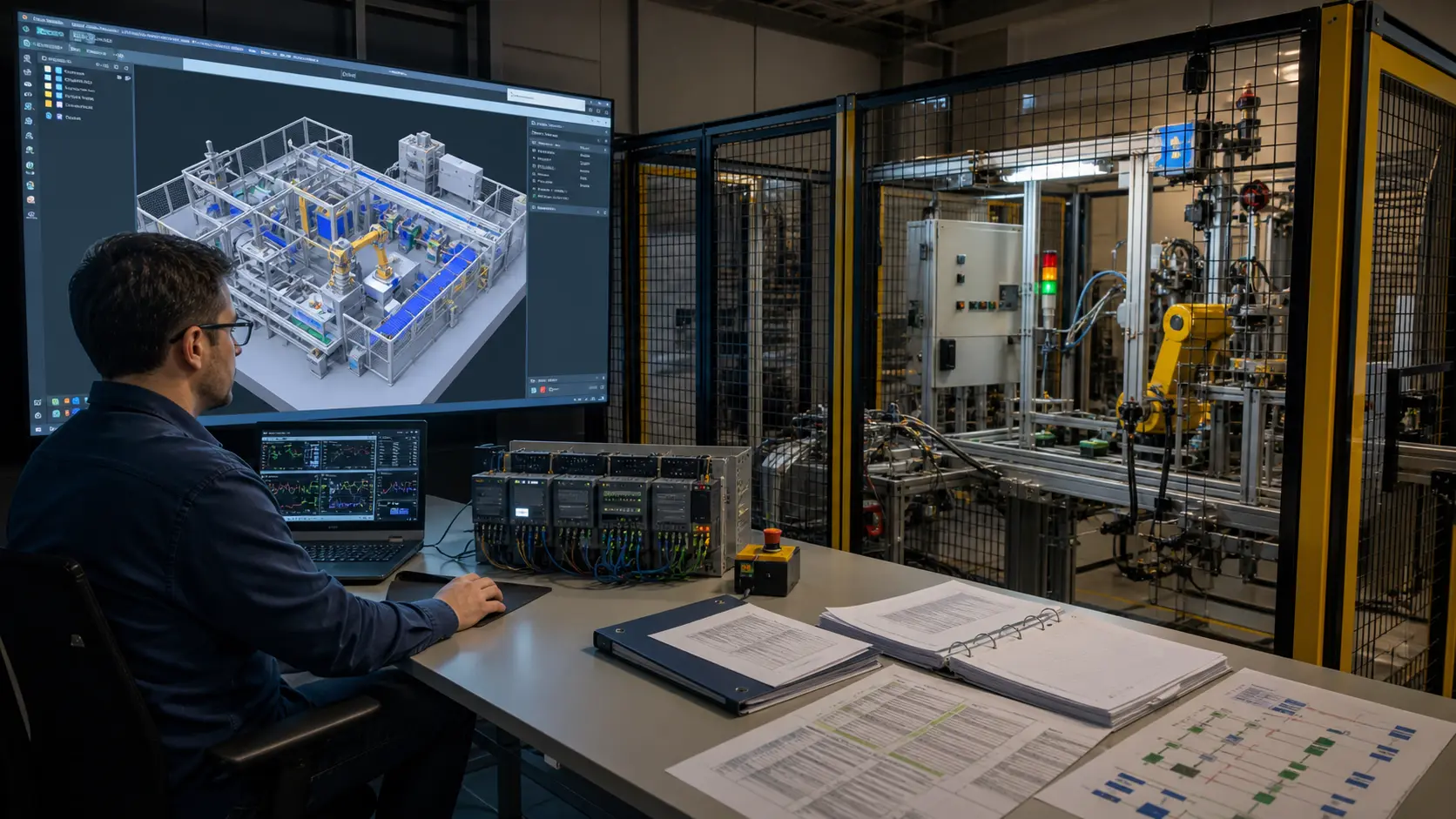
a controls engineer comparing a plant simulation model, physical training cell, PLC evidence and versioned test records while studying deterministic PLC scenario acceptance tests
The scene keeps deterministic PLC scenario acceptance tests attached to declared conditions, observable results, diagnostic boundaries and evidence another person can reproduce.

System map / 02

Six concepts that control the result

Treat these as connected checkpoints. Each checkpoint has an expected state, an observable state and a boundary to the next part of the system. That structure prevents a software indication from being mistaken for physical proof.

NODE 01observable

Define the operating contract

requirement, initial state, reset behavior, timed stimulus, observed tags, modeled machine state, tolerance, timeout, pass rule, diagnostics and repeatability. For deterministic PLC scenario acceptance tests, record the initial condition, actor, requested change, observable result and stopping condition before selecting a tool or implementation.

NODE 02observable

Map the evidence path

scenario reset through program load and scans, input actions, modeled process response, assertions, failure output and retained attempt evidence. Separate request, internal state, output or service, physical or user-visible result and independent feedback so each boundary can be inspected.

NODE 03observable

Prove normal operation

one normal and one stop case repeated from fresh state with identical pass results. Run more than one cycle from a known state and retain the values, timings or artifacts that demonstrate repeatability.

NODE 04observable

Exercise a boundary case

stimulus before boundary, exactly at boundary, after boundary, simultaneous actions, invalid input, timeout, restart and nondeterministic state leak. Choose minimum, maximum, simultaneous, delayed or restart conditions that reveal assumptions hidden by the happy path.

NODE 05observable

Diagnose a controlled fault

a requirement, reset, timing, stimulus, tag, model, tolerance, assertion, diagnostic or state-isolation mismatch. Preserve the first symptom, divide the system at a measurable boundary and change one condition only after predicting the result.

NODE 06observable

Transfer and hand over

cases versioned with scenario behavior and replicated on target equipment where commissioning truth is required. Restore normal state, remove temporary changes, repeat affected checks and document which claims remain limited to the learning environment.

Procedure / 03

A six-step practice and commissioning workflow

Run the steps in order the first time. Later, the same structure becomes a diagnostic loop: define the expected condition, observe the boundary, interpret the difference and choose one proving action.

  1. 01

    Write the acceptance case

    Convert requirement, initial state, reset behavior, timed stimulus, observed tags, modeled machine state, tolerance, timeout, pass rule, diagnostics and repeatability into initial conditions, one stimulus and observable pass criteria.

    Evidence: Another person can repeat the case without guessing the intended result.

    Avoid: Using page completion or an animation as the acceptance criterion.

  2. 02

    Build the map

    Document scenario reset through program load and scans, input actions, modeled process response, assertions, failure output and retained attempt evidence and name who owns each state or decision.

    Evidence: Every request and result has a source, destination and useful inspection point.

    Avoid: Using the same value as command, status and independent feedback.

  3. 03

    Run the baseline

    Apply one normal and one stop case repeated from fresh state with identical pass results from a clean start and record the expected evidence.

    Evidence: Repeated runs produce the same bounded result.

    Avoid: Changing several parameters before a baseline exists.

  4. 04

    Challenge assumptions

    Test stimulus before boundary, exactly at boundary, after boundary, simultaneous actions, invalid input, timeout, restart and nondeterministic state leak without changing the acceptance contract.

    Evidence: Limits, timing and restart behavior reach defined states.

    Avoid: Testing only one ideal sequence.

  5. 05

    Isolate one failure

    Introduce or analyse a requirement, reset, timing, stimulus, tag, model, tolerance, assertion, diagnostic or state-isolation mismatch and locate the first disagreement.

    Evidence: The proving action distinguishes the leading hypotheses.

    Avoid: Resetting, forcing or replacing before evidence is retained.

  6. 06

    Close the evidence loop

    Complete cases versioned with scenario behavior and replicated on target equipment where commissioning truth is required and repeat the affected regression cases.

    Evidence: Reference use is complete when inputs, assumptions, units or initial conditions are recorded and the result is independently checked at a useful boundary.

    Avoid: Treating an acknowledged message or one successful rerun as handover.

Diagnostic matrix / 04

Symptoms, proving points and next actions

The table is a reasoning aid, not a parts-replacement chart. Preserve the initial symptom, inspect the named boundary and use the interpretation to choose the next controlled test. Site safety procedures and equipment manuals remain authoritative.

Diagnostic symptoms, inspection points, interpretations and next actions for PLC scenario test-harness documentation: implementation, evidence and troubleshooting
Observed symptomInspectInterpretationNext proving action
The expected result is unclearRequirement, initial state, actor, stimulus, units and pass conditionThe technician, programmer and reviewer may be solving different versions of the task.Rewrite one observable acceptance case before continuing.
Internal state changes but the outcome does notRequest, final owner, output or service boundary and independent feedbackA software or interface indication proves intent at one layer, not the complete outcome.Trace the first boundary after the changing state.
Normal case passes but an edge case failsLimits, timing, simultaneous events, reset and restart assumptionsThe implementation contains a hidden assumption exposed by the changed condition.Add the failed boundary as a permanent regression case.
The failure disappears after resetOriginal symptom, histories, diagnostics, timestamps and active causeReset changed evidence or state without proving the initiating cause.Reproduce under a controlled condition and preserve pre/post-event data.
Simulator and target disagreeModel boundary, software version, task timing, I/O behavior, data types and configurationA learning model and the intended target do not share one of the recorded assumptions.Reduce the case and verify against current target documentation.
The result cannot be explainedPrediction, observation, proving action, alternative hypotheses and limitationsActivity occurred but the evidence is not yet transferable or reviewable.Have the learner defend the signal path and repeat a changed case.

Product evidence / 05

What the browser practice can actually demonstrate

The page connects definitions and worked examples to runnable tools, explicit assumptions and repeatable checks so a formula or pattern can be challenged.

Where simulation stops

The public harness verifies the modeled runtime and scenario contract; it does not validate target firmware, physical I/O, safety, equipment performance or production commissioning.

Commissioning notebook / 06

Six cases that turn the concepts into evidence

Use these as written briefs rather than click-through instructions. For every case, state the expected condition before acting, retain the first useful observation and explain why the final result proves the requirement. A different program or component choice can still be correct when it produces the same bounded behavior and evidence.

Case 01

predict → observe → prove

Prove define the operating contract

Engineering context. requirement, initial state, reset behavior, timed stimulus, observed tags, modeled machine state, tolerance, timeout, pass rule, diagnostics and repeatability. For deterministic PLC scenario acceptance tests, record the initial condition, actor, requested change, observable result and stopping condition before selecting a tool or implementation. Begin with a written normal condition and identify which request, state, physical result or communication value will provide independent confirmation. Do not begin by changing the configuration; the initial state is part of the evidence and should remain reproducible.

Controlled setup. Use the “Write the acceptance case” stage of the workflow: convert requirement, initial state, reset behavior, timed stimulus, observed tags, modeled machine state, tolerance, timeout, pass rule, diagnostics and repeatability into initial conditions, one stimulus and observable pass criteria. The acceptance record should show this result: another person can repeat the case without guessing the intended result. Record initial conditions, the exact stimulus and the observation point so another learner can repeat the case without relying on your memory.

Fault challenge. Introduce or analyse “The expected result is unclear” as one bounded deviation. Inspect requirement, initial state, actor, stimulus, units and pass condition The working interpretation is that the technician, programmer and reviewer may be solving different versions of the task. The next proving action is to rewrite one observable acceptance case before continuing. Change only one condition before observing the result, and preserve timestamps or measurements where timing matters.

Review and recovery. The most common trap here is using page completion or an animation as the acceptance criterion. After restoring the cause, repeat the normal case and at least one stop, timeout, disconnect or restart boundary relevant to this topic. Remove temporary forces and bypasses, return the model to a known state and retain the evidence that both operation and recovery are deliberate.

Explain it aloud: What is a PLC test harness? A defensible short answer is: It is a controlled runner that establishes initial state, applies defined inputs over time and checks observable program and machine results.

Case 02

predict → observe → prove

Prove map the evidence path

Engineering context. scenario reset through program load and scans, input actions, modeled process response, assertions, failure output and retained attempt evidence. Separate request, internal state, output or service, physical or user-visible result and independent feedback so each boundary can be inspected. Begin with a written normal condition and identify which request, state, physical result or communication value will provide independent confirmation. Do not begin by changing the configuration; the initial state is part of the evidence and should remain reproducible.

Controlled setup. Use the “Build the map” stage of the workflow: document scenario reset through program load and scans, input actions, modeled process response, assertions, failure output and retained attempt evidence and name who owns each state or decision. The acceptance record should show this result: every request and result has a source, destination and useful inspection point. Record initial conditions, the exact stimulus and the observation point so another learner can repeat the case without relying on your memory.

Fault challenge. Introduce or analyse “Internal state changes but the outcome does not” as one bounded deviation. Inspect request, final owner, output or service boundary and independent feedback The working interpretation is that a software or interface indication proves intent at one layer, not the complete outcome. The next proving action is to trace the first boundary after the changing state. Change only one condition before observing the result, and preserve timestamps or measurements where timing matters.

Review and recovery. The most common trap here is using the same value as command, status and independent feedback. After restoring the cause, repeat the normal case and at least one stop, timeout, disconnect or restart boundary relevant to this topic. Remove temporary forces and bypasses, return the model to a known state and retain the evidence that both operation and recovery are deliberate.

Explain it aloud: Why reset before every PLC test? A defensible short answer is: A clean reset prevents retained state or a prior case from changing the outcome and makes failures reproducible.

Case 03

predict → observe → prove

Prove prove normal operation

Engineering context. one normal and one stop case repeated from fresh state with identical pass results. Run more than one cycle from a known state and retain the values, timings or artifacts that demonstrate repeatability. Begin with a written normal condition and identify which request, state, physical result or communication value will provide independent confirmation. Do not begin by changing the configuration; the initial state is part of the evidence and should remain reproducible.

Controlled setup. Use the “Run the baseline” stage of the workflow: apply one normal and one stop case repeated from fresh state with identical pass results from a clean start and record the expected evidence. The acceptance record should show this result: repeated runs produce the same bounded result. Record initial conditions, the exact stimulus and the observation point so another learner can repeat the case without relying on your memory.

Fault challenge. Introduce or analyse “Normal case passes but an edge case fails” as one bounded deviation. Inspect limits, timing, simultaneous events, reset and restart assumptions The working interpretation is that the implementation contains a hidden assumption exposed by the changed condition. The next proving action is to add the failed boundary as a permanent regression case. Change only one condition before observing the result, and preserve timestamps or measurements where timing matters.

Review and recovery. The most common trap here is changing several parameters before a baseline exists. After restoring the cause, repeat the normal case and at least one stop, timeout, disconnect or restart boundary relevant to this topic. Remove temporary forces and bypasses, return the model to a known state and retain the evidence that both operation and recovery are deliberate.

Explain it aloud: What should I learn first about deterministic PLC scenario acceptance tests? A defensible short answer is: Start with the operating contract and evidence path: requirement, initial state, reset behavior, timed stimulus, observed tags, modeled machine state, tolerance, timeout, pass rule, diagnostics and repeatability, followed by scenario reset through program load and scans, input actions, modeled process response, assertions, failure output and retained attempt evidence. Add advanced features only after the baseline is predictable.

Case 04

predict → observe → prove

Prove exercise a boundary case

Engineering context. stimulus before boundary, exactly at boundary, after boundary, simultaneous actions, invalid input, timeout, restart and nondeterministic state leak. Choose minimum, maximum, simultaneous, delayed or restart conditions that reveal assumptions hidden by the happy path. Begin with a written normal condition and identify which request, state, physical result or communication value will provide independent confirmation. Do not begin by changing the configuration; the initial state is part of the evidence and should remain reproducible.

Controlled setup. Use the “Challenge assumptions” stage of the workflow: test stimulus before boundary, exactly at boundary, after boundary, simultaneous actions, invalid input, timeout, restart and nondeterministic state leak without changing the acceptance contract. The acceptance record should show this result: limits, timing and restart behavior reach defined states. Record initial conditions, the exact stimulus and the observation point so another learner can repeat the case without relying on your memory.

Fault challenge. Introduce or analyse “The failure disappears after reset” as one bounded deviation. Inspect original symptom, histories, diagnostics, timestamps and active cause The working interpretation is that reset changed evidence or state without proving the initiating cause. The next proving action is to reproduce under a controlled condition and preserve pre/post-event data. Change only one condition before observing the result, and preserve timestamps or measurements where timing matters.

Review and recovery. The most common trap here is testing only one ideal sequence. After restoring the cause, repeat the normal case and at least one stop, timeout, disconnect or restart boundary relevant to this topic. Remove temporary forces and bypasses, return the model to a known state and retain the evidence that both operation and recovery are deliberate.

Explain it aloud: How do I practise deterministic PLC scenario acceptance tests effectively? A defensible short answer is: Use short cases with known initial conditions, a written prediction, one action and an observable result. Then alter a boundary or fault and explain why the evidence changed.

Case 05

predict → observe → prove

Prove diagnose a controlled fault

Engineering context. a requirement, reset, timing, stimulus, tag, model, tolerance, assertion, diagnostic or state-isolation mismatch. Preserve the first symptom, divide the system at a measurable boundary and change one condition only after predicting the result. Begin with a written normal condition and identify which request, state, physical result or communication value will provide independent confirmation. Do not begin by changing the configuration; the initial state is part of the evidence and should remain reproducible.

Controlled setup. Use the “Isolate one failure” stage of the workflow: introduce or analyse a requirement, reset, timing, stimulus, tag, model, tolerance, assertion, diagnostic or state-isolation mismatch and locate the first disagreement. The acceptance record should show this result: the proving action distinguishes the leading hypotheses. Record initial conditions, the exact stimulus and the observation point so another learner can repeat the case without relying on your memory.

Fault challenge. Introduce or analyse “Simulator and target disagree” as one bounded deviation. Inspect model boundary, software version, task timing, I/O behavior, data types and configuration The working interpretation is that a learning model and the intended target do not share one of the recorded assumptions. The next proving action is to reduce the case and verify against current target documentation. Change only one condition before observing the result, and preserve timestamps or measurements where timing matters.

Review and recovery. The most common trap here is resetting, forcing or replacing before evidence is retained. After restoring the cause, repeat the normal case and at least one stop, timeout, disconnect or restart boundary relevant to this topic. Remove temporary forces and bypasses, return the model to a known state and retain the evidence that both operation and recovery are deliberate.

Explain it aloud: What counts as proof of competence? A defensible short answer is: A repeatable artifact or system result plus an explanation of the signal path is stronger than time spent, screenshots or a copied answer. Physical competence requires separate supervised evidence.

Case 06

predict → observe → prove

Prove transfer and hand over

Engineering context. cases versioned with scenario behavior and replicated on target equipment where commissioning truth is required. Restore normal state, remove temporary changes, repeat affected checks and document which claims remain limited to the learning environment. Begin with a written normal condition and identify which request, state, physical result or communication value will provide independent confirmation. Do not begin by changing the configuration; the initial state is part of the evidence and should remain reproducible.

Controlled setup. Use the “Close the evidence loop” stage of the workflow: complete cases versioned with scenario behavior and replicated on target equipment where commissioning truth is required and repeat the affected regression cases. The acceptance record should show this result: reference use is complete when inputs, assumptions, units or initial conditions are recorded and the result is independently checked at a useful boundary. Record initial conditions, the exact stimulus and the observation point so another learner can repeat the case without relying on your memory.

Fault challenge. Introduce or analyse “The result cannot be explained” as one bounded deviation. Inspect prediction, observation, proving action, alternative hypotheses and limitations The working interpretation is that activity occurred but the evidence is not yet transferable or reviewable. The next proving action is to have the learner defend the signal path and repeat a changed case. Change only one condition before observing the result, and preserve timestamps or measurements where timing matters.

Review and recovery. The most common trap here is treating an acknowledged message or one successful rerun as handover. After restoring the cause, repeat the normal case and at least one stop, timeout, disconnect or restart boundary relevant to this topic. Remove temporary forces and bypasses, return the model to a known state and retain the evidence that both operation and recovery are deliberate.

Explain it aloud: Why test faults and restart behavior? A defensible short answer is: Because a requirement, reset, timing, stimulus, tag, model, tolerance, assertion, diagnostic or state-isolation mismatch or stimulus before boundary, exactly at boundary, after boundary, simultaneous actions, invalid input, timeout, restart and nondeterministic state leak can expose assumptions that never appear during ideal startup and steady operation.

Answer surface / 07

Questions people ask about PLC scenario test-harness documentation

These concise answers define the operating, training and product boundaries most often missed in broad summaries. The full workflow and diagnostic table above provide the evidence behind them.

What is a PLC test harness?

It is a controlled runner that establishes initial state, applies defined inputs over time and checks observable program and machine results.

Why reset before every PLC test?

A clean reset prevents retained state or a prior case from changing the outcome and makes failures reproducible.

What should I learn first about deterministic PLC scenario acceptance tests?

Start with the operating contract and evidence path: requirement, initial state, reset behavior, timed stimulus, observed tags, modeled machine state, tolerance, timeout, pass rule, diagnostics and repeatability, followed by scenario reset through program load and scans, input actions, modeled process response, assertions, failure output and retained attempt evidence. Add advanced features only after the baseline is predictable.

How do I practise deterministic PLC scenario acceptance tests effectively?

Use short cases with known initial conditions, a written prediction, one action and an observable result. Then alter a boundary or fault and explain why the evidence changed.

What counts as proof of competence?

A repeatable artifact or system result plus an explanation of the signal path is stronger than time spent, screenshots or a copied answer. Physical competence requires separate supervised evidence.

Why test faults and restart behavior?

Because a requirement, reset, timing, stimulus, tag, model, tolerance, assertion, diagnostic or state-isolation mismatch or stimulus before boundary, exactly at boundary, after boundary, simultaneous actions, invalid input, timeout, restart and nondeterministic state leak can expose assumptions that never appear during ideal startup and steady operation.

Can browser practice replace official software or hardware?

No. It can build concepts and diagnostic reasoning. Exact firmware, I/O electrical behavior, networking, safety and commissioning require current official tools, documentation and target equipment.

How should progress be documented?

Keep the requirement, initial state, program or configuration, observed values, fault hypothesis, proving action, recovery result and a concise limitations statement.