TL;DR: SCADA (Supervisory Control and Data Acquisition) supervises industrial processes — manufacturing lines, pipelines, power grids — collecting data from PLCs and RTUs over Modbus, EtherNet/IP, or DNP3. A BMS (Building Management System) supervises mechanical and electrical services inside a building — HVAC, lighting, access control, fire detection — collecting data from controllers over BACnet or LonWorks. Both display live data, manage alarms, and log history, but they target different equipment types, run on different protocols, and serve very different operators.
Controls engineers moving between industrial and commercial projects frequently encounter both systems and assume they are interchangeable. They are not. A SCADA package tuned for refinery process control and a BMS tuned for HVAC scheduling are both "supervisory" software but optimized for entirely different physics, time scales, and operator workflows.
What SCADA Does
SCADA stands for Supervisory Control and Data Acquisition. It collects real-time data from PLCs and RTUs spread across a site or region, displays it to operators, logs it historically, and allows supervisory commands — setpoint changes, mode switches, remote start/stop — without executing control logic itself.
SCADA targets process and manufacturing industries: oil and gas pipelines, water treatment, power generation, chemical plants, discrete manufacturing. Equipment is controlled by PLCs or RTUs; SCADA provides the operator window and the historian above them.
SCADA characteristics
- Protocols: Modbus TCP, EtherNet/IP, PROFINET, DNP3, OPC UA — industrial protocols with documented register maps.
- Scan rate: 1–5 seconds for most process values, sub-second for critical alarms.
- Historian: high-volume time-series data — millions of tag values per day across a large plant.
- Control: supervisory only — SCADA writes setpoints and commands to PLC tags; the PLC validates logic and safety interlocks.
- Users: process operators, control room engineers, maintenance technicians.
- Uptime target: 24/7 continuous — unplanned shutdown of a refinery or power station is expensive.
What a BMS Does
A BMS (Building Management System) — sometimes called a Building Automation System (BAS) — monitors and controls mechanical and electrical services inside a building: HVAC (heating, ventilation, air conditioning), chiller plants, boiler rooms, electrical distribution, lighting, access control, and fire alarm integration.
Building controllers — DDC (Direct Digital Control) units — sit inside air handling units, VAV boxes, chiller panels, and lighting circuits, running setpoint loops and schedules locally. The BMS server sits above them, providing centralized monitoring, alarm management, and energy reporting.
BMS characteristics
- Protocols: BACnet MS/TP (RS-485 serial), BACnet/IP (Ethernet), LonWorks, Modbus RTU for legacy plant.
- Scan rate: 30 seconds to 5 minutes for most HVAC values — temperature and damper position do not need 1-second polling.
- Scheduling: time-of-day and calendar schedules for occupancy, lighting setback, and HVAC pre-conditioning.
- Energy monitoring: kWh consumption, demand trending, energy dashboards — often tied to billing and sustainability targets.
- Users: facilities managers, building operators, energy managers.
- Uptime target: business hours critical; tolerance for planned maintenance windows during unoccupied periods.
Side-by-Side Comparison
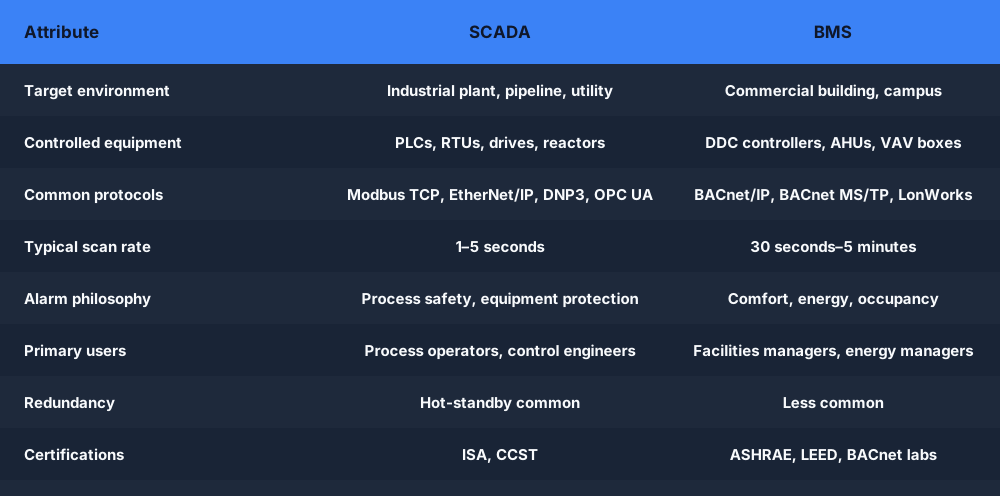
| SCADA | BMS | |
|---|---|---|
| Target environment | Industrial plant, pipeline, utility | Commercial building, data center, campus |
| Controlled equipment | PLCs, RTUs, drives, pumps, reactors | DDC controllers, AHUs, chillers, VAV boxes |
| Common protocols | Modbus TCP, EtherNet/IP, DNP3, OPC UA | BACnet/IP, BACnet MS/TP, LonWorks, KNX |
| Typical scan rate | 1–5 seconds | 30 seconds–5 minutes |
| Control capability | Supervisory commands to PLCs | Setpoint and schedule changes to DDC |
| Historian depth | High volume, all process values | Selected points, energy trends |
| Alarm philosophy | Process safety, equipment protection | Comfort, energy efficiency, occupancy |
| Primary users | Process operators, control engineers | Facilities managers, energy managers |
| Certifications | ISA, CCST | ASHRAE, LEED, BACnet testing labs |
| Redundancy | Hot-standby common in critical applications | Less common; scheduled maintenance windows |
BACnet — the BMS Protocol SCADA Engineers Encounter
BACnet (Building Automation and Control Networks) is the protocol equivalent of Modbus in the building world. It is an open ASHRAE/ISO/IEC standard designed specifically for HVAC and building services.
BACnet objects
BACnet uses an object model rather than register maps. A BACnet device exposes a list of objects — Analog Input, Analog Output, Binary Input, Binary Value, Schedule, Calendar, Trend Log — each with properties (Present Value, Description, Units, Out of Service).
Compared to Modbus registers, BACnet objects are self-describing: an engineer with a BACnet browser can discover device objects and their units without a register map. The tradeoff is that BACnet is more complex to implement than Modbus.
BACnet MS/TP vs BACnet/IP
| BACnet MS/TP | BACnet/IP | |
|---|---|---|
| Physical layer | RS-485 serial | Ethernet |
| Speed | 9600–76800 baud | 10/100 Mbit |
| Token passing | Yes — master-slave/token-passing bus | No — uses IP broadcast/unicast |
| Where found | DDC field controllers, VAV boxes | Supervisor workstations, router/gateway devices |
In a typical BMS, BACnet MS/TP runs from the field controller to a router, and BACnet/IP runs from the router to the BMS server. The architecture parallels Modbus RTU field devices connected through a Modbus TCP gateway.
Decision Guide
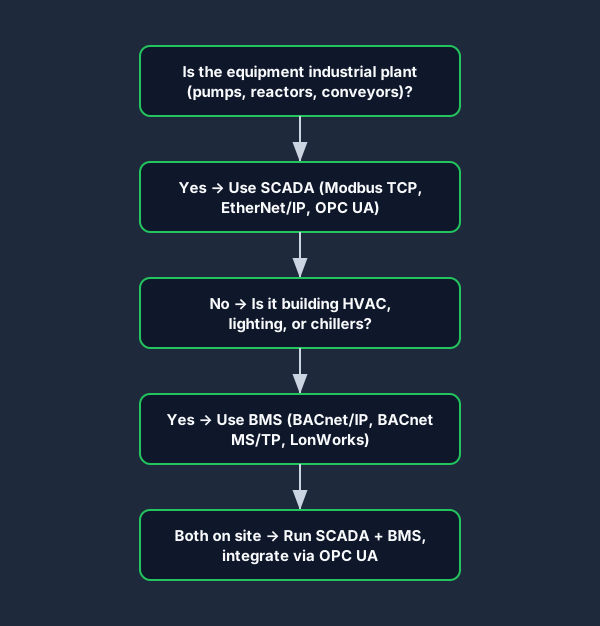
Use SCADA when:
- You are supervising industrial equipment — pumps, compressors, reactors, conveyors — controlled by PLCs or RTUs.
- Your devices speak Modbus, EtherNet/IP, PROFINET, or DNP3.
- You need sub-5-second scan rates for process safety.
- Regulatory requirements demand process historian and audit trails (OSHA, EPA, ISA-18.2 alarm management).
Use a BMS when:
- You are supervising mechanical and electrical building services — HVAC, chillers, boilers, lighting.
- Your controllers speak BACnet, LonWorks, or KNX.
- Scheduling, occupancy setback, and energy dashboards are primary requirements.
- Your client has LEED, BREEAM, or ISO 50001 energy management obligations.
Use both when:
- A facility has both an industrial production area (SCADA) and commercial building services (BMS) — a pharmaceutical manufacturing plant with GMP process areas and an office/lab building, for example.
- Integration between them is typically via OPC UA or a shared Modbus/BACnet gateway — the SCADA reads selected BMS energy points for energy-to-production reporting.
Where the Lines Blur
Data centers are the clearest example of overlap. A data center has critical mechanical plant (cooling towers, precision air conditioning, UPS) that needs industrial-grade monitoring and BACnet-speaking building controllers — so many data center operators run a SCADA layer above a BACnet BMS, with OPC UA as the integration bridge.
Hospitals follow a similar pattern: the building services wing uses BACnet for HVAC, but medical gas monitoring and steriliser control use industrial PLCs and SCADA.
Frequently Asked Questions
Q: Is a BMS the same as a SCADA system?
A: No. Both are supervisory systems but optimized for different domains. SCADA targets industrial processes (manufacturing, utilities, pipelines) and integrates with PLCs and RTUs over industrial protocols. A BMS targets building mechanical and electrical services and integrates with DDC controllers over BACnet or LonWorks. The alarm philosophies, scan rates, historian requirements, and user profiles differ significantly.
Q: Can SCADA software read BACnet devices?
A: Many modern SCADA platforms — Ignition, Wonderware, AVEVA — have BACnet drivers or OPC UA integration that can pull BACnet points. This is common in facilities that need to combine industrial process data and building energy data in one dashboard. A BACnet/IP driver is typically an add-on license rather than standard equipment.
Q: What protocol does a BMS use?
A: BACnet is the dominant open standard — BACnet/IP over Ethernet for supervisory communication and BACnet MS/TP over RS-485 for field devices. LonWorks is an older standard found in large campuses. KNX is common in European commercial buildings, particularly for lighting and shading. Modbus RTU is widely used for energy meters and chillers as a legacy or cost-driven alternative.
Q: Does a BMS use PLCs?
A: Traditional BMS uses DDC (Direct Digital Control) controllers — purpose-built building controllers from vendors like Honeywell, Johnson Controls, Siemens Building Technologies, and Schneider. Some industrial buildings and critical facilities use PLCs (Allen-Bradley, Siemens) as the field controller layer with SCADA above — this is more common in pharmaceutical, food, and data center projects where engineering teams have stronger PLC than DDC expertise.
Q: What is the difference between BMS and EMS?
A: A BMS covers all building services — HVAC, lighting, access, fire integration. An EMS (Energy Management System) focuses specifically on energy consumption monitoring, demand management, and reduction targets. An EMS is typically a module within or above the BMS, pulling electrical and thermal meter data and presenting it as energy dashboards, peak demand alerts, and carbon reporting.
Practice Modbus communication — the protocol used to connect BMS energy meters and many building plant items to supervisory systems — with the Modbus register read scenario. The RS-485 wiring lab covers the physical layer that BACnet MS/TP and Modbus RTU both depend on.
