Register notation is not the wire address
A manual may label a holding register 40001, but the Modbus application data unit normally carries address 0. Confirm whether a vendor table is one-based or zero-based before blaming the network.
Run real Modbus request exercises before you connect a PLC, drive or meter.
First challenge
Read two holding registers
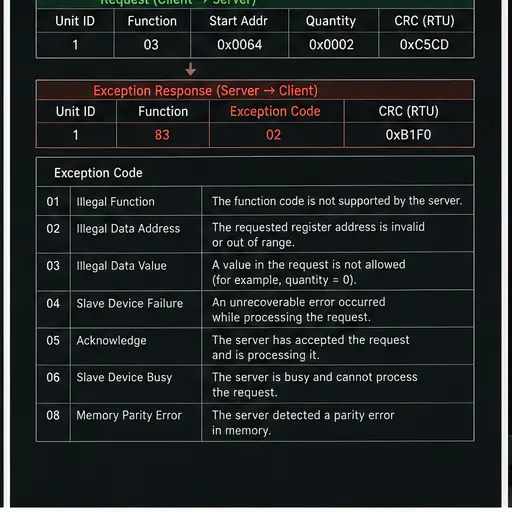
Poll unit 1 for the first two holding registers using the protocol data address.
Watch the real browser product respond to the task on this page, then try the same practical workflow yourself. No slides, concept mockups, install, or credit card.
Try this in the browserRead the request from wire to application
Modbus troubleshooting becomes predictable when you separate transport, unit identity, function, protocol address, data representation and application behavior. These views follow the same sequence used in the interactive workbench.
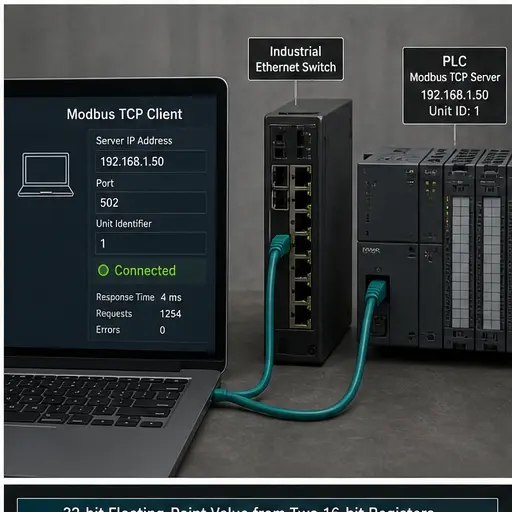
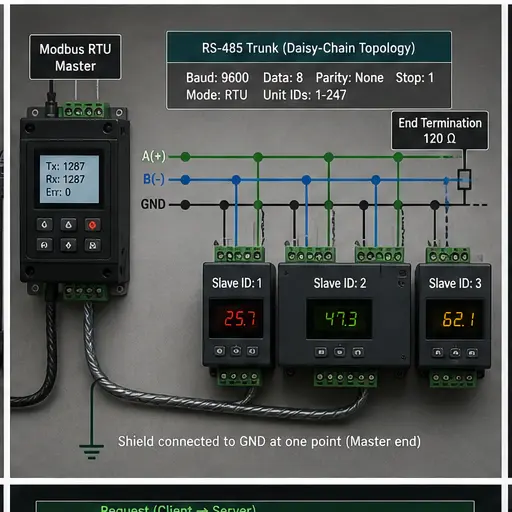
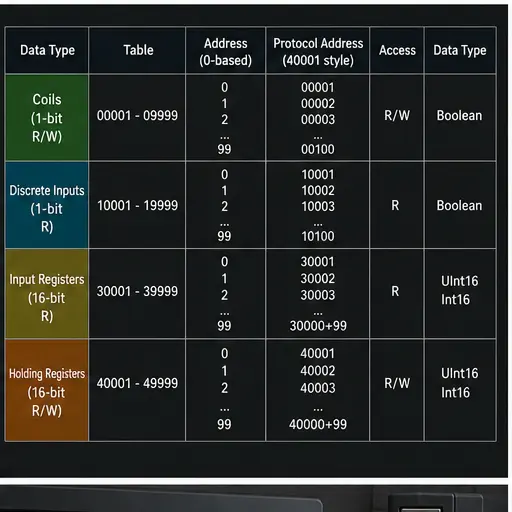
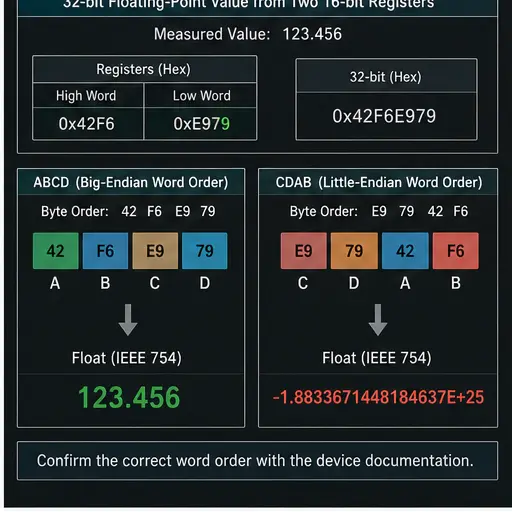
Interactive request lab
Poll unit 1 for the first two holding registers using the protocol data address.
The backend calculates the expected result and returns individual checks, a score and reproducible evidence. Client-supplied scores are ignored.
Your run is free. Keep the evidence when it matters.
Create an account only when you want saved attempts, projects, sharing and progress.
Training outcomes
Each run teaches a transferable industrial workflow and produces evidence you can inspect, repeat and discuss.
Translate 4xxxx register notation into the zero-based address carried on the wire.
Choose function 03, 06 and exception responses without vendor-specific software.
Save a register-map fixture, share it with a class and fork a colleague’s setup.
Build evidence from graded attempts instead of relying on a self-marked worksheet.
Field method
A manual may label a holding register 40001, but the Modbus application data unit normally carries address 0. Confirm whether a vendor table is one-based or zero-based before blaming the network.
Prove the unit ID, function, address and quantity with the smallest possible poll. Expand the block only after the device returns a normal response.
An exception response is useful evidence. Function 83 with code 02 means the device understood a function-03 request but the requested address range was not mapped.
Continue from a single exercise to a complete training record.
Guided scenarios, saved progress, fault diagnosis and instructor reporting are built into the main platform.
Technical practice library
Each reference explains a distinct industrial task and links back to an exact grader preset with server-owned acceptance evidence.
Variable-frequency drive
Compose a Modbus request for a VFD output-frequency holding register and verify the zero-based address and quantity.
Energy meter
Build a two-register input-register poll for a 32-bit energy-meter value and retain word-order evidence.
Panel temperature controller
Compose a function-03 poll for a scaled temperature process value at protocol address 200.
Remote-I/O coupler
Build a packed 16-coil function-01 poll and verify the bit quantity and zero-based start address.
Remote-I/O digital-input module
Compose a Modbus function-02 request for 16 read-only remote-I/O inputs and verify the address, quantity and packed-bit evidence.
Pump controller
Encode an ON command as FF00 for a documented pump run coil and verify the function-05 request.
Temperature controller
Compose a single-register setpoint write and preserve the distinction between engineering units and the scaled register value.
Alarm annunciator
Build a packed eight-coil function-15 write and check quantity, byte count and ownership boundaries.
Technical review
Reviewed 7 August 2026. The simulator teaches a repeatable training method; always use the exact module and instrument manuals for live commissioning work.
Industrial communications field guide
Direct answer
Modbus simulator is learned by making the data contract explicit: client request, server response, unit identifier, function code, starting address, quantity and data. Successful packets are not enough; verify that coils, discrete inputs, input registers and holding registers represent the intended engineering state and that loss, stale data and recovery produce defined application behavior.
This guide is written for controls technicians and engineers commissioning controller-to-device or controller-to-software communications. The intended result is specific: the learner can separate physical link, network identity, transport/session, protocol request, data mapping and application behavior, then find the first failing layer.
Name each endpoint and which side initiates, serves, produces or consumes data within client request, server response, unit identifier, function code, starting address, quantity and data.
Prove the exact endpoint and device identity before debugging the payload.
Map coils, discrete inputs, input registers and holding registers into typed engineering tags with direction, units and ownership.
Document cyclic, polled, subscribed or event behavior plus timing and timeout.
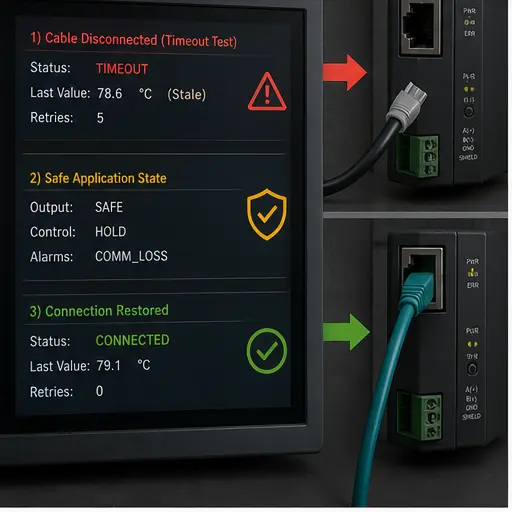
A value needs freshness and communication state; last-known data must not masquerade as current truth.
Test disconnect, restart, reconnection, resubscription or connection establishment and application safe response.
Name endpoints, switches, media, addressing and ownership.
Evidence: The intended path is unambiguous.
Avoid: Beginning with random software settings.
Check power, link, media, topology and port state.
Evidence: Basic connectivity is proven.
Avoid: Treating a link light as application success.
Confirm address, name, device/revision and endpoint role.
Evidence: The configuration targets the intended device.
Avoid: Connecting to the wrong but reachable endpoint.
Compare client request, server response, unit identifier, function code, starting address, quantity and data at both ends.
Evidence: Direction, size and identifiers agree.
Avoid: Changing multiple fields simultaneously.
Operate one real or simulated input and map coils, discrete inputs, input registers and holding registers.
Evidence: The expected tag changes with correct type and units.
Avoid: Accepting a successful status with wrong data.
Disconnect deliberately under an approved test and restore.
Evidence: Timeout, safe state, stale indication and recovery pass.
Avoid: Testing only startup success.
| Observed symptom | Inspect | Interpretation | Next proving action |
|---|---|---|---|
| No physical link | Power, media, connector, switch and port state | The failure is below protocol configuration. | Restore link first. |
| Reachable but no session/connection | Endpoint role, identity, security or connection parameters | Network path works while protocol establishment fails. | Read exact status and logs. |
| Protocol exception or reject | Function/service, object/address and client request, server response, unit identifier, function code, starting address, quantity and data | The peer understood enough to reject a request. | Use the returned diagnostic. |
| Data changes but is wrong | Type, direction, byte/word mapping, scale and coils, discrete inputs, input registers and holding registers | Transport succeeds while interpretation fails. | Compare a known pattern. |
| Intermittent timeout | Load, update rate, topology, errors and resource limits | Timing margin or physical quality may be unstable. | Capture counters and timestamps. |
| Reconnect leaves stale state | Timeout policy, quality, resubscription/reconnection and application state | Communication returned without restoring the data contract. | Test complete recovery sequence. |
Product evidence / 05
The public training surface provides vendor-neutral diagrams, mapping examples, staged diagnostics and links into related browser labs without claiming wire-level conformance.
Start with roles and the exact data contract: client request, server response, unit identifier, function code, starting address, quantity and data.
No. Verify direction, type, scale, units, quality and physical meaning.
Move layer by layer from physical link and identity through protocol status, mapping and application behavior.
It is a previously valid value that is no longer being updated within the required freshness contract.
No. Preserve evidence and identify physical, load, configuration or processing causes before masking them.
No. It teaches concepts and diagnosis; formal conformance needs approved specifications and test programs.
Real systems lose links. The control response, indication and recovery are part of the design.
Topology, identities, configuration, mapped points, timing baseline, fault response and recovery results.
Industrial communications path
Choose the physical layer, frame the request, inspect the mapped data and diagnose exception evidence in one connected sequence.