PLC Simulator
RealPars comparison

RealPars vs Hands-On PLC Practice — An Honest Comparison

RealPars is one of the best video-course platforms in industrial automation. We are a browser-based simulator with auto-graded scenarios. Different tools for different halves of the same skill — here is the honest breakdown, including why many learners use both.

Join 9900+ learners practicing PLC programming

Opening honesty

RealPars is legitimately good at what it does.

Over a million people subscribe to the RealPars YouTube channel, and the production quality of their paid courses is the best in the niche. If you want a working engineer to walk you through how a VFD works or what a Siemens hardware configuration looks like, RealPars is a genuinely strong choice. This page is not about talking you out of that — it is about what video alone cannot do, and where hands-on practice fits.

Background

What RealPars is

RealPars is a subscription video-course platform for industrial automation, built around years of polished instructional video. The membership includes 120+ courses, weekly live classes, a learner community, and completion certificates, covering topics across Siemens, Allen-Bradley, Omron, CODESYS, instrumentation, and more. Alongside the paid platform, RealPars runs one of the largest free PLC education channels on YouTube, with over a million subscribers and hundreds of free tutorial videos.

Pricing (as of June 2026, per realpars.com): $60/month billed monthly, or $50/month billed annually (~$600/year), with a 7-day free trial. A separate per-seat business membership exists for teams.

What the membership does not bundle is a practice environment. RealPars teaches through video; when a course needs software to demonstrate, it uses vendor tools (TIA Portal, Connected Components Workbench, Sysmac Studio) or third-party simulators like Factory I/O — which you install and license separately.

Strengths

What RealPars does well

Best-in-class video instruction

Professionally scripted, animated, and narrated lessons that make hard concepts — PID, fieldbuses, drive parameters — genuinely easy to follow. Nobody in the niche produces clearer explainer video.

Breadth across real vendor tools

Courses walk through Siemens TIA Portal, Allen-Bradley environments, Omron Sysmac Studio, CODESYS, and instrumentation topics — useful exposure to what the real software looks like before you ever install it.

Structure, community, live classes

A guided curriculum, weekly live classes, completion certificates, and a learner community keep self-paced study from drifting. The 7-day free trial and huge free YouTube library make it easy to evaluate.

Learner friction

Where video alone leaves a gap

None of this is a knock on RealPars — it is the nature of the format. Watching is not the same skill as building, and a video platform cannot grade a rung you never wrote.

No bundled practice environment

The membership is courses, classes, community, and certificates. To actually write logic you install vendor software or buy a third-party simulator separately — each with its own OS requirements and licence.

Watching feels like learning

Video creates fluent recognition: you follow the instructor and it all makes sense. Then a blank editor asks you to build the same circuit and the recall is not there. Active practice closes that gap; video alone does not.

Nothing checks your work

Follow along with a video and make a subtle mistake — a NO contact where an NC belongs — and nothing tells you. An auto-grader running your logic against test cases catches exactly that.

Price reflects the production value

At $50–$60/month (as of June 2026) RealPars is priced like the premium video library it is. If your main need is repetitions writing ladder logic, you may be paying for polish you will not use.

Feature comparison

RealPars vs plcsimulationsoftware.com

RealPars details from realpars.com, as of June 2026.

FeatureRealParsOurs
FormatVideo courses + live classes + communityBrowser-based simulator + graded scenarios
Hands-on practiceNot bundled — vendor software / Factory I/O sourced separatelyBuilt in — editor, live simulation, grading in one tab
Auto-graded scenariosNo135 auto-graded scenarios
Pricing$60/mo, or $50/mo billed annually (~$600/yr)Basic $12/mo ($99/yr) · Pro $29/mo ($249/yr)
Free tier7-day free trial + free YouTube libraryFree forever tier: lessons 1–6 + 27 free scenarios
CertificatesCompletion certificatesLinkedIn-shareable certificates + portfolio PDF export (Pro)
Platform/dialect coverageCourses across Siemens, Allen-Bradley, Omron, CODESYS, and more9 dialects side-by-side on Pro (IEC, AB, Siemens, Mitsubishi, Omron, KEYENCE, Schneider, Delta, IL)

What the hands-on half looks like

RealPars shows it on video. Here you build it and get graded.

A video can explain each concept below beautifully. The difference here is that you write the logic yourself, run it live in the browser, and an auto-grader scores it against test cases — the deliberate-practice half that watching alone cannot give you.

The hands-on PLC simulator running in a browser tab — editor, live simulation and auto-grader in one place, the practice environment RealPars does not bundleA web browser window running a PLC ladder logic simulator with an input/output strip, requiring no installation or download.plcsimulator.app/playno installINPUTSOUTPUTS
Editor, live simulation, and auto-grader in one tab — no separate simulator to source.
The PLC scan cycle — read inputs, execute the program, update outputs, repeat — a concept you watch explained on RealPars and then build and run yourself hereThe repeating PLC scan cycle: read inputs, execute the ladder logic, update outputs, then housekeeping, looping continuously.1Read Inputs2Execute Logic3Update Outputs4HousekeepingSCANCYCLE
The scan cycle — watch the explanation, then run it live yourself.
A ladder logic rung — a normally-open contact driving an output coil — that you write and the auto-grader scores against test cases, the practice a video course cannot gradeA basic ladder logic rung between two power rails: an examine-if-closed contact (XIC) in series driving an output coil (OTE).L1L2] [StartXIC I:0/0LampOTE O:0/0
Your rung, graded — a video cannot check a circuit you never wrote.
A seal-in latching circuit — the auxiliary-contact hold logic a RealPars video can explain and that you prove you can build here against a power-flicker test caseA seal-in latch rung: a Start contact in parallel with a Hold contact, in series with a normally-closed Stop contact, driving an output coil.StartHold (seal)StopMotor
Seal-in logic — watch it explained, then pass the power-flicker test case here.
An IEC TON on-delay timer timing chart — explained on RealPars video and then built and auto-graded as a timer scenario in this browser simulatorA TON on-delay timer: the accumulated time bar ramps up toward the preset value, and the done (DN) bit turns on when the accumulator reaches preset.TONPRE 5000ACCACC ramps to PREPREDNdone bit
Timers — watch a RealPars lesson, then pass the graded TON delay scenario.
The five IEC 61131-3 languages and eight vendor dialects you can compare side-by-side in the simulator — broader hands-on dialect coverage than a single video trackThe five IEC 61131-3 PLC programming languages as chips: Ladder Diagram, Function Block Diagram, Structured Text, Instruction List and Sequential Function Chart.IEC 61131-3 — five languagesLDLadder DiagramFBDFunction BlockSTStructured TextILInstruction ListSFCSequential Func. Chart
Eight dialects side-by-side — compare AB, Siemens and six more, hands-on.

Better together

Watch the theory there. Prove it here.

The most effective learners we see treat video and practice as two halves of one loop. A RealPars video can explain the seal-in circuit beautifully — why the auxiliary contact holds the coil, why the stop button is normally closed. A graded scenario proves you can actually build it: write the rung, run the test harness, get scored on whether the motor latches, stops, and survives a power-flicker test case.

That loop works for every topic the two platforms share. Watch a timer lesson, then pass the TON delay scenario. Watch a counter walkthrough, then build the box-counting conveyor and let the grader find the edge case you missed. Recognition from video, recall from practice — in learning-science terms, that is exactly the combination that sticks.

And because our free tier is free forever — not a 7-day window — you can run that loop indefinitely on lessons 1–6 and 27 free scenarios before spending anything on either platform.

Can you learn PLC programming from videos alone?

Not to a hireable standard. Video builds recognition — concepts make sense while you watch — but PLC programming is a production skill, and production skills need recall: writing a rung from a blank editor and having something check it. Pair any video course with graded practice; recognition plus recall is what actually sticks.

“Video builds recognition; a grader builds recall — and the plant only pays for recall.”
— Paul, creator of plcsimulationsoftware.com

Pick RealPars if…

  • You learn best from structured, professionally produced video.
  • You want broad theory across instrumentation, drives, networking, and vendor tools.
  • You value live classes, community, and a guided curriculum.
  • You already have vendor software or a simulator to practise in.
  • The $50–$60/month price fits your training budget.

Pick us if…

  • You want to write and test real ladder logic, not just watch it.
  • You want scored scenarios with immediate pass/fail feedback.
  • You want to compare AB, Siemens, and 6 other dialects side-by-side.
  • You want a free tier that never expires, with no card required.
  • You are prepping for an interview and need graded repetitions fast.

And if both columns sound like you — use both. They overlap less than you would think.

Questions

RealPars vs hands-on practice FAQ

For structured video theory, yes. RealPars has been building one of the most polished video libraries in industrial automation since the mid-2010s — 120+ courses, weekly live classes, a community, and completion certificates, with a 7-day free trial (as of June 2026). If you learn well from professionally produced video and want a guided curriculum across Siemens, Allen-Bradley, Omron, and CODESYS topics, it is a credible investment. What it does not give you is a place to write and test your own logic — that practice has to come from somewhere else.

Watched the videos? Now build the rung.

Lessons 1–6 and 27 scenarios free, forever. No card, no trial countdown.

Start free

Software evaluation field guide

RealPars alternative and companion: implementation, evidence and troubleshooting

Direct answer

RealPars alternative and companion becomes useful when it connects target role, prerequisite, topic depth, learning format, device access, runnable practice, feedback, assessment, evidence and budget with instructional explanation through guided exercise, independent system behavior, feedback, remediation and retained competency evidence, then proves one representative control or diagnostic task completed and explained in each shortlisted learning format under normal, boundary, fault and recovery conditions. The objective is a repeatable engineering or learning result, not merely activity inside a page or tool.

This guide is written for automation learners comparing video-led industrial training with executable PLC, wiring, process and troubleshooting practice. The intended result is specific: the reader can distinguish explanation, demonstration, guided practice, independent assessment and target-equipment transfer.
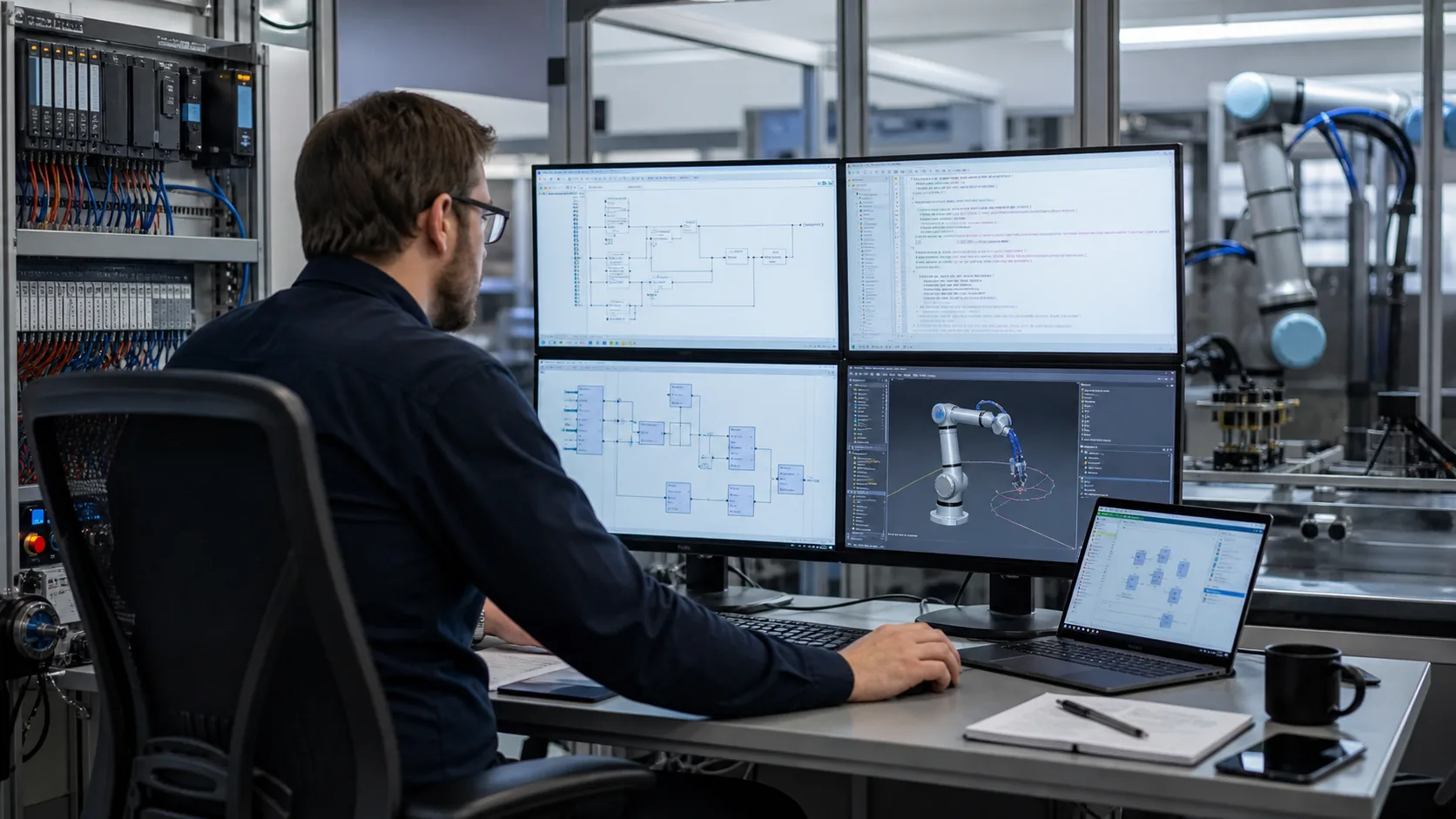
Automation engineer comparing PLC and robot programming workflows at a vendor-neutral workstation for industrial training content and runnable practice selection
A migration decision is credible when industrial training content and runnable practice selection is tested against the same declared behavior and target constraints.

System map / 02

Six concepts that control the result

Treat these as connected checkpoints. Each checkpoint has an expected state, an observable state and a boundary to the next part of the system. That structure prevents a software indication from being mistaken for physical proof.

NODE 01observable

Define the operating contract

target role, prerequisite, topic depth, learning format, device access, runnable practice, feedback, assessment, evidence and budget. For industrial training content and runnable practice selection, record the initial condition, actor, requested change, observable result and stopping condition before selecting a tool or implementation.

NODE 02observable

Map the evidence path

instructional explanation through guided exercise, independent system behavior, feedback, remediation and retained competency evidence. Separate request, internal state, output or service, physical or user-visible result and independent feedback so each boundary can be inspected.

NODE 03observable

Prove normal operation

one representative control or diagnostic task completed and explained in each shortlisted learning format. Run more than one cycle from a known state and retain the values, timings or artifacts that demonstrate repeatability.

NODE 04observable

Exercise a boundary case

passive completion, shallow quiz, copied solution, inaccessible tool, weak feedback, outdated claim and no physical transfer. Choose minimum, maximum, simultaneous, delayed or restart conditions that reveal assumptions hidden by the happy path.

NODE 05observable

Diagnose a controlled fault

a knowledge, implementation, diagnostic, feedback, assessment, accessibility or transfer gap. Preserve the first symptom, divide the system at a measurable boundary and change one condition only after predicting the result.

NODE 06observable

Transfer and hand over

the selected evidence combined with official vendor study and supervised physical practice appropriate to the role. Restore normal state, remove temporary changes, repeat affected checks and document which claims remain limited to the learning environment.

Procedure / 03

A six-step practice and commissioning workflow

Run the steps in order the first time. Later, the same structure becomes a diagnostic loop: define the expected condition, observe the boundary, interpret the difference and choose one proving action.

  1. 01

    Write the acceptance case

    Convert target role, prerequisite, topic depth, learning format, device access, runnable practice, feedback, assessment, evidence and budget into initial conditions, one stimulus and observable pass criteria.

    Evidence: Another person can repeat the case without guessing the intended result.

    Avoid: Using page completion or an animation as the acceptance criterion.

  2. 02

    Build the map

    Document instructional explanation through guided exercise, independent system behavior, feedback, remediation and retained competency evidence and name who owns each state or decision.

    Evidence: Every request and result has a source, destination and useful inspection point.

    Avoid: Using the same value as command, status and independent feedback.

  3. 03

    Run the baseline

    Apply one representative control or diagnostic task completed and explained in each shortlisted learning format from a clean start and record the expected evidence.

    Evidence: Repeated runs produce the same bounded result.

    Avoid: Changing several parameters before a baseline exists.

  4. 04

    Challenge assumptions

    Test passive completion, shallow quiz, copied solution, inaccessible tool, weak feedback, outdated claim and no physical transfer without changing the acceptance contract.

    Evidence: Limits, timing and restart behavior reach defined states.

    Avoid: Testing only one ideal sequence.

  5. 05

    Isolate one failure

    Introduce or analyse a knowledge, implementation, diagnostic, feedback, assessment, accessibility or transfer gap and locate the first disagreement.

    Evidence: The proving action distinguishes the leading hypotheses.

    Avoid: Resetting, forcing or replacing before evidence is retained.

  6. 06

    Close the evidence loop

    Complete the selected evidence combined with official vendor study and supervised physical practice appropriate to the role and repeat the affected regression cases.

    Evidence: An evaluation is complete when the same representative job is tested in each candidate and differences are recorded as evidence rather than inferred from feature labels.

    Avoid: Treating an acknowledged message or one successful rerun as handover.

Diagnostic matrix / 04

Symptoms, proving points and next actions

The table is a reasoning aid, not a parts-replacement chart. Preserve the initial symptom, inspect the named boundary and use the interpretation to choose the next controlled test. Site safety procedures and equipment manuals remain authoritative.

Diagnostic symptoms, inspection points, interpretations and next actions for RealPars alternative and companion: implementation, evidence and troubleshooting
Observed symptomInspectInterpretationNext proving action
The expected result is unclearRequirement, initial state, actor, stimulus, units and pass conditionThe evaluator, instructor and technical buyer may be solving different versions of the task.Rewrite one observable acceptance case before continuing.
Internal state changes but the outcome does notRequest, final owner, output or service boundary and independent feedbackA software or interface indication proves intent at one layer, not the complete outcome.Trace the first boundary after the changing state.
Normal case passes but an edge case failsLimits, timing, simultaneous events, reset and restart assumptionsThe implementation contains a hidden assumption exposed by the changed condition.Add the failed boundary as a permanent regression case.
The failure disappears after resetOriginal symptom, histories, diagnostics, timestamps and active causeReset changed evidence or state without proving the initiating cause.Reproduce under a controlled condition and preserve pre/post-event data.
Simulator and target disagreeModel boundary, software version, task timing, I/O behavior, data types and configurationA learning model and the intended target do not share one of the recorded assumptions.Reduce the case and verify against current target documentation.
The result cannot be explainedPrediction, observation, proving action, alternative hypotheses and limitationsActivity occurred but the evidence is not yet transferable or reviewable.Have the learner defend the signal path and repeat a changed case.

Product evidence / 05

What the browser practice can actually demonstrate

The public product surface exposes runnable examples, capability boundaries, pricing context and test-harness behavior that can be checked before a purchasing decision.

Where simulation stops

This independent comparison is not affiliated with RealPars and does not claim identical courses, credentials, instructors or coverage.

Commissioning notebook / 06

Six cases that turn the concepts into evidence

Use these as written briefs rather than click-through instructions. For every case, state the expected condition before acting, retain the first useful observation and explain why the final result proves the requirement. A different program or component choice can still be correct when it produces the same bounded behavior and evidence.

Case 01

predict → observe → prove

Prove define the operating contract

Engineering context. target role, prerequisite, topic depth, learning format, device access, runnable practice, feedback, assessment, evidence and budget. For industrial training content and runnable practice selection, record the initial condition, actor, requested change, observable result and stopping condition before selecting a tool or implementation. Begin with a written normal condition and identify which request, state, physical result or communication value will provide independent confirmation. Do not begin by changing the configuration; the initial state is part of the evidence and should remain reproducible.

Controlled setup. Use the “Write the acceptance case” stage of the workflow: convert target role, prerequisite, topic depth, learning format, device access, runnable practice, feedback, assessment, evidence and budget into initial conditions, one stimulus and observable pass criteria. The acceptance record should show this result: another person can repeat the case without guessing the intended result. Record initial conditions, the exact stimulus and the observation point so another learner can repeat the case without relying on your memory.

Fault challenge. Introduce or analyse “The expected result is unclear” as one bounded deviation. Inspect requirement, initial state, actor, stimulus, units and pass condition The working interpretation is that the evaluator, instructor and technical buyer may be solving different versions of the task. The next proving action is to rewrite one observable acceptance case before continuing. Change only one condition before observing the result, and preserve timestamps or measurements where timing matters.

Review and recovery. The most common trap here is using page completion or an animation as the acceptance criterion. After restoring the cause, repeat the normal case and at least one stop, timeout, disconnect or restart boundary relevant to this topic. Remove temporary forces and bypasses, return the model to a known state and retain the evidence that both operation and recovery are deliberate.

Explain it aloud: What should I learn first about industrial training content and runnable practice selection? A defensible short answer is: Start with the operating contract and evidence path: target role, prerequisite, topic depth, learning format, device access, runnable practice, feedback, assessment, evidence and budget, followed by instructional explanation through guided exercise, independent system behavior, feedback, remediation and retained competency evidence. Add advanced features only after the baseline is predictable.

Case 02

predict → observe → prove

Prove map the evidence path

Engineering context. instructional explanation through guided exercise, independent system behavior, feedback, remediation and retained competency evidence. Separate request, internal state, output or service, physical or user-visible result and independent feedback so each boundary can be inspected. Begin with a written normal condition and identify which request, state, physical result or communication value will provide independent confirmation. Do not begin by changing the configuration; the initial state is part of the evidence and should remain reproducible.

Controlled setup. Use the “Build the map” stage of the workflow: document instructional explanation through guided exercise, independent system behavior, feedback, remediation and retained competency evidence and name who owns each state or decision. The acceptance record should show this result: every request and result has a source, destination and useful inspection point. Record initial conditions, the exact stimulus and the observation point so another learner can repeat the case without relying on your memory.

Fault challenge. Introduce or analyse “Internal state changes but the outcome does not” as one bounded deviation. Inspect request, final owner, output or service boundary and independent feedback The working interpretation is that a software or interface indication proves intent at one layer, not the complete outcome. The next proving action is to trace the first boundary after the changing state. Change only one condition before observing the result, and preserve timestamps or measurements where timing matters.

Review and recovery. The most common trap here is using the same value as command, status and independent feedback. After restoring the cause, repeat the normal case and at least one stop, timeout, disconnect or restart boundary relevant to this topic. Remove temporary forces and bypasses, return the model to a known state and retain the evidence that both operation and recovery are deliberate.

Explain it aloud: How do I practise industrial training content and runnable practice selection effectively? A defensible short answer is: Use short cases with known initial conditions, a written prediction, one action and an observable result. Then alter a boundary or fault and explain why the evidence changed.

Case 03

predict → observe → prove

Prove prove normal operation

Engineering context. one representative control or diagnostic task completed and explained in each shortlisted learning format. Run more than one cycle from a known state and retain the values, timings or artifacts that demonstrate repeatability. Begin with a written normal condition and identify which request, state, physical result or communication value will provide independent confirmation. Do not begin by changing the configuration; the initial state is part of the evidence and should remain reproducible.

Controlled setup. Use the “Run the baseline” stage of the workflow: apply one representative control or diagnostic task completed and explained in each shortlisted learning format from a clean start and record the expected evidence. The acceptance record should show this result: repeated runs produce the same bounded result. Record initial conditions, the exact stimulus and the observation point so another learner can repeat the case without relying on your memory.

Fault challenge. Introduce or analyse “Normal case passes but an edge case fails” as one bounded deviation. Inspect limits, timing, simultaneous events, reset and restart assumptions The working interpretation is that the implementation contains a hidden assumption exposed by the changed condition. The next proving action is to add the failed boundary as a permanent regression case. Change only one condition before observing the result, and preserve timestamps or measurements where timing matters.

Review and recovery. The most common trap here is changing several parameters before a baseline exists. After restoring the cause, repeat the normal case and at least one stop, timeout, disconnect or restart boundary relevant to this topic. Remove temporary forces and bypasses, return the model to a known state and retain the evidence that both operation and recovery are deliberate.

Explain it aloud: What counts as proof of competence? A defensible short answer is: A repeatable artifact or system result plus an explanation of the signal path is stronger than time spent, screenshots or a copied answer. Physical competence requires separate supervised evidence.

Case 04

predict → observe → prove

Prove exercise a boundary case

Engineering context. passive completion, shallow quiz, copied solution, inaccessible tool, weak feedback, outdated claim and no physical transfer. Choose minimum, maximum, simultaneous, delayed or restart conditions that reveal assumptions hidden by the happy path. Begin with a written normal condition and identify which request, state, physical result or communication value will provide independent confirmation. Do not begin by changing the configuration; the initial state is part of the evidence and should remain reproducible.

Controlled setup. Use the “Challenge assumptions” stage of the workflow: test passive completion, shallow quiz, copied solution, inaccessible tool, weak feedback, outdated claim and no physical transfer without changing the acceptance contract. The acceptance record should show this result: limits, timing and restart behavior reach defined states. Record initial conditions, the exact stimulus and the observation point so another learner can repeat the case without relying on your memory.

Fault challenge. Introduce or analyse “The failure disappears after reset” as one bounded deviation. Inspect original symptom, histories, diagnostics, timestamps and active cause The working interpretation is that reset changed evidence or state without proving the initiating cause. The next proving action is to reproduce under a controlled condition and preserve pre/post-event data. Change only one condition before observing the result, and preserve timestamps or measurements where timing matters.

Review and recovery. The most common trap here is testing only one ideal sequence. After restoring the cause, repeat the normal case and at least one stop, timeout, disconnect or restart boundary relevant to this topic. Remove temporary forces and bypasses, return the model to a known state and retain the evidence that both operation and recovery are deliberate.

Explain it aloud: Why test faults and restart behavior? A defensible short answer is: Because a knowledge, implementation, diagnostic, feedback, assessment, accessibility or transfer gap or passive completion, shallow quiz, copied solution, inaccessible tool, weak feedback, outdated claim and no physical transfer can expose assumptions that never appear during ideal startup and steady operation.

Case 05

predict → observe → prove

Prove diagnose a controlled fault

Engineering context. a knowledge, implementation, diagnostic, feedback, assessment, accessibility or transfer gap. Preserve the first symptom, divide the system at a measurable boundary and change one condition only after predicting the result. Begin with a written normal condition and identify which request, state, physical result or communication value will provide independent confirmation. Do not begin by changing the configuration; the initial state is part of the evidence and should remain reproducible.

Controlled setup. Use the “Isolate one failure” stage of the workflow: introduce or analyse a knowledge, implementation, diagnostic, feedback, assessment, accessibility or transfer gap and locate the first disagreement. The acceptance record should show this result: the proving action distinguishes the leading hypotheses. Record initial conditions, the exact stimulus and the observation point so another learner can repeat the case without relying on your memory.

Fault challenge. Introduce or analyse “Simulator and target disagree” as one bounded deviation. Inspect model boundary, software version, task timing, I/O behavior, data types and configuration The working interpretation is that a learning model and the intended target do not share one of the recorded assumptions. The next proving action is to reduce the case and verify against current target documentation. Change only one condition before observing the result, and preserve timestamps or measurements where timing matters.

Review and recovery. The most common trap here is resetting, forcing or replacing before evidence is retained. After restoring the cause, repeat the normal case and at least one stop, timeout, disconnect or restart boundary relevant to this topic. Remove temporary forces and bypasses, return the model to a known state and retain the evidence that both operation and recovery are deliberate.

Explain it aloud: Can browser practice replace official software or hardware? A defensible short answer is: No. It can build concepts and diagnostic reasoning. Exact firmware, I/O electrical behavior, networking, safety and commissioning require current official tools, documentation and target equipment.

Case 06

predict → observe → prove

Prove transfer and hand over

Engineering context. the selected evidence combined with official vendor study and supervised physical practice appropriate to the role. Restore normal state, remove temporary changes, repeat affected checks and document which claims remain limited to the learning environment. Begin with a written normal condition and identify which request, state, physical result or communication value will provide independent confirmation. Do not begin by changing the configuration; the initial state is part of the evidence and should remain reproducible.

Controlled setup. Use the “Close the evidence loop” stage of the workflow: complete the selected evidence combined with official vendor study and supervised physical practice appropriate to the role and repeat the affected regression cases. The acceptance record should show this result: an evaluation is complete when the same representative job is tested in each candidate and differences are recorded as evidence rather than inferred from feature labels. Record initial conditions, the exact stimulus and the observation point so another learner can repeat the case without relying on your memory.

Fault challenge. Introduce or analyse “The result cannot be explained” as one bounded deviation. Inspect prediction, observation, proving action, alternative hypotheses and limitations The working interpretation is that activity occurred but the evidence is not yet transferable or reviewable. The next proving action is to have the learner defend the signal path and repeat a changed case. Change only one condition before observing the result, and preserve timestamps or measurements where timing matters.

Review and recovery. The most common trap here is treating an acknowledged message or one successful rerun as handover. After restoring the cause, repeat the normal case and at least one stop, timeout, disconnect or restart boundary relevant to this topic. Remove temporary forces and bypasses, return the model to a known state and retain the evidence that both operation and recovery are deliberate.

Explain it aloud: How should progress be documented? A defensible short answer is: Keep the requirement, initial state, program or configuration, observed values, fault hypothesis, proving action, recovery result and a concise limitations statement.

Answer surface / 07

Questions people ask about RealPars alternative and companion

These concise answers define the operating, training and product boundaries most often missed in broad summaries. The full workflow and diagnostic table above provide the evidence behind them.

What should I learn first about industrial training content and runnable practice selection?

Start with the operating contract and evidence path: target role, prerequisite, topic depth, learning format, device access, runnable practice, feedback, assessment, evidence and budget, followed by instructional explanation through guided exercise, independent system behavior, feedback, remediation and retained competency evidence. Add advanced features only after the baseline is predictable.

How do I practise industrial training content and runnable practice selection effectively?

Use short cases with known initial conditions, a written prediction, one action and an observable result. Then alter a boundary or fault and explain why the evidence changed.

What counts as proof of competence?

A repeatable artifact or system result plus an explanation of the signal path is stronger than time spent, screenshots or a copied answer. Physical competence requires separate supervised evidence.

Why test faults and restart behavior?

Because a knowledge, implementation, diagnostic, feedback, assessment, accessibility or transfer gap or passive completion, shallow quiz, copied solution, inaccessible tool, weak feedback, outdated claim and no physical transfer can expose assumptions that never appear during ideal startup and steady operation.

Can browser practice replace official software or hardware?

No. It can build concepts and diagnostic reasoning. Exact firmware, I/O electrical behavior, networking, safety and commissioning require current official tools, documentation and target equipment.

How should progress be documented?

Keep the requirement, initial state, program or configuration, observed values, fault hypothesis, proving action, recovery result and a concise limitations statement.

What should I do when the answer differs from a guide?

Check assumptions, version, units and initial state first. Reduce the case, compare one boundary at a time and prefer current primary documentation for target-specific behavior.

When is a industrial training content and runnable practice selection exercise finished?

An evaluation is complete when the same representative job is tested in each candidate and differences are recorded as evidence rather than inferred from feature labels.