TL;DR: SCADA (Supervisory Control and Data Acquisition) monitors and controls real-time plant operations — collecting live data from PLCs, displaying it to operators, and allowing supervisory commands in seconds to minutes. A MES (Manufacturing Execution System) manages production orders, schedules work at each work center, tracks materials and WIP (work-in-progress), and records quality and traceability data — operating over minutes to shifts. SCADA answers "what is happening on the floor right now?" MES answers "are we building the right things in the right order, and can we prove it?" They sit at different levels of the ISA-95 automation hierarchy and they must exchange data with each other to close the loop between what was planned and what was actually produced.
Controls engineers encounter both systems but often only deeply understand one. The confusion is understandable — both sit between the factory floor and the enterprise software layer, and both generate reports about production. The distinction matters when a project scope document says "integrate the SCADA with the MES" and you need to know which system owns what data.
The ISA-95 Hierarchy
ISA-95 is the international standard (also known as IEC 62264) that defines how enterprise and control systems are structured in manufacturing. It divides operations into five levels:
- Level 0–1: Physical devices — sensors, actuators, PLCs.
- Level 2: Supervisory control — SCADA, DCS, HMI systems.
- Level 3: Manufacturing operations — MES, batch management, laboratory systems.
- Level 4: Business planning — ERP (SAP, Oracle), inventory, scheduling.
SCADA lives at Level 2. MES lives at Level 3. They are adjacent layers, not competing replacements.
What SCADA Does
SCADA is a software platform that aggregates real-time data from multiple PLCs and RTUs, presents it to operators through graphical displays, manages an alarm system, and logs process historian data.
Key SCADA capabilities:
- Live process displays: trend screens, faceplates, mimic diagrams updated every 500 ms to 5 seconds.
- Alarm management: detecting abnormal conditions, routing notifications, tracking acknowledgement.
- Historian: time-series database recording process values at configurable intervals.
- Supervisory commands: setpoint changes, mode changes, start/stop commands sent to PLCs.
- Reports: production totals, OEE (overall equipment effectiveness), downtime events.
SCADA does not manage production orders. It does not know whether the product being produced this hour was supposed to be produced on this machine or scheduled for another line. It knows the machine is running and what its current parameters are.
What MES Does
A MES is the production management layer. It takes work orders from the ERP and breaks them down into scheduled operations at specific work centers, dispatches jobs to the floor, tracks material consumption and WIP, and records quality data and genealogy.
Key MES capabilities:
- Work order dispatch: issues job cards to operators and machines showing what to produce, how many, and to what specification.
- Scheduling: sequences operations across work centers, handles capacity constraints.
- Material tracking: records which batch of raw material was consumed in which production run (genealogy/traceability).
- Quality management: collects in-process quality measurements, holds suspect batches, triggers QA review.
- Labor and downtime tracking: records who worked on what, how long, and what caused downtime.
- Reporting to ERP: feeds actuals back (quantities produced, materials consumed) to close out the work order in the ERP.
MES operates over time horizons of minutes to shifts. It does not care about the 2-second process value trend inside a PLC register — it cares about how many units were completed in the last hour against a production target.
Side-by-Side Comparison
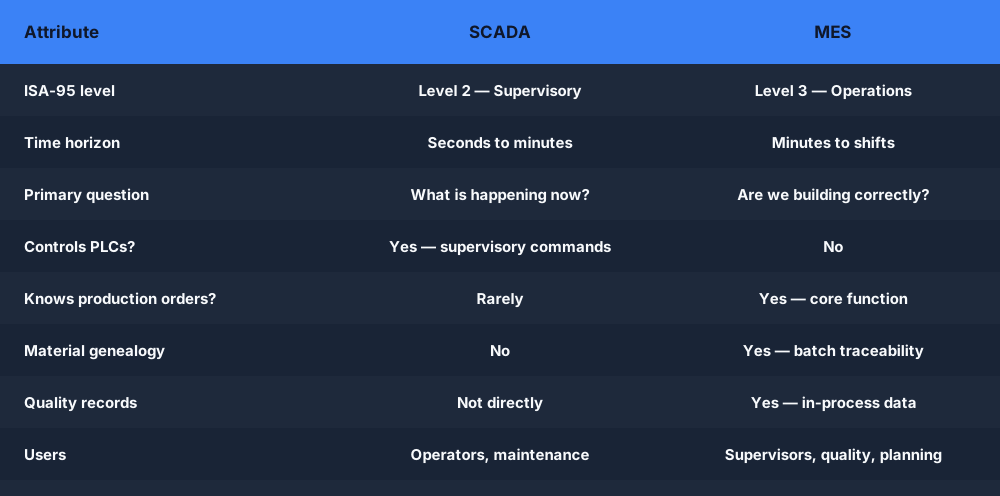
| SCADA | MES | |
|---|---|---|
| ISA-95 level | Level 2 — Supervisory control | Level 3 — Manufacturing operations |
| Time horizon | Seconds to minutes | Minutes to shifts |
| Primary question | What is happening right now? | Are we building the right things correctly? |
| Data type | Process variables, alarms, historian | Work orders, WIP, quality, genealogy |
| Users | Control room operators, maintenance | Production supervisors, quality, planning |
| Controls PLCs? | Yes — supervisory commands | No — dispatches job instructions to operators |
| Knows production orders? | Rarely (unless integrated) | Yes — core function |
| Material tracking | No | Yes — batch genealogy, consumption |
| Quality records | Not directly | Yes — in-process data, hold/release |
| Common platforms | Ignition, WinCC, iFIX, Wonderware | SAP ME, Opcenter, Plex, Epicor, Tulip |
Where They Intersect
The integration point between SCADA and MES is where real-time plant data becomes production context.
A typical integration flow:
- MES dispatches a work order to an operator station on the floor: "Produce 500 units of product A on Line 3."
- SCADA monitors Line 3 in real time: records actual cycle times, equipment alarms, OEE metrics.
- MES consumes SCADA data (via OPC UA or a database connection): receives actual count, downtime events, and quality measurement results from the SCADA historian.
- MES closes the loop to ERP: "Work order completed: 487 units produced, 13 scrapped, 2.3 kg material consumed."
Without this integration, MES works from operator-entered actuals (slow, error-prone), and SCADA has no context about what the machine was supposed to be producing (no production reporting, no OEE).
Common Misconceptions
"SCADA can do what MES does": A SCADA historian reports production counts and downtime. This is SCADA doing Level 3 work without the full MES capability — no order management, no genealogy, no ERP integration. It is common in smaller operations where a full MES is not cost-justified, but it is not a true MES.
"MES replaces SCADA": MES does not connect to PLCs. It does not respond in sub-second time. If a machine trips on a fault, SCADA responds immediately. The MES learns about the downtime event minutes later through integration.
"You need both for any factory": Smaller discrete manufacturers often run with just SCADA and a paper or spreadsheet-based production tracking system. MES becomes cost-effective when lot traceability is mandatory (pharmaceuticals, food and beverage, automotive) or when scheduling complexity across many work centers makes manual management unworkable.
Frequently Asked Questions
Q: What is the difference between SCADA and MES?
A: SCADA monitors real-time plant conditions from PLCs — alarms, process values, historian data — at second-level resolution. MES manages production orders, schedules work at work centers, and records quality and traceability data over minutes-to-shifts time horizons. SCADA is the live control layer; MES is the production management layer. They exchange data but serve different users and different questions.
Q: Does MES talk to PLCs directly?
A: Typically no. MES connects to SCADA, OPC UA servers, or manufacturing databases to get production data. It does not issue direct PLC commands. The chain is: ERP sends work order to MES → MES dispatches job to operator → operator starts machine → PLC runs the machine → SCADA records results → MES receives actuals from SCADA or historian.
Q: What is the difference between MES and ERP?
A: ERP (Enterprise Resource Planning — SAP, Oracle) manages business-level planning: purchasing, inventory valuation, financial reporting, sales orders, and demand-driven production scheduling. MES is the execution layer that takes ERP work orders and manages them on the factory floor in real time. ERP works in days and weeks; MES works in hours and shifts.
Q: What protocols does SCADA use to send data to MES?
A: The most common integration methods are OPC UA (preferred for new systems), database replication (SCADA historian to MES database), REST API, or flat-file exchange. OPC UA is increasingly standard because it is vendor-neutral, supports security certificates, and allows the MES to subscribe to process data without constant polling.
Understanding how SCADA fits in the plant hierarchy starts with understanding how PLCs feed it. The Modbus register read scenario and the SCADA vs HMI comparison give you the foundation for understanding how data flows from PLC to SCADA to MES.
