When our simulator fits
You need browser-based PLC and HMI learning, dynamic machine feedback, reusable 3D factory components, faults and objective scenario grading.
Independent category guide · 2026
Start with the decision the model must support. A production-flow model, a PLC training simulator and a commissioning-grade digital twin can all be called “simulation software” while solving fundamentally different jobs.
Fast answer
Choose the model whose outputs match the decision—not the one with the most impressive 3D screenshot.
Category map
| Software category | Primary decision | Model underneath | Best fit |
|---|---|---|---|
| Discrete-event flow | Capacity, queues, buffers, labor and throughput | Statistical events and resources | Factory planning before controls detail |
| PLC and machine simulation | Sequence, interlocks, I/O, alarms and recovery | Scan-based controller plus dynamic equipment | Controls learning and machine behavior |
| Virtual commissioning | Will production PLC/HMI/robot interfaces work before site? | High-fidelity controller and equipment interfaces | Engineering acceptance and integration |
| Process simulation | How do mass, energy, fluids or chemistry behave? | Equations, balances and physical properties | Process design and operating studies |
| Robot-cell simulation | Reach, collisions, cycle time and offline programs | Kinematics, tooling and robot controllers | Robotic cell engineering |
| Operator training simulator | Can operators recognize and recover from plant conditions? | Process dynamics plus operational interfaces | Procedure and abnormal-situation practice |
Write acceptance criteria before shortlisting vendors. The right evidence differs across training, planning and production engineering.
Name the decision, owner, date and cost of being wrong.
List which physical, controller, timing and human behaviors must be represented.
Identify PLCs, HMI, robots, data sources, CAD and reporting that truly need integration.
Use one real sequence, fault or planning problem—not the vendor’s polished demo.
Compare setup time, model validity, repeatability, learner or engineering outcomes and total cost.
Decide who maintains logic, assets, licenses and validation after the first project.
You need browser-based PLC and HMI learning, dynamic machine feedback, reusable 3D factory components, faults and objective scenario grading.
Use specialist DES, CFD/process, robot offline-programming or commissioning software when the production decision requires those engineering models.
Teach sequences and diagnosis here, then expose advanced learners to the production engineering tools used by their employer or discipline.
Software evaluation field guide
Direct answer
The evaluator can define a representative plant job, choose the required model fidelity and interfaces, and compare candidates with the same acceptance evidence.
Written for controls engineers, educators and technical buyers comparing process models, discrete-event analysis, PLC-connected simulation, digital twins and training scenarios.
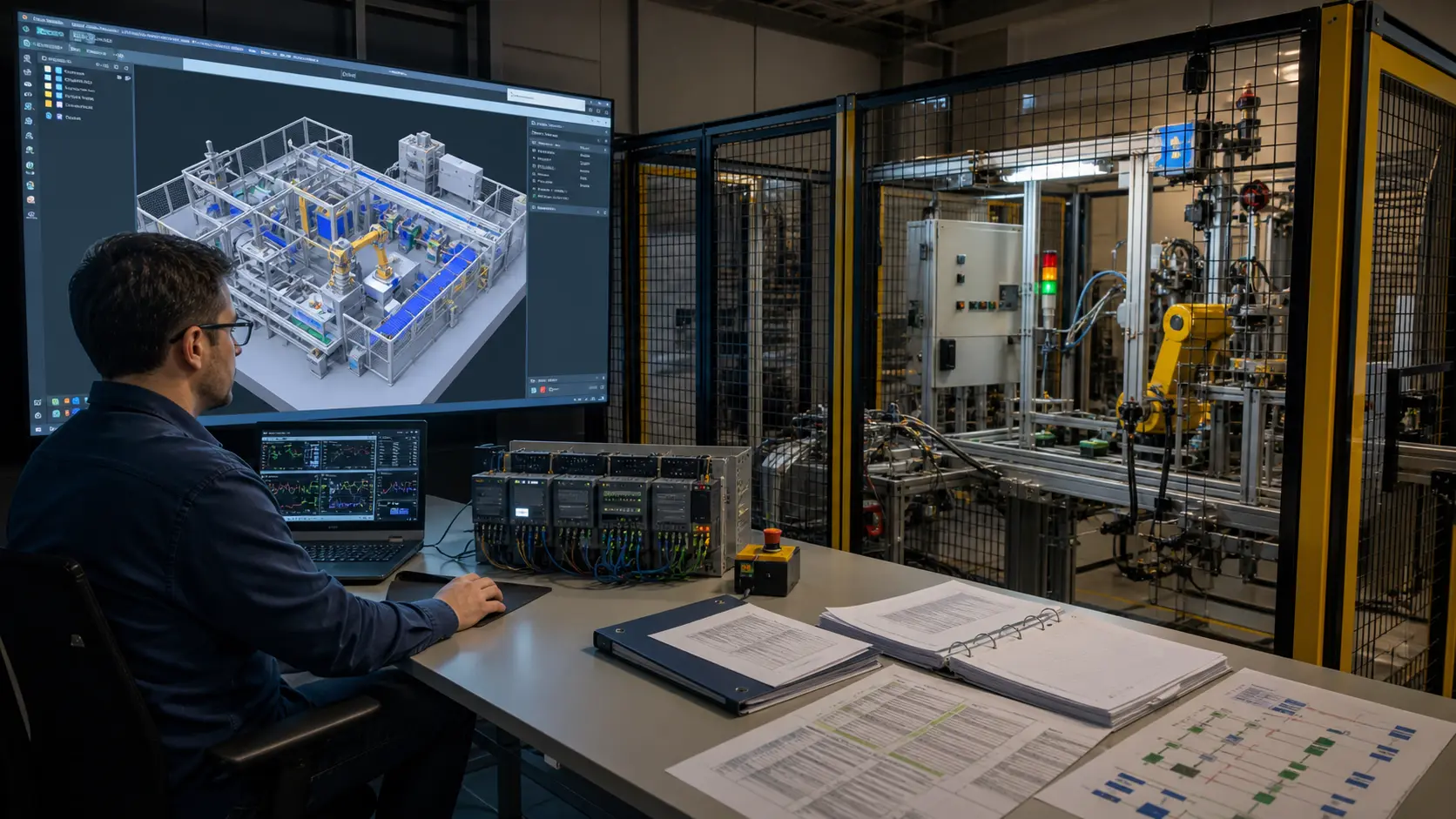
Decision goal, plant domain, time scale, physics and statistical fidelity, controller interface, I/O contract, scenario and fault authoring, data, collaboration, deployment, licensing and lifecycle support.
Control or planning request through model inputs, simulated plant behavior, process outputs, controller or analysis result, visualization and retained acceptance evidence.
One representative normal run connected, stopped, faulted, recovered and repeated with documented model assumptions.
Timing drift, invalid initial state, communication loss, model mismatch, unavailable asset, simultaneous events, version change, restart and data export.
A requirement, model, interface, I/O, timing, physics, statistics, asset, data, deployment or commercial mismatch.
Shortlisted software proven with representative data, target controllers where needed and witnessed stakeholder acceptance cases.
Uses include process design, material-flow analysis, PLC testing, virtual commissioning, operator training and communicating expected plant behavior.
Run the same representative job and compare model fidelity, interfaces, faults, data, deployment, collaboration, lifecycle cost and evidence—not feature labels alone.