PLC Practice Test: 10 Real Questions, Graded Instantly
The same mix employer assessments use — reading ladder rungs, timers, counters, addressing, troubleshooting and safety — with a full explanation for every answer. No signup. Scroll down and start.
Join 12600+ learners practicing PLC programming
What this assessment actually measures
From reading a rung to proving the physical fault
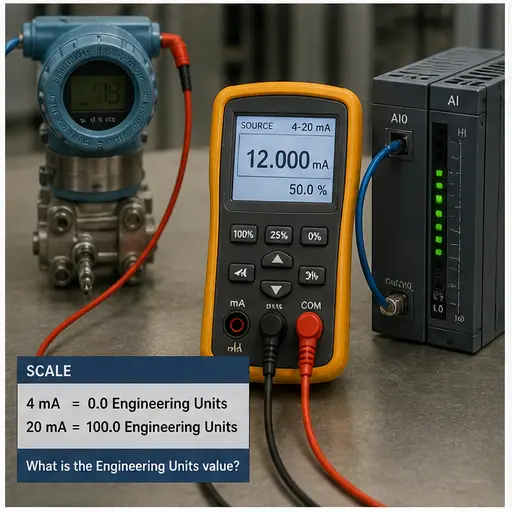
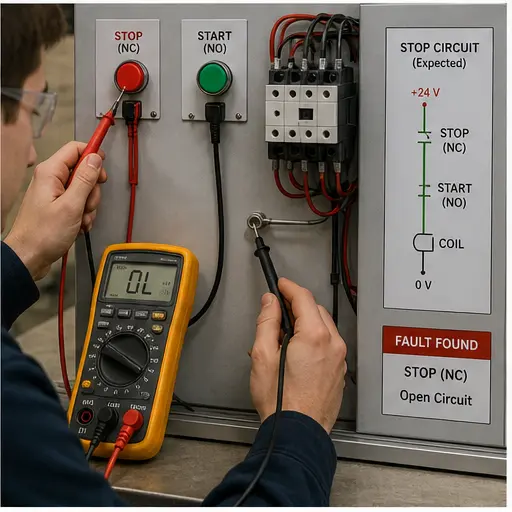
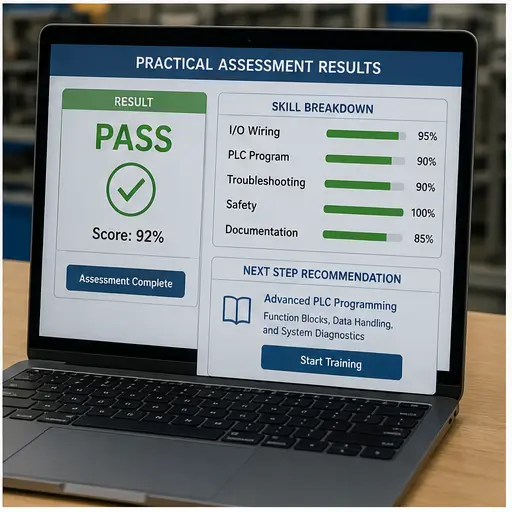
The ten-question test samples the reasoning employers need: scan order, Boolean paths, timers, counters, analog scaling and signal-path troubleshooting. The result is a diagnostic starting point, not a vanity score.
10 questions · self-graded · free
Take the PLC practice test
Four of these questions ask you to read an actual ladder rung — exactly what a paper-based employer assessment does. Answer all ten, hit Grade my test, and you get your score plus the reasoning behind every answer. Around 7/10 is a comfortable pass on most screens.
Question 1 of 10 · Reading a rung
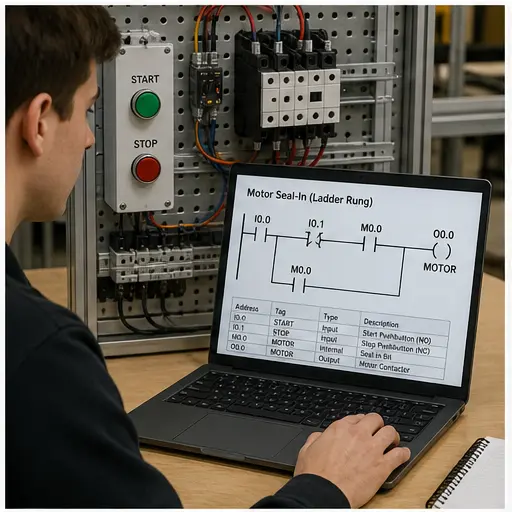
Read the rung above. The operator presses START, then releases it. STOP is not pressed. What does the MOTOR output do?
Question 2 of 10 · NO/NC & fail-safe wiring
Why is the physical Stop push-button on a motor start/stop circuit almost always wired as a normally-closed (NC) contact?
Question 3 of 10 · Timers (TON vs TOF)
A cooling fan must keep running for 30 seconds after the pump motor stops, to carry away residual heat. Which timer instruction is the right choice?
Question 4 of 10 · Scan cycle
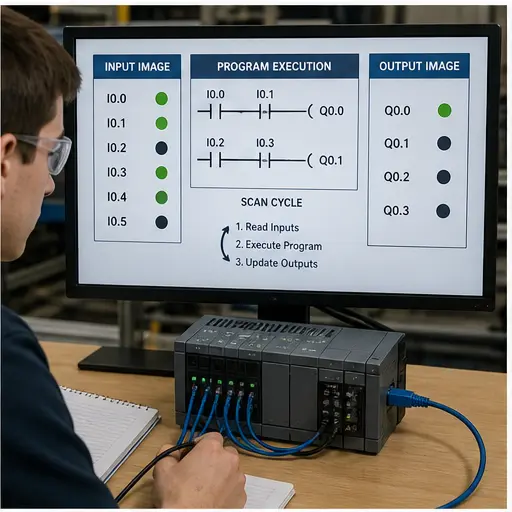
In which order does a PLC execute its scan cycle?
Question 5 of 10 · Counters (CTU)
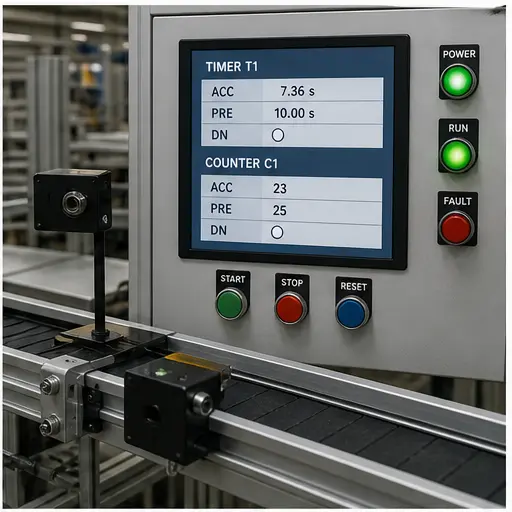
Read the rung above. The part sensor has pulsed 5 times, so the count value equals the preset. What is the state of the counter, and what happens on a 6th pulse?
Question 6 of 10 · I/O addressing
One PLC program refers to %I0.2 and %Q0.1; another refers to I:1/2 and O:2/1. Which addressing convention is which?
Question 7 of 10 · Troubleshooting
Read the rung above. The operator holds START, but the motor never starts. The coil, wiring and output card all test good. Why does the motor never start?
Question 8 of 10 · Structured text
MotorRun := (StartPB OR MotorRun) AND NOT StopPB;This one line of IEC 61131-3 structured text is a direct translation of a very common ladder pattern. Which one?
Question 9 of 10 · Safety / E-stop
Which statement about emergency-stop circuits follows accepted machine-safety convention?
Question 10 of 10 · Symbol identification
Look at the four ladder logic symbols above, labelled A to D. Which one is the normally-closed (examine-if-open, XIO) contact?
0 of 10 answered. Answer every question to see your score and the explanations.
Know the exam
What employer PLC assessment tests actually cover
The short answer: employer PLC assessments test four things — reading ladder rungs (NO/NC contacts, seal-in latches), timer and counter behaviour (TON vs TOF, CTU presets and done bits), troubleshooting order from symptom to cause, and I/O addressing across IEC, SLC and Logix notation. Most screens run 20–50 questions and pass at roughly 70%.
Whether it's a maintenance-tech screen at a food plant or a controls-technician assessment at an automotive supplier, employer PLC tests are remarkably consistent. They are not trying to find out whether you have memorised an instruction set — they are checking whether you can read a program you have never seen and predict what the machine will do. That comes down to four areas.
1. Reading rungs. You will be shown ladder diagrams and asked what happens when an input changes: seal-in latches (question 1 above), series vs parallel logic, and the crucial distinction between a field device's wiring (NO or NC push-button) and the instruction examining it (XIC or XIO). If you can explain why a stop button is wired NC but examined with a normally-open instruction, you are ahead of most candidates. Brush up with the complete ladder logic symbols reference first if any symbol in the test above looked unfamiliar.
2. Timers and counters. Expect at least two questions on TON vs TOF behaviour — when the done bit sets, what happens to the accumulator when the rung drops — and one on counters: does a CTU reset itself at preset (no), does the done bit stay set (yes), what does a RES instruction do. These are the highest-yield fifteen minutes of revision you can do.
3. Troubleshooting order. Scenario questions give you a symptom ("the motor never starts") and ask for the most likely cause or the correct first check. Good answers follow signal flow: confirm the input is reaching the PLC (indicator LED, input image), confirm the logic solves TRUE (rung highlighting), confirm the output is being written, then suspect the field side. Guessing "replace the coil" before checking the rung is the classic wrong answer.
4. Addressing and platforms. You should recognise IEC-style direct addresses (%I0.2, %Q0.1), Allen-Bradley SLC-style addresses (I:1/2, O:2/1) and tag-based addressing in modern Logix controllers — and know which platform each belongs to. Plants that run Siemens will slant IEC; North-American plants slant Allen-Bradley. If the job ad names the platform, revise its notation.
7-day plan
How to prepare for a PLC test in one week
A week of deliberate, hands-on practice beats a month of reading. The plan below assumes 45–60 minutes a day and uses the free browser simulator — no hardware, no trial installs.
Days 1–2
Build the fundamentals, hands-on
Work through the first lessons of the free Beginner Track — contacts, coils, series/parallel logic and the seal-in latch. Building the start/stop circuit yourself and watching the power flow makes question 1 above permanent knowledge instead of a memorised fact. Start free — the beginner lessons are included in the free tier.
Days 3–4
Timers, counters and the scan cycle
Build one TON circuit (motor start delay) and one TOF circuit (fan run-on), then a CTU parts counter with a reset rung. Say out loud what the done bit is doing at each moment. Then work a batch of PLC practice problems to force recall under mild pressure.
Day 5
Troubleshooting method
Practice the signal-flow method on broken rungs: input → logic → output → field device. The troubleshooting scenarios in the simulator plant real faults for you to find, which is exactly the format assessment scenario questions use.
Day 6
Timed test conditions
Retake the 10-question test on this page cold, then sit the longer graded quizzes with a timer running. Review every miss until you can explain why the right answer is right.
Day 7
Interview and viva prep
Many employers follow the written screen with verbal questions. The PLC interview prep guide covers the questions hiring managers actually ask — and how to talk through a rung on a whiteboard without freezing.
Know which test you're taking
Employer screens vs CCST and certification exams
Not every "PLC test" is the same animal, and preparing for the wrong one wastes your week. An employer assessment is short (20–50 questions), practical and narrow: read rungs, predict timer and counter behaviour, spot a planted fault. It is scored pass/fail, usually around 70%, and the ten questions above are a faithful miniature of it.
A certification exam is broader and longer. ISA's CCST runs 125–150 multiple-choice questions over 3–4 hours, requires a minimum of five years' experience even at Level 1, and covers calibration, loop checking, process measurement, documentation and safety systems in addition to PLCs — being a strong ladder-logic reader gets you perhaps a third of the marks. If your goal is CCST, use the dedicated CCST practice exam to see the real breadth before booking a seat.
If you want a credential to attach to a job application without the experience prerequisites of CCST, the PLC Technician Certificate is earned by completing graded, hands-on simulator work — every certificate is publicly verifiable, so a hiring manager can confirm you actually built and ran the programs rather than watched videos about them. The preparation is worth the week: O*NET (U.S. Department of Labor) projects roughly 81,000 US electrician job openings a year through 2034, at a 2025 median wage of $63,190 — and passing the PLC screen is what separates the controls-track candidates in that queue.
“Flashcards get you past the multiple choice; they do not get you past the wiring diagram on day one. Build the ten classic circuits in a simulator that grades you against test cases and the answers stop being memorised facts — they become things you have watched happen.”
Answer key
PLC practice test answer key & explanations
Prefer to study the reasoning directly? Every question from the test above, with its correct answer and the explanation in full. (No peeking before you take it.)
Question 1 · Reading a rung
Read the rung above. The operator presses START, then releases it. STOP is not pressed. What does the MOTOR output do?
Correct answer: Starts when START is pressed and keeps running after START is released
This is the classic seal-in (latch) circuit. When START closes, power reaches the MOTOR coil through the normally-closed STOP contact. The MOTOR contact in parallel with START — the seal-in branch — then closes because the coil is energised, providing an alternative power path. When START is released, current keeps flowing through the seal-in branch, so the motor stays running until STOP opens the rung.
Question 2 · NO/NC & fail-safe wiring
Why is the physical Stop push-button on a motor start/stop circuit almost always wired as a normally-closed (NC) contact?
Correct answer: So a broken wire or lost signal de-energises the rung and stops the motor — the circuit fails to a safe state
This is the fail-safe convention. A NC stop button holds its PLC input ON while the circuit is healthy; the ladder examines it with a normally-open (XIC) instruction, which is TRUE while the wire is intact. If the wire breaks, a terminal loosens, or the button is pressed, the input drops to OFF, the XIC goes FALSE, and the motor stops. Wired NO, a broken stop-button wire would go unnoticed — and the stop would silently do nothing when you needed it.
Question 3 · Timers (TON vs TOF)
A cooling fan must keep running for 30 seconds after the pump motor stops, to carry away residual heat. Which timer instruction is the right choice?
Correct answer: TOF (off-delay timer) — its done bit stays TRUE for the preset after the enabling rung goes FALSE
A TOF (off-delay) timer delays the turn-OFF of an output. Its done bit is TRUE the whole time the enabling rung (the pump-run bit) is energised, and stays TRUE for the full preset after the rung drops. Drive the fan from the TOF done bit and the fan runs with the pump, then runs on for exactly 30 seconds after it stops. A TON does the opposite — it delays turn-ON — which is the single most common timer mix-up on assessment tests.
Question 4 · Scan cycle
In which order does a PLC execute its scan cycle?
Correct answer: Read inputs → execute the logic top-to-bottom → write outputs
The scan cycle is: (1) read all physical inputs into the input image table, (2) solve the ladder logic top-to-bottom left-to-right using that frozen snapshot, (3) write the results to the physical outputs, then do housekeeping/communications and repeat. Inputs are NOT live during logic execution — a sensor that changes mid-scan is not seen until the next input scan. Assessment tests probe this because it explains real behaviours like one-scan delays and why rung order matters.
Question 5 · Counters (CTU)
Read the rung above. The part sensor has pulsed 5 times, so the count value equals the preset. What is the state of the counter, and what happens on a 6th pulse?
Correct answer: DN is set and stays set; a 6th pulse increments the count to 6 — the counter keeps counting past preset
A CTU sets its done bit (DN) when the accumulated count reaches or exceeds the preset, and the bit stays set — it does not self-clear and the counter does not self-reset. Pulses keep incrementing the accumulator past the preset (5 → 6 → 7 …). To start a new batch you must reset the counter explicitly, with a RES instruction (Allen-Bradley) or the reset input (IEC CTU). "Does the counter reset itself?" is a favourite trick question on employer screens — the answer is no.
Question 6 · I/O addressing
One PLC program refers to %I0.2 and %Q0.1; another refers to I:1/2 and O:2/1. Which addressing convention is which?
Correct answer: %I/%Q is IEC 61131-3 style (Siemens, Codesys); I:/O: is Allen-Bradley SLC/RSLogix 500 style
Percent-prefixed direct addresses (%I0.2 = input byte 0, bit 2; %Q0.1 = output byte 0, bit 1 — Q from the German "Quelle"-era convention for outputs) come from IEC 61131-3 and are used by Siemens, Codesys, OpenPLC and most European platforms. The colon-slash format (I:1/2 = input, slot 1, bit 2; O:2/1 = output, slot 2, bit 1) is Allen-Bradley SLC-500/MicroLogix (RSLogix 500). Modern AB Logix controllers use tag names instead of either. Recognising both instantly is an easy point on any assessment.
Question 7 · Troubleshooting
Read the rung above. The operator holds START, but the motor never starts. The coil, wiring and output card all test good. Why does the motor never start?
Correct answer: STOP is a normally-open button examined with XIC — its input is never ON, so the rung can never pass power
Work the rung left to right: XIC START is TRUE while the button is held — fine. But XIC STOP asks "is the STOP input ON?", and a normally-open stop button that nobody is pressing keeps its input OFF. That instruction is permanently FALSE, so power can never reach the coil no matter what START does. The fix is the fail-safe convention from earlier: wire the stop button normally-closed so its input is ON when healthy, and keep examining it with XIC. Mismatched field wiring vs. instruction choice is the single most common fault planted in assessment troubleshooting questions.
Question 8 · Structured text
MotorRun := (StartPB OR MotorRun) AND NOT StopPB;This one line of IEC 61131-3 structured text is a direct translation of a very common ladder pattern. Which one?
Correct answer: A start/stop seal-in latch — MotorRun holds itself on until StopPB goes TRUE
Substitute the rung from question 1: (StartPB OR MotorRun) is the START contact in parallel with the MOTOR seal-in contact, and AND NOT StopPB is the normally-closed STOP contact in series. Once MotorRun goes TRUE it feeds back into its own equation and holds itself TRUE — the seal-in — until StopPB goes TRUE and the AND NOT term breaks the latch. Being able to translate between ladder and structured text is increasingly tested, especially for Codesys/TIA Portal shops.
Question 9 · Safety / E-stop
Which statement about emergency-stop circuits follows accepted machine-safety convention?
Correct answer: The E-stop must be a hardwired, normally-closed, mechanically latching circuit (or safety-rated relay/PLC) that removes power independently of the standard PLC program
A standard PLC can crash, hang mid-scan, or run buggy logic — so safety standards (ISO 13850, IEC 60204-1) require the emergency-stop function to work independently of it: a hardwired NC, mechanically latching (twist-to-release) circuit dropping a master control relay or safety contactor, or a safety-rated relay/safety PLC. The standard PLC typically still monitors the E-stop state on an input for alarms and controlled restart, but it must not be the only thing standing between the operator and moving machinery.
Question 10 · Symbol identification
Look at the four ladder logic symbols above, labelled A to D. Which one is the normally-closed (examine-if-open, XIO) contact?
Correct answer: Symbol B — the parallel lines with a diagonal slash through them
A is the normally-open contact (XIC, examine-if-closed): TRUE when its bit is ON. B — the same contact with a diagonal slash — is the normally-closed contact (XIO, examine-if-open): TRUE when its bit is OFF. C is the standard output coil (OTE, output energise), and D is the latching output coil (OTL, output latch), which stays set until a matching unlatch (OTU) fires. If you can read these four symbols plus timer and counter blocks, you can read the majority of real-world ladder programs.
Ten questions is a warm-up.
The full quiz bank grades you topic by topic — contacts, latches, timers, counters, troubleshooting — and pairs knowledge checks with hands-on work drawn from 140 published scenarios, so a wrong answer becomes a circuit you build until it clicks.
PLC practice test FAQ
Don't just quiz — build the circuits
Free auto-graded ladder logic scenarios in your browser. No install, no licence, no credit card.
Create free account →