
PLC Simulator
PLC field notesmitsubishi

Mitsubishi PLC Training 2026: FX, Q-Series, iQ-R with GX Works3

A practical Mitsubishi PLC training guide covering FX3U/FX5U micro, Q-Series mid-range, and iQ-R modern controllers in GX Works3. Addressing conventions, free software, used-hardware sourcing, and how to build portable IEC-compliant skills even on a Japanese-market vendor.

PLC Simulation Software8 min read

Mitsubishi PLC training — FX, Q, iQ-R in 2026

Mitsubishi PLCs dominate Japanese manufacturing, have strong positions across South-East Asia, and appear regularly in European packaging and machinery. If your local job market runs Mitsubishi, you need GX Works3 fluency — and the path is surprisingly accessible because the free IDE and cheap used hardware make it one of the lowest-cost vendor stacks to learn.

This post is the orientation. For the broader strategy of learning multiple dialects, see our PLC dialects comparison post.

The Mitsubishi landscape
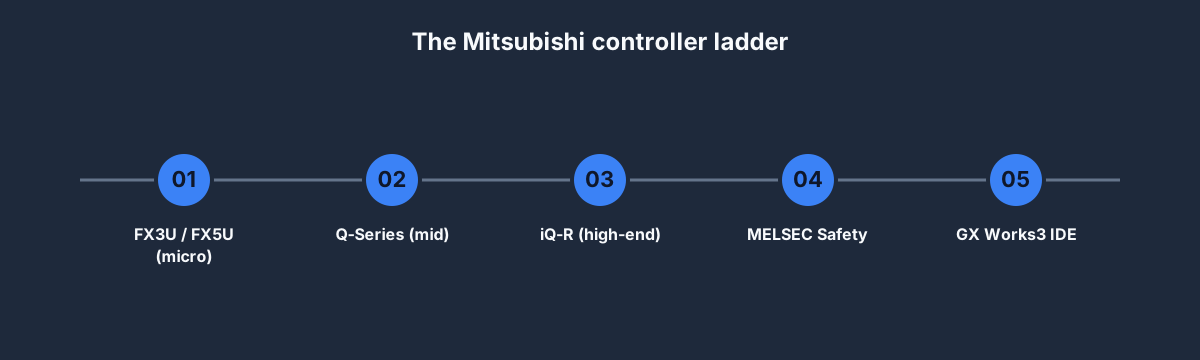
The Mitsubishi controller ladder

  • FX3U / FX5U — micro-PLCs, brick format, typical for packaging machines and machine-tool axes. FX3U is legacy; FX5U is the 2020+ generation.
  • Q-Series — mid-range modular, still widely installed.
  • iQ-R — the modern high-end platform; PLCs, motion controllers, safety, and process control all in one chassis. What Mitsubishi pushes for new projects.
  • MELSEC Safety — SIL3-capable safety controllers.
  • GX Works3 — the unified IDE for FX5U and iQ-R.
  • GX Works2 — legacy IDE for FX3U and Q-Series. Many existing plants still run this.

If you're self-studying, pick FX5U + GX Works3 as the primary path. It covers the modern convention and lets you open most legacy Q-Series projects with a bit of effort.

Key addressing conventions

Mitsubishi's addressing is its own thing — a bit of a shock to engineers coming from Rockwell or Siemens.
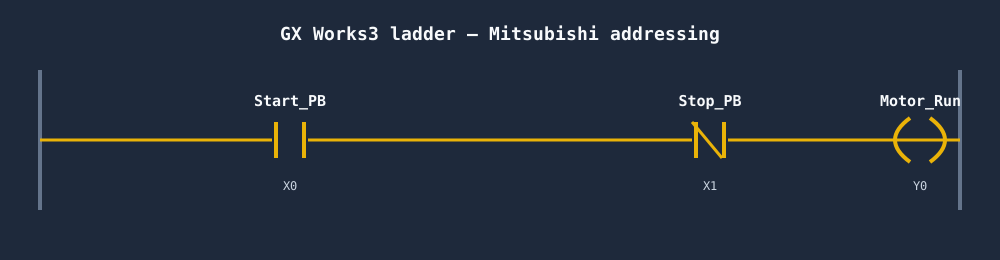
GX Works3 ladder — Mitsubishi addressing

  • X prefix — inputs. X0, X1, etc.
  • Y prefix — outputs. Y0, Y1, etc.
  • M prefix — internal bits (auxiliary relays).
  • D prefix — data registers (word-sized).
  • T prefix — timers.
  • C prefix — counters.

So the start/stop rung above reads: X0 (Start) AND NOT X1 (Stop) → Y0 (Motor). No prefix punctuation, no Local:1:I.Data.0, no %I0.0. Short and flat.

The 6-week self-study path

Weeks 1–2: GX Works3 basics + FX5U

Download GX Works3 (free with registration from Mitsubishi Electric). Install on Windows. Create a new project targeting an FX5U-32MR/ES.

  • Configure I/O
  • Define labels (Mitsubishi's term for tagged variables)
  • Write the start/stop rung
  • Use GX Works3's simulator to test without hardware

Port the 20 basic rungs to Mitsubishi addressing. Notice how the compact X0/Y0/M100 syntax reads quickly once you're used to it.

Weeks 3–4: Data handling + function blocks

Mitsubishi's IEC 61131-3 function-block support is solid in GX Works3. Build:

  • A motor-control function block with Start/Stop/Run parameters
  • A data-logger FB that samples temperature every second into a ring buffer
  • A sequencer FB that walks through phases

This is where GX Works3 feels modern rather than 1990s-era (which GX Works2 does).

Weeks 5–6: CC-Link IE Field + motion (optional)

CC-Link IE Field is Mitsubishi's fieldbus. If your target role involves remote I/O or motion, spend this block on it.

  • CC-Link IE TSN (the 2020+ successor with time-sensitive networking)
  • Configuring a remote I/O head + slice I/O
  • Basic motion with MR-J5 servo drives

Skip for basic maintenance or controls roles.

Free and cheap resources

Get Mitsubishi-ready with these five resources

  • GX Works3 — free download after Mitsubishi registration. Full featured.
  • GX Works2 — free, needed for some legacy FX3U and Q-Series projects.
  • Mitsubishi Factory Automation YouTube — official getting-started content.
  • Used FX3U on eBay — USD 100–200. Runs on GX Works2.
  • Used FX5U — USD 300–500 used, USD 500–800 new. Runs on GX Works3.
  • Automation24 and Inductive Automation's community forums — independent coverage.

Where our simulator fits

The browser simulator runs IEC 61131-3 semantics. Mitsubishi's modern controllers (FX5U, iQ-R) support IEC 61131-3 natively via labels and structured text. So: the code you learn in our simulator ports to Mitsubishi almost verbatim; the addressing (X0, Y0, M100) is Mitsubishi-specific and best learned in GX Works3.

For fundamentals — scan cycle, seal-in, timer patterns, state machines — our simulator wins on cost and feedback speed. For IDE fluency, pair it with GX Works3's own simulator mode.

Is Mitsubishi worth specialising in?

Depends on geography and industry, same as Omron:

  • Japan: yes, huge installed base.
  • South-East Asia, Australia, India: yes, strong penetration.
  • North America: limited except in packaging and machine tools.
  • Europe: limited except in specific OEM equipment.

If your local market runs Mitsubishi, learn it as primary. Otherwise, it's a useful second vendor that broadens your scope.

FAQ

Is GX Works3 free?

Yes, free to download from Mitsubishi Electric after registration. Full-featured for learning use.

What's the difference between GX Works2 and GX Works3?

GX Works2 is the legacy IDE for FX3U and Q-Series. GX Works3 is the modern IDE for FX5U and iQ-R. Projects don't port automatically — you can open GX Works2 projects in GX Works3 but conversion isn't always clean. Learn GX Works3 first.

Is Mitsubishi PLC training widely available?

In Japan, Korea, and Taiwan: yes, with vendor classrooms and many private academies. Elsewhere: thinner, mostly online and self-study.

How long does it take to learn Mitsubishi PLCs?

6 weeks at 8 hours/week for entry-level FX5U/GX Works3 competence. 3–4 months for Q-Series / iQ-R depth.

Can I learn Mitsubishi without hardware?

Yes. GX Works3's built-in simulator covers basic execution. For fundamentals, use our browser simulator — the IEC skills port directly.

Where to start

  1. Decide if your target job market runs Mitsubishi. If not, learn Rockwell or Siemens first.
  2. If yes: download GX Works3, sign up for our free simulator, and start with the basic PLC programming post.
  3. Port the rungs to GX Works3 using Mitsubishi's X/Y/M/D addressing.
  4. Buy a used FX3U or FX5U for hardware time once you've written 10 scenarios.

6 weeks, USD 200–500 end-to-end. Entry to a specialist vendor that's valuable wherever it's in demand.


Mitsubishi, GX Works, GX Works3, FX, FX3U, FX5U, Q-Series, and iQ-R are trademarks of Mitsubishi Electric Corporation. This article is not affiliated with or endorsed by Mitsubishi Electric Corporation.
ShareX / TwitterLinkedIn

From reading to running logic

Practice this yourself in the simulator

Start with guided PLC practice in your browser. No install and no credit card required.

Start practising free

Continue learning

Related field notes

All articles
delta
ispsoft

Delta PLC Training (2026): DVP, AS, and AH Series with ISPSoft

A practical Delta PLC training guide — DVP micro-PLCs, AS-series mid-range, AH high-end, all programmed in ISPSoft. Covers IEC 61131-3 support, CANopen and Modbus, and a 6-week self-study path that uses cheap hardware to get you productive.

8 min read
omron
sysmac

Omron PLC Training: CP1L to NJ/NX with Sysmac Studio (2026)

A practical Omron PLC training path from entry-level CP1L micro-PLCs to modern NJ and NX controllers in Sysmac Studio. Where to get hardware cheaply, which software is free for learners, and how to build portable skills even if your employer runs a different brand.

8 min read
training
near me

PLC Training Near Me vs Online: Which Is Worth the Money in 2026?

If you searched 'PLC training near me,' there are three realistic options: a local community college course, a vendor-run classroom, and a laptop-plus-USD-99-a-year online path. This post walks the trade-offs, five decision questions, and a hybrid stack that beats both for most budgets.

9 min read

Independent vendor-platform field guide

Mitsubishi PLC training: implementation, evidence and troubleshooting

Direct answer

Mitsubishi PLC training becomes useful when it connects target role, controller family, engineering suite, software version, addressing, iec language, hardware access and competency evidence with x, y, m, d, timer and counter concepts through program organization, monitoring, simulated i/o and machine behavior, then proves one start-stop, timer, counter and sequence case recreated from a clean project under normal, boundary, fault and recovery conditions. The objective is a repeatable engineering or learning result, not merely activity inside a page or tool.

This guide is written for learners and technicians moving from transferable PLC fundamentals into Mitsubishi FX, Q, L or iQ platform workflows. The intended result is specific: the learner can build a sequenced Mitsubishi-oriented study plan and state which controller, addressing, software and hardware assumptions remain.

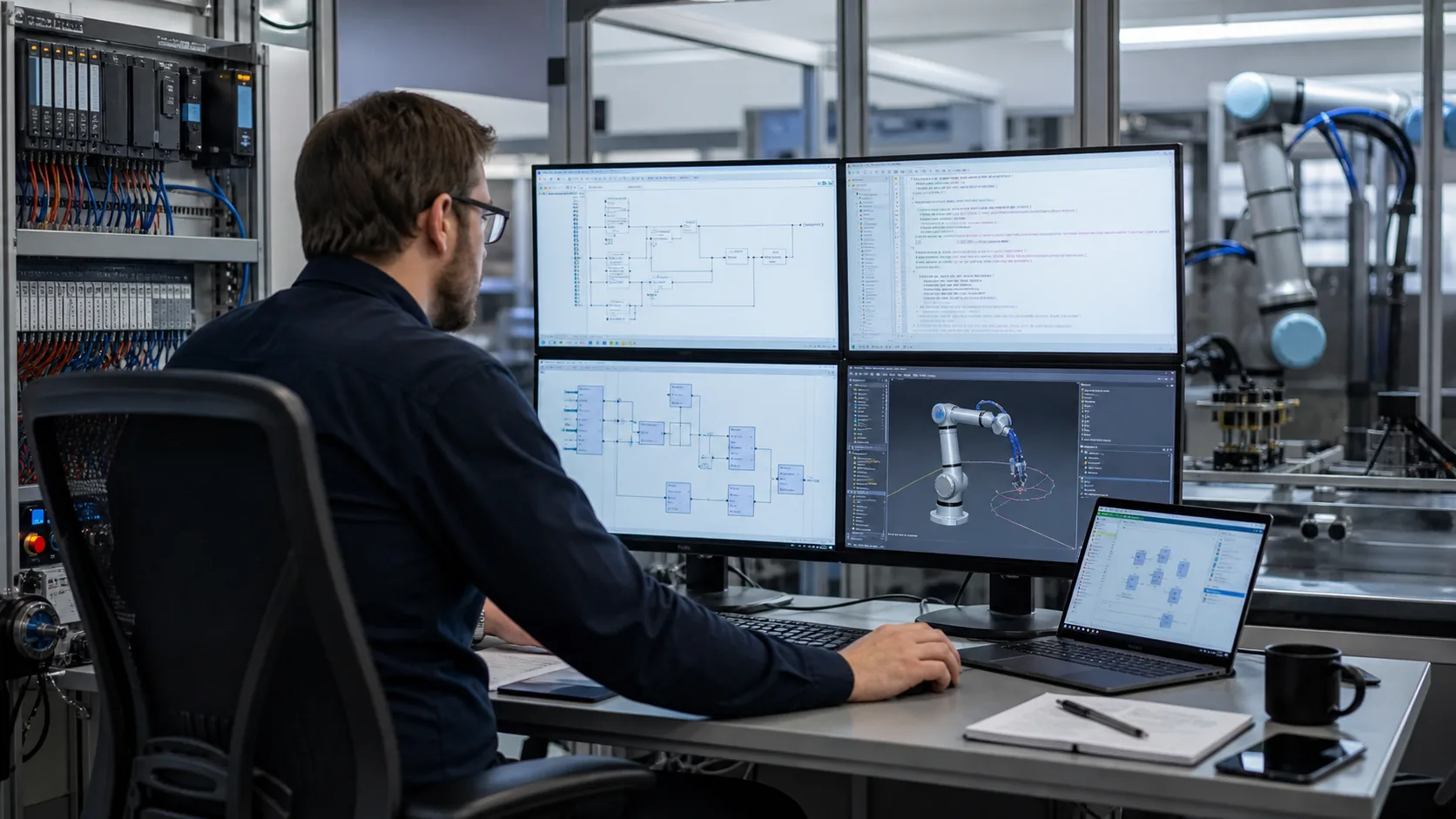
Automation engineer comparing PLC and robot programming workflows at a vendor-neutral workstation for Mitsubishi PLC learning and GX Works transfer
A migration decision is credible when Mitsubishi PLC learning and GX Works transfer is tested against the same declared behavior and target constraints.

System map / 02

Six concepts that control the result

Treat these as connected checkpoints. Each checkpoint has an expected state, an observable state and a boundary to the next part of the system. That structure prevents a software indication from being mistaken for physical proof.

NODE 01observable

Define the operating contract

target role, controller family, engineering suite, software version, addressing, IEC language, hardware access and competency evidence. For Mitsubishi PLC learning and GX Works transfer, record the initial condition, actor, requested change, observable result and stopping condition before selecting a tool or implementation.

NODE 02observable

Map the evidence path

X, Y, M, D, timer and counter concepts through program organization, monitoring, simulated I/O and machine behavior. Separate request, internal state, output or service, physical or user-visible result and independent feedback so each boundary can be inspected.

NODE 03observable

Prove normal operation

one start-stop, timer, counter and sequence case recreated from a clean project. Run more than one cycle from a known state and retain the values, timings or artifacts that demonstrate repeatability.

NODE 04observable

Exercise a boundary case

GX Works generation mismatch, device ranges, retention, scan behavior, project conversion, communications and licensing. Choose minimum, maximum, simultaneous, delayed or restart conditions that reveal assumptions hidden by the happy path.

NODE 05observable

Diagnose a controlled fault

an address, instruction, device, project, runtime, communication or machine-feedback mismatch. Preserve the first symptom, divide the system at a measurable boundary and change one condition only after predicting the result.

NODE 06observable

Transfer and hand over

the work recreated, compiled, monitored and regression-tested in the exact official Mitsubishi environment. Restore normal state, remove temporary changes, repeat affected checks and document which claims remain limited to the learning environment.

Procedure / 03

A six-step practice and commissioning workflow

Run the steps in order the first time. Later, the same structure becomes a diagnostic loop: define the expected condition, observe the boundary, interpret the difference and choose one proving action.

  1. 01

    Write the acceptance case

    Convert target role, controller family, engineering suite, software version, addressing, iec language, hardware access and competency evidence into initial conditions, one stimulus and observable pass criteria.

    Evidence: Another person can repeat the case without guessing the intended result.

    Avoid: Using page completion or an animation as the acceptance criterion.

  2. 02

    Build the map

    Document x, y, m, d, timer and counter concepts through program organization, monitoring, simulated i/o and machine behavior and name who owns each state or decision.

    Evidence: Every request and result has a source, destination and useful inspection point.

    Avoid: Using the same value as command, status and independent feedback.

  3. 03

    Run the baseline

    Apply one start-stop, timer, counter and sequence case recreated from a clean project from a clean start and record the expected evidence.

    Evidence: Repeated runs produce the same bounded result.

    Avoid: Changing several parameters before a baseline exists.

  4. 04

    Challenge assumptions

    Test gx works generation mismatch, device ranges, retention, scan behavior, project conversion, communications and licensing without changing the acceptance contract.

    Evidence: Limits, timing and restart behavior reach defined states.

    Avoid: Testing only one ideal sequence.

  5. 05

    Isolate one failure

    Introduce or analyse an address, instruction, device, project, runtime, communication or machine-feedback mismatch and locate the first disagreement.

    Evidence: The proving action distinguishes the leading hypotheses.

    Avoid: Resetting, forcing or replacing before evidence is retained.

  6. 06

    Close the evidence loop

    Complete the work recreated, compiled, monitored and regression-tested in the exact official mitsubishi environment and repeat the affected regression cases.

    Evidence: Transfer is complete only after the example is recreated, compiled and tested in the official engineering environment and on the intended controller family.

    Avoid: Treating an acknowledged message or one successful rerun as handover.

Diagnostic matrix / 04

Symptoms, proving points and next actions

The table is a reasoning aid, not a parts-replacement chart. Preserve the initial symptom, inspect the named boundary and use the interpretation to choose the next controlled test. Site safety procedures and equipment manuals remain authoritative.

Diagnostic symptoms, inspection points, interpretations and next actions for Mitsubishi PLC training: implementation, evidence and troubleshooting
Observed symptomInspectInterpretationNext proving action
The expected result is unclearRequirement, initial state, actor, stimulus, units and pass conditionThe learner, maintainer and target-platform reviewer may be solving different versions of the task.Rewrite one observable acceptance case before continuing.
Internal state changes but the outcome does notRequest, final owner, output or service boundary and independent feedbackA software or interface indication proves intent at one layer, not the complete outcome.Trace the first boundary after the changing state.
Normal case passes but an edge case failsLimits, timing, simultaneous events, reset and restart assumptionsThe implementation contains a hidden assumption exposed by the changed condition.Add the failed boundary as a permanent regression case.
The failure disappears after resetOriginal symptom, histories, diagnostics, timestamps and active causeReset changed evidence or state without proving the initiating cause.Reproduce under a controlled condition and preserve pre/post-event data.
Simulator and target disagreeModel boundary, software version, task timing, I/O behavior, data types and configurationA learning model and the intended target do not share one of the recorded assumptions.Reduce the case and verify against current target documentation.
The result cannot be explainedPrediction, observation, proving action, alternative hypotheses and limitationsActivity occurred but the evidence is not yet transferable or reviewable.Have the learner defend the signal path and repeat a changed case.

Product evidence / 05

What the browser practice can actually demonstrate

The browser material teaches transferable control behavior and vendor-oriented terminology while keeping project files, firmware and exact runtime behavior outside the claim.

Where simulation stops

Independent browser training does not run Mitsubishi firmware or engineering software, provide licences, open native projects or replace target commissioning.

Commissioning notebook / 06

Six cases that turn the concepts into evidence

Use these as written briefs rather than click-through instructions. For every case, state the expected condition before acting, retain the first useful observation and explain why the final result proves the requirement. A different program or component choice can still be correct when it produces the same bounded behavior and evidence.

Case 01

predict → observe → prove

Prove define the operating contract

Engineering context. target role, controller family, engineering suite, software version, addressing, IEC language, hardware access and competency evidence. For Mitsubishi PLC learning and GX Works transfer, record the initial condition, actor, requested change, observable result and stopping condition before selecting a tool or implementation. Begin with a written normal condition and identify which request, state, physical result or communication value will provide independent confirmation. Do not begin by changing the configuration; the initial state is part of the evidence and should remain reproducible.

Controlled setup. Use the “Write the acceptance case” stage of the workflow: convert target role, controller family, engineering suite, software version, addressing, iec language, hardware access and competency evidence into initial conditions, one stimulus and observable pass criteria. The acceptance record should show this result: another person can repeat the case without guessing the intended result. Record initial conditions, the exact stimulus and the observation point so another learner can repeat the case without relying on your memory.

Fault challenge. Introduce or analyse “The expected result is unclear” as one bounded deviation. Inspect requirement, initial state, actor, stimulus, units and pass condition The working interpretation is that the learner, maintainer and target-platform reviewer may be solving different versions of the task. The next proving action is to rewrite one observable acceptance case before continuing. Change only one condition before observing the result, and preserve timestamps or measurements where timing matters.

Review and recovery. The most common trap here is using page completion or an animation as the acceptance criterion. After restoring the cause, repeat the normal case and at least one stop, timeout, disconnect or restart boundary relevant to this topic. Remove temporary forces and bypasses, return the model to a known state and retain the evidence that both operation and recovery are deliberate.

Explain it aloud: What should I learn first about Mitsubishi PLC learning and GX Works transfer? A defensible short answer is: Start with the operating contract and evidence path: target role, controller family, engineering suite, software version, addressing, iec language, hardware access and competency evidence, followed by x, y, m, d, timer and counter concepts through program organization, monitoring, simulated i/o and machine behavior. Add advanced features only after the baseline is predictable.

Case 02

predict → observe → prove

Prove map the evidence path

Engineering context. X, Y, M, D, timer and counter concepts through program organization, monitoring, simulated I/O and machine behavior. Separate request, internal state, output or service, physical or user-visible result and independent feedback so each boundary can be inspected. Begin with a written normal condition and identify which request, state, physical result or communication value will provide independent confirmation. Do not begin by changing the configuration; the initial state is part of the evidence and should remain reproducible.

Controlled setup. Use the “Build the map” stage of the workflow: document x, y, m, d, timer and counter concepts through program organization, monitoring, simulated i/o and machine behavior and name who owns each state or decision. The acceptance record should show this result: every request and result has a source, destination and useful inspection point. Record initial conditions, the exact stimulus and the observation point so another learner can repeat the case without relying on your memory.

Fault challenge. Introduce or analyse “Internal state changes but the outcome does not” as one bounded deviation. Inspect request, final owner, output or service boundary and independent feedback The working interpretation is that a software or interface indication proves intent at one layer, not the complete outcome. The next proving action is to trace the first boundary after the changing state. Change only one condition before observing the result, and preserve timestamps or measurements where timing matters.

Review and recovery. The most common trap here is using the same value as command, status and independent feedback. After restoring the cause, repeat the normal case and at least one stop, timeout, disconnect or restart boundary relevant to this topic. Remove temporary forces and bypasses, return the model to a known state and retain the evidence that both operation and recovery are deliberate.

Explain it aloud: How do I practise Mitsubishi PLC learning and GX Works transfer effectively? A defensible short answer is: Use short cases with known initial conditions, a written prediction, one action and an observable result. Then alter a boundary or fault and explain why the evidence changed.

Case 03

predict → observe → prove

Prove prove normal operation

Engineering context. one start-stop, timer, counter and sequence case recreated from a clean project. Run more than one cycle from a known state and retain the values, timings or artifacts that demonstrate repeatability. Begin with a written normal condition and identify which request, state, physical result or communication value will provide independent confirmation. Do not begin by changing the configuration; the initial state is part of the evidence and should remain reproducible.

Controlled setup. Use the “Run the baseline” stage of the workflow: apply one start-stop, timer, counter and sequence case recreated from a clean project from a clean start and record the expected evidence. The acceptance record should show this result: repeated runs produce the same bounded result. Record initial conditions, the exact stimulus and the observation point so another learner can repeat the case without relying on your memory.

Fault challenge. Introduce or analyse “Normal case passes but an edge case fails” as one bounded deviation. Inspect limits, timing, simultaneous events, reset and restart assumptions The working interpretation is that the implementation contains a hidden assumption exposed by the changed condition. The next proving action is to add the failed boundary as a permanent regression case. Change only one condition before observing the result, and preserve timestamps or measurements where timing matters.

Review and recovery. The most common trap here is changing several parameters before a baseline exists. After restoring the cause, repeat the normal case and at least one stop, timeout, disconnect or restart boundary relevant to this topic. Remove temporary forces and bypasses, return the model to a known state and retain the evidence that both operation and recovery are deliberate.

Explain it aloud: What counts as proof of competence? A defensible short answer is: A repeatable artifact or system result plus an explanation of the signal path is stronger than time spent, screenshots or a copied answer. Physical competence requires separate supervised evidence.

Case 04

predict → observe → prove

Prove exercise a boundary case

Engineering context. GX Works generation mismatch, device ranges, retention, scan behavior, project conversion, communications and licensing. Choose minimum, maximum, simultaneous, delayed or restart conditions that reveal assumptions hidden by the happy path. Begin with a written normal condition and identify which request, state, physical result or communication value will provide independent confirmation. Do not begin by changing the configuration; the initial state is part of the evidence and should remain reproducible.

Controlled setup. Use the “Challenge assumptions” stage of the workflow: test gx works generation mismatch, device ranges, retention, scan behavior, project conversion, communications and licensing without changing the acceptance contract. The acceptance record should show this result: limits, timing and restart behavior reach defined states. Record initial conditions, the exact stimulus and the observation point so another learner can repeat the case without relying on your memory.

Fault challenge. Introduce or analyse “The failure disappears after reset” as one bounded deviation. Inspect original symptom, histories, diagnostics, timestamps and active cause The working interpretation is that reset changed evidence or state without proving the initiating cause. The next proving action is to reproduce under a controlled condition and preserve pre/post-event data. Change only one condition before observing the result, and preserve timestamps or measurements where timing matters.

Review and recovery. The most common trap here is testing only one ideal sequence. After restoring the cause, repeat the normal case and at least one stop, timeout, disconnect or restart boundary relevant to this topic. Remove temporary forces and bypasses, return the model to a known state and retain the evidence that both operation and recovery are deliberate.

Explain it aloud: Why test faults and restart behavior? A defensible short answer is: Because an address, instruction, device, project, runtime, communication or machine-feedback mismatch or gx works generation mismatch, device ranges, retention, scan behavior, project conversion, communications and licensing can expose assumptions that never appear during ideal startup and steady operation.

Case 05

predict → observe → prove

Prove diagnose a controlled fault

Engineering context. an address, instruction, device, project, runtime, communication or machine-feedback mismatch. Preserve the first symptom, divide the system at a measurable boundary and change one condition only after predicting the result. Begin with a written normal condition and identify which request, state, physical result or communication value will provide independent confirmation. Do not begin by changing the configuration; the initial state is part of the evidence and should remain reproducible.

Controlled setup. Use the “Isolate one failure” stage of the workflow: introduce or analyse an address, instruction, device, project, runtime, communication or machine-feedback mismatch and locate the first disagreement. The acceptance record should show this result: the proving action distinguishes the leading hypotheses. Record initial conditions, the exact stimulus and the observation point so another learner can repeat the case without relying on your memory.

Fault challenge. Introduce or analyse “Simulator and target disagree” as one bounded deviation. Inspect model boundary, software version, task timing, I/O behavior, data types and configuration The working interpretation is that a learning model and the intended target do not share one of the recorded assumptions. The next proving action is to reduce the case and verify against current target documentation. Change only one condition before observing the result, and preserve timestamps or measurements where timing matters.

Review and recovery. The most common trap here is resetting, forcing or replacing before evidence is retained. After restoring the cause, repeat the normal case and at least one stop, timeout, disconnect or restart boundary relevant to this topic. Remove temporary forces and bypasses, return the model to a known state and retain the evidence that both operation and recovery are deliberate.

Explain it aloud: Can browser practice replace official software or hardware? A defensible short answer is: No. It can build concepts and diagnostic reasoning. Exact firmware, I/O electrical behavior, networking, safety and commissioning require current official tools, documentation and target equipment.

Case 06

predict → observe → prove

Prove transfer and hand over

Engineering context. the work recreated, compiled, monitored and regression-tested in the exact official Mitsubishi environment. Restore normal state, remove temporary changes, repeat affected checks and document which claims remain limited to the learning environment. Begin with a written normal condition and identify which request, state, physical result or communication value will provide independent confirmation. Do not begin by changing the configuration; the initial state is part of the evidence and should remain reproducible.

Controlled setup. Use the “Close the evidence loop” stage of the workflow: complete the work recreated, compiled, monitored and regression-tested in the exact official mitsubishi environment and repeat the affected regression cases. The acceptance record should show this result: transfer is complete only after the example is recreated, compiled and tested in the official engineering environment and on the intended controller family. Record initial conditions, the exact stimulus and the observation point so another learner can repeat the case without relying on your memory.

Fault challenge. Introduce or analyse “The result cannot be explained” as one bounded deviation. Inspect prediction, observation, proving action, alternative hypotheses and limitations The working interpretation is that activity occurred but the evidence is not yet transferable or reviewable. The next proving action is to have the learner defend the signal path and repeat a changed case. Change only one condition before observing the result, and preserve timestamps or measurements where timing matters.

Review and recovery. The most common trap here is treating an acknowledged message or one successful rerun as handover. After restoring the cause, repeat the normal case and at least one stop, timeout, disconnect or restart boundary relevant to this topic. Remove temporary forces and bypasses, return the model to a known state and retain the evidence that both operation and recovery are deliberate.

Explain it aloud: How should progress be documented? A defensible short answer is: Keep the requirement, initial state, program or configuration, observed values, fault hypothesis, proving action, recovery result and a concise limitations statement.

Answer surface / 07

Questions people ask about Mitsubishi PLC training

These concise answers define the operating, training and product boundaries most often missed in broad summaries. The full workflow and diagnostic table above provide the evidence behind them.

What should I learn first about Mitsubishi PLC learning and GX Works transfer?

Start with the operating contract and evidence path: target role, controller family, engineering suite, software version, addressing, iec language, hardware access and competency evidence, followed by x, y, m, d, timer and counter concepts through program organization, monitoring, simulated i/o and machine behavior. Add advanced features only after the baseline is predictable.

How do I practise Mitsubishi PLC learning and GX Works transfer effectively?

Use short cases with known initial conditions, a written prediction, one action and an observable result. Then alter a boundary or fault and explain why the evidence changed.

What counts as proof of competence?

A repeatable artifact or system result plus an explanation of the signal path is stronger than time spent, screenshots or a copied answer. Physical competence requires separate supervised evidence.

Why test faults and restart behavior?

Because an address, instruction, device, project, runtime, communication or machine-feedback mismatch or gx works generation mismatch, device ranges, retention, scan behavior, project conversion, communications and licensing can expose assumptions that never appear during ideal startup and steady operation.

Can browser practice replace official software or hardware?

No. It can build concepts and diagnostic reasoning. Exact firmware, I/O electrical behavior, networking, safety and commissioning require current official tools, documentation and target equipment.

How should progress be documented?

Keep the requirement, initial state, program or configuration, observed values, fault hypothesis, proving action, recovery result and a concise limitations statement.

What should I do when the answer differs from a guide?

Check assumptions, version, units and initial state first. Reduce the case, compare one boundary at a time and prefer current primary documentation for target-specific behavior.

When is a Mitsubishi PLC learning and GX Works transfer exercise finished?

Transfer is complete only after the example is recreated, compiled and tested in the official engineering environment and on the intended controller family.