PLC Simulator
Online certificate pathway

PLC Technician Certificate — Online & Hands-On

Build practical PLC technician skills in guided lessons, wiring labs and graded machine scenarios. Start free with no install or card, then use a Pro interview track to prove a job-focused skill and earn its certificate.

Free: the guided lab and beginner lessons. The certificate itself is earned by passing a certificate-eligible graded interview track and issuing it with Pro. The free Junior track has no certificate.

What a PLC technician certificate holder should be able to do.

See the actual product

Watch a real PLC program run in the browser.

This is recorded from the working simulator—not a conceptual mockup. See the editor, live I/O and industrial scenario respond together before you create an account.

Free PLC Simulator — program a PLC in your browser

What the footage proves

Program the real simulator

Write ladder or structured text, run the scan, toggle live I/O and see the machine state respond.

Learn inside industrial scenarios

Practice motors, tanks, conveyors, alarms and interlocks instead of watching a decorative animation.

Get a guided next step

Use checks, explanations and structured learning paths to move from a first rung to job-relevant control work.

Run your first PLC program free →

No install. No card. Start with a working circuit.

From signal to machine

What PLC technician work looks like in practice

A useful certificate should represent observable skills. These are the field tasks the learning path builds toward: reading a machine, tracing signals, checking I/O, diagnosing motor control and proving the repair.

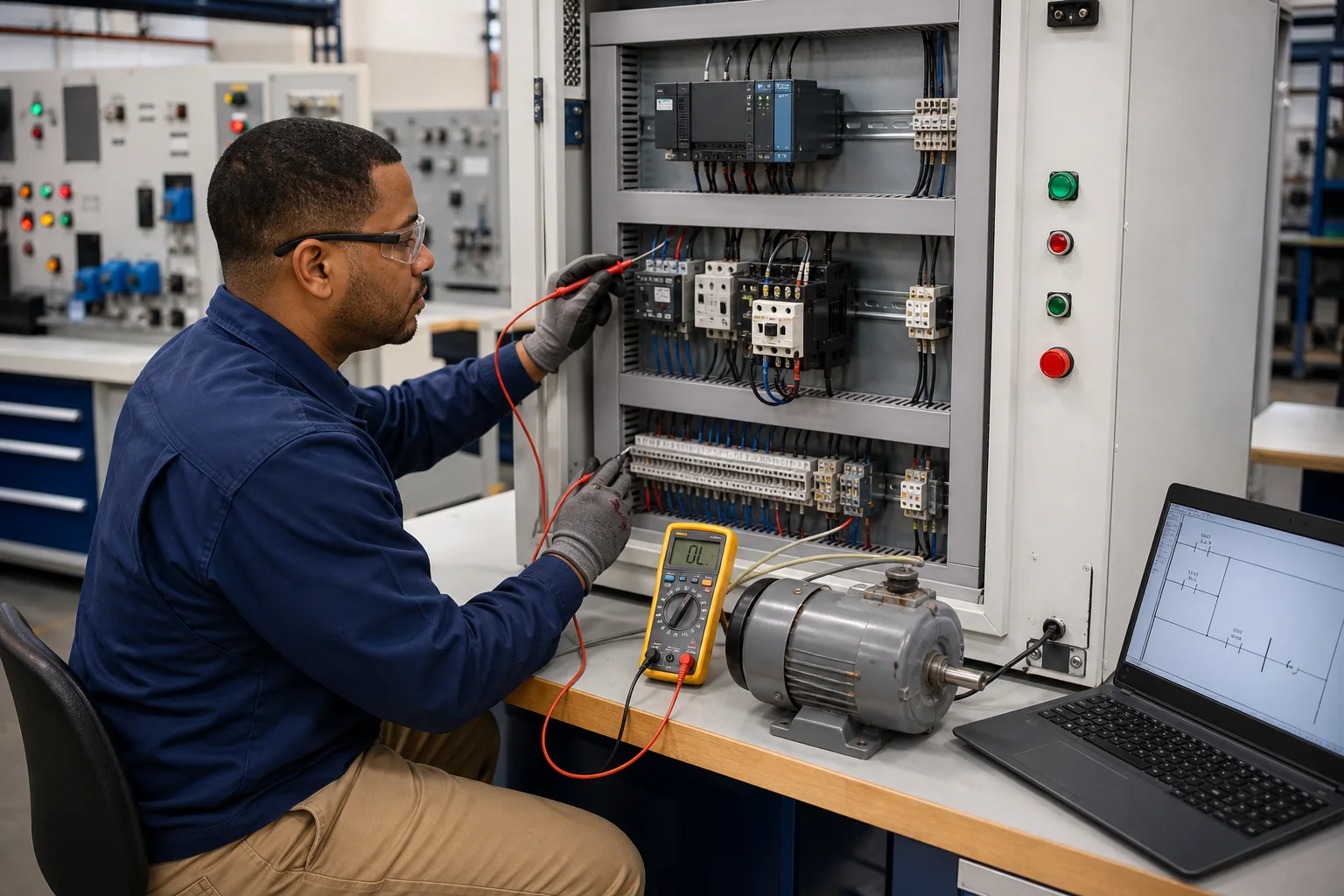
PLC technician tracing a motor-control fault between the controller, contactor and training motor
01Trace a real control problem from the PLC cabinet to the motor instead of memorizing isolated symbols.
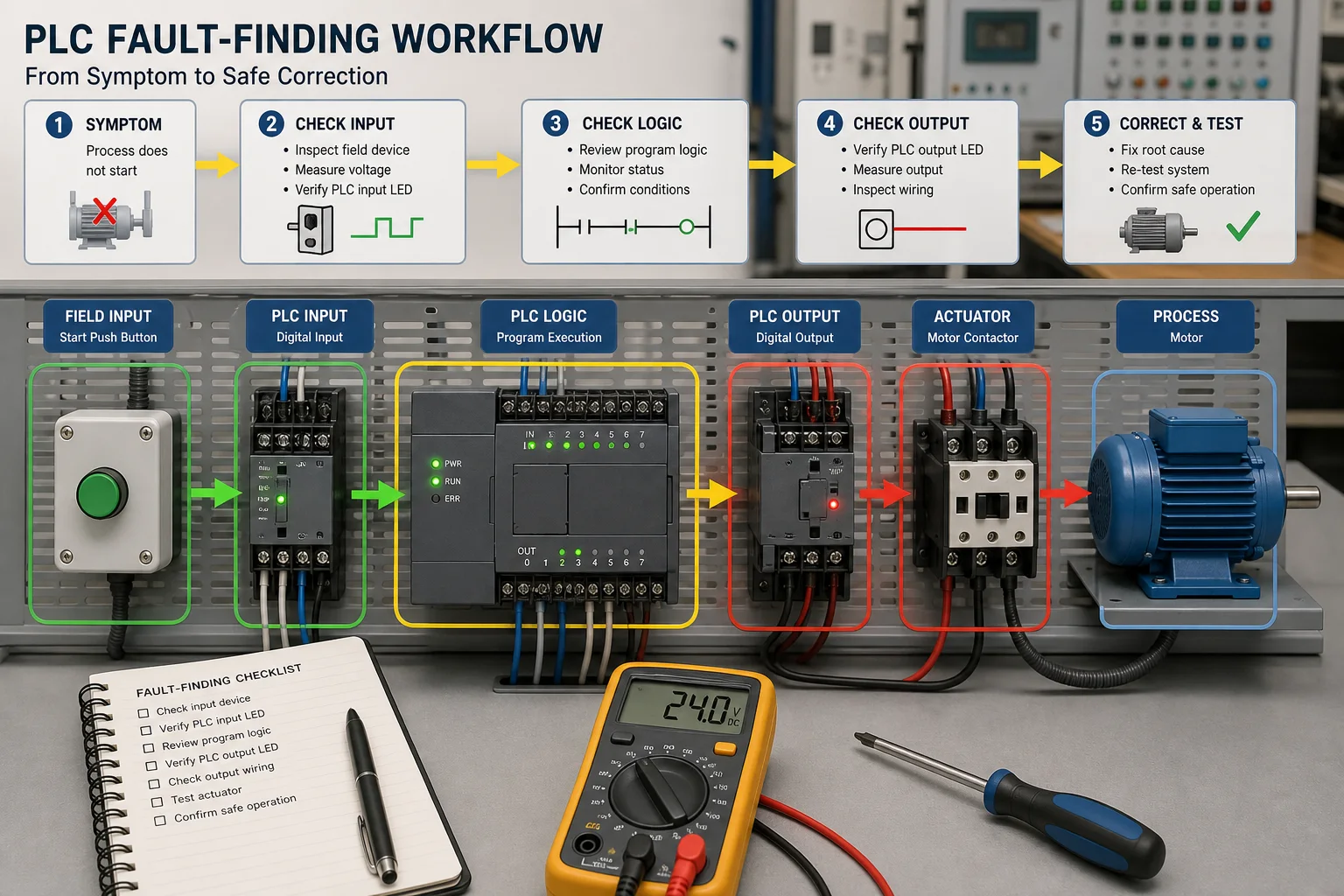
PLC fault-finding workflow from field input through controller logic and output to the motor
02Use a repeatable signal-path method: field input, PLC logic, output command and physical machine response.
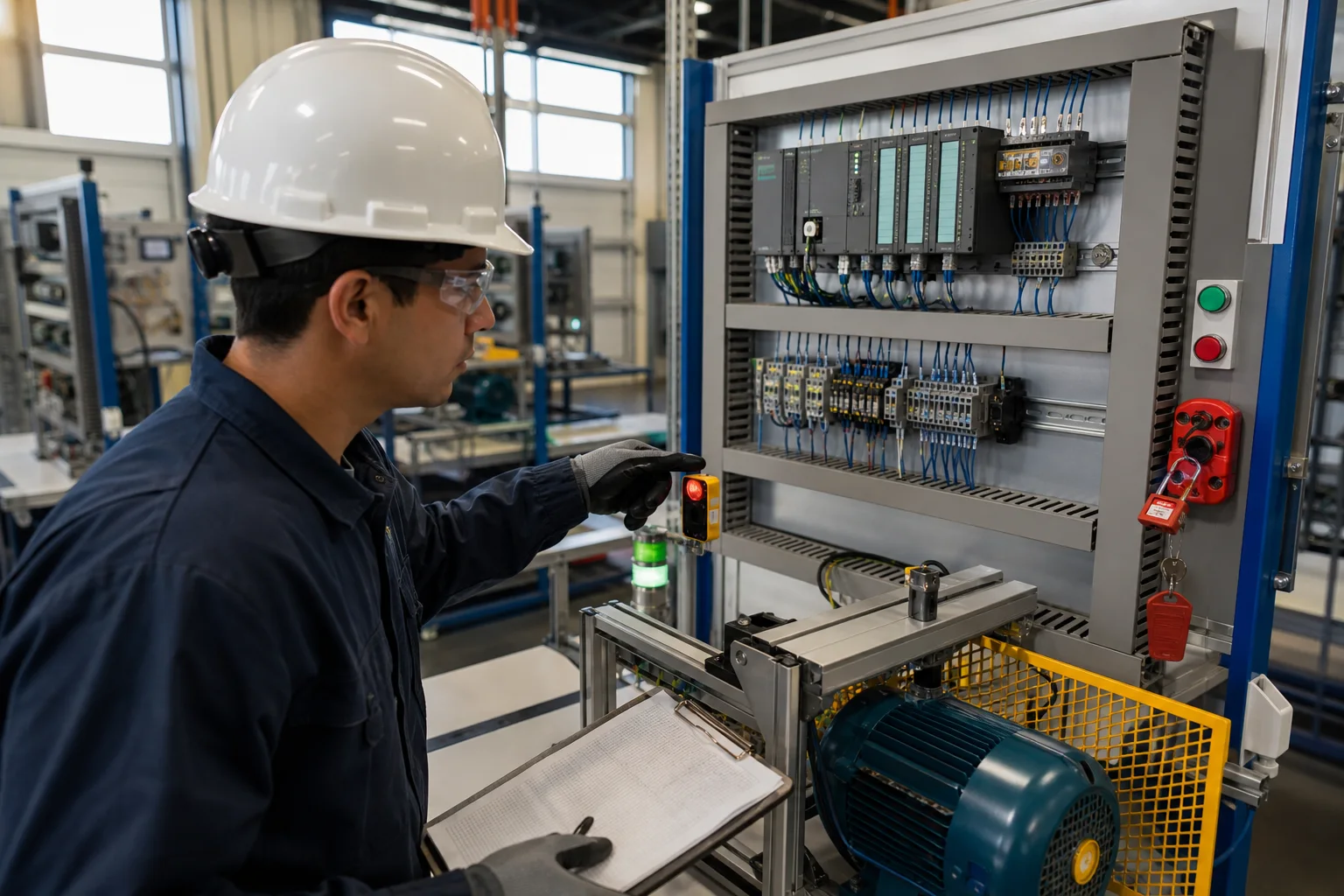
Technician checking a proximity sensor and PLC input state during an I/O checkout
03Compare the field device with its live I/O state so wiring and programming faults are not confused.
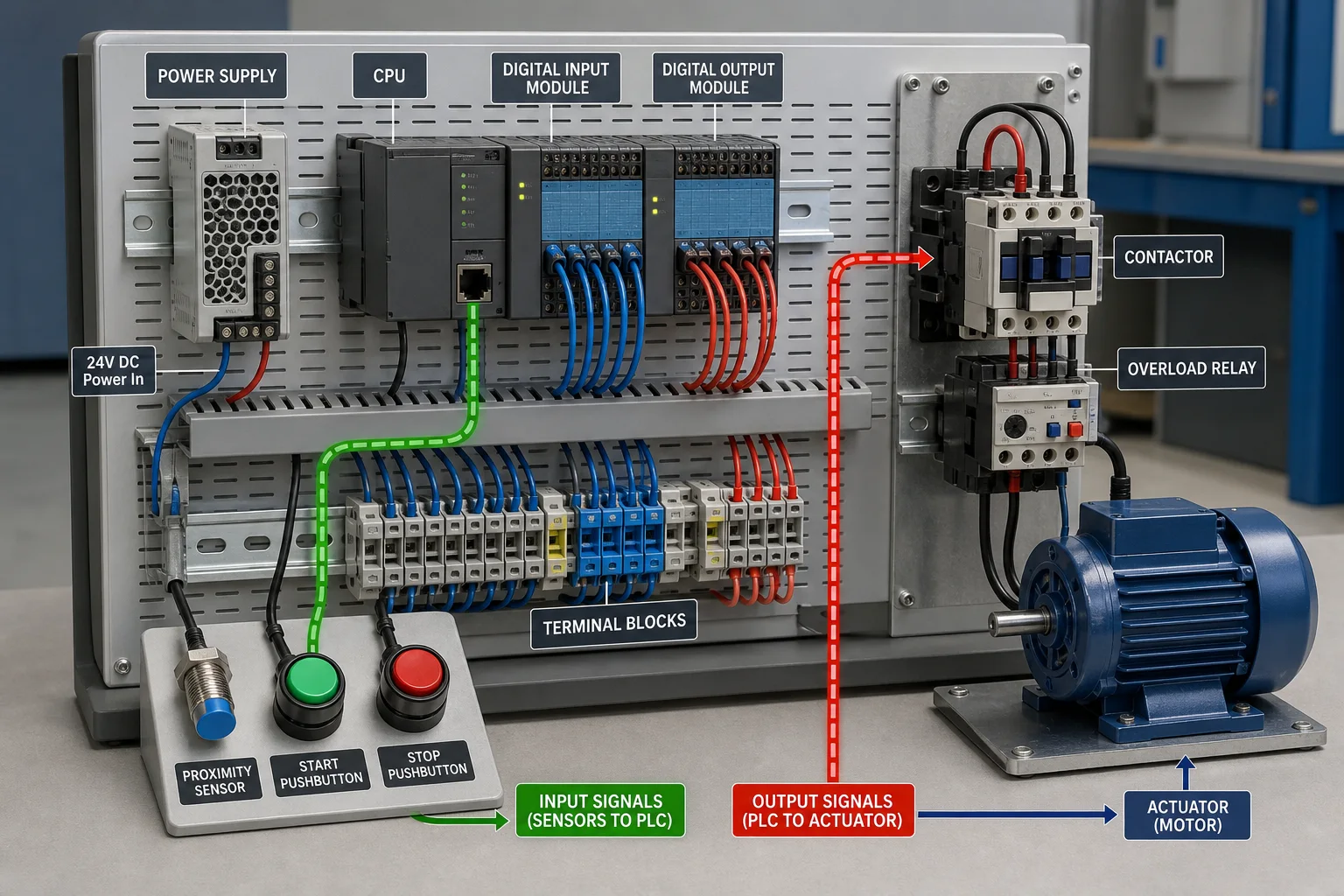
PLC training system showing power supply, CPU, digital I/O, terminal blocks, contactor, overload and motor
04Recognize how the controller, power supply, I/O, protection and load fit together as one control system.
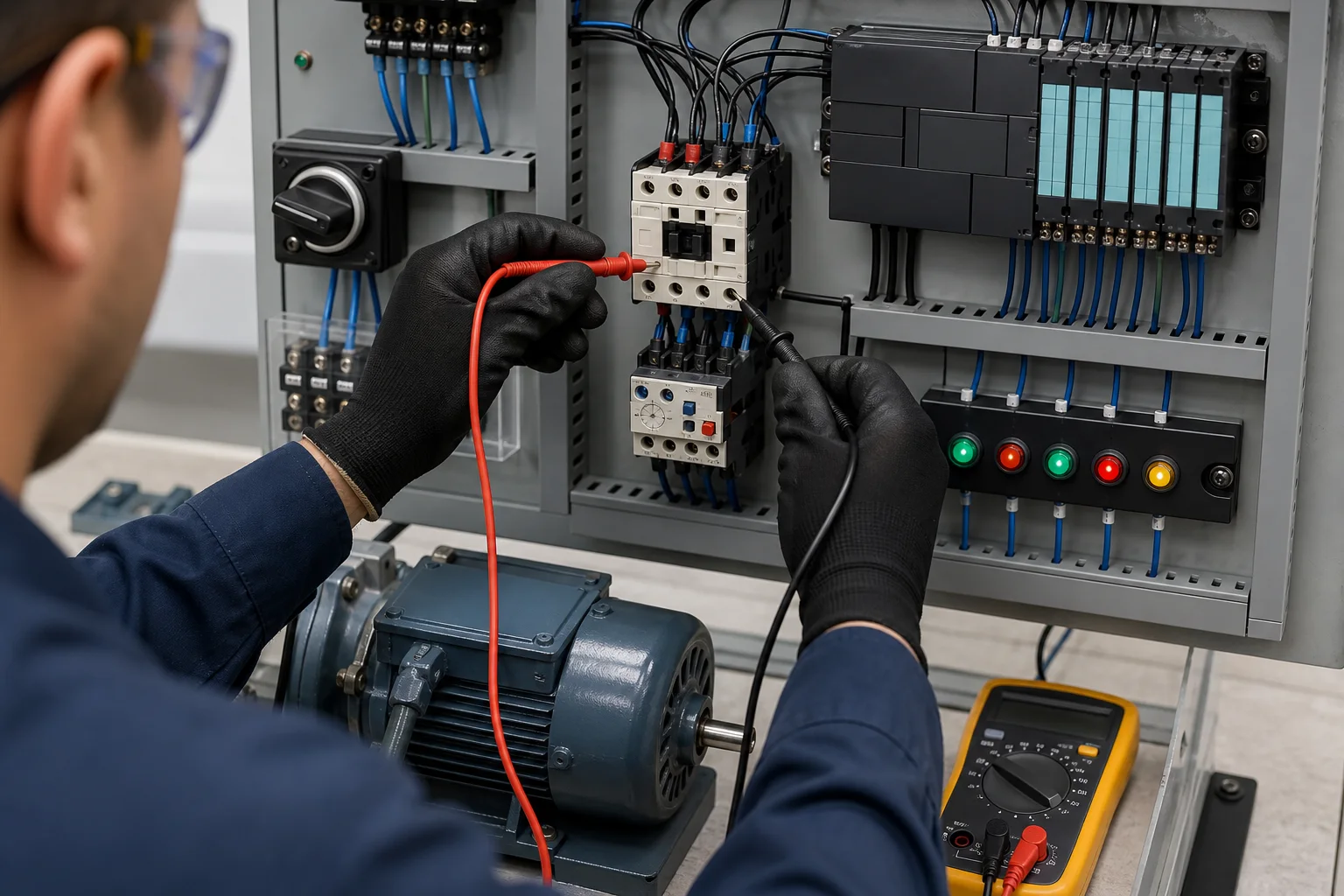
Technician measuring a motor contactor coil while checking the thermal overload relay
05Diagnose the electrical side safely: confirm the command, coil voltage, overload state and contactor response.
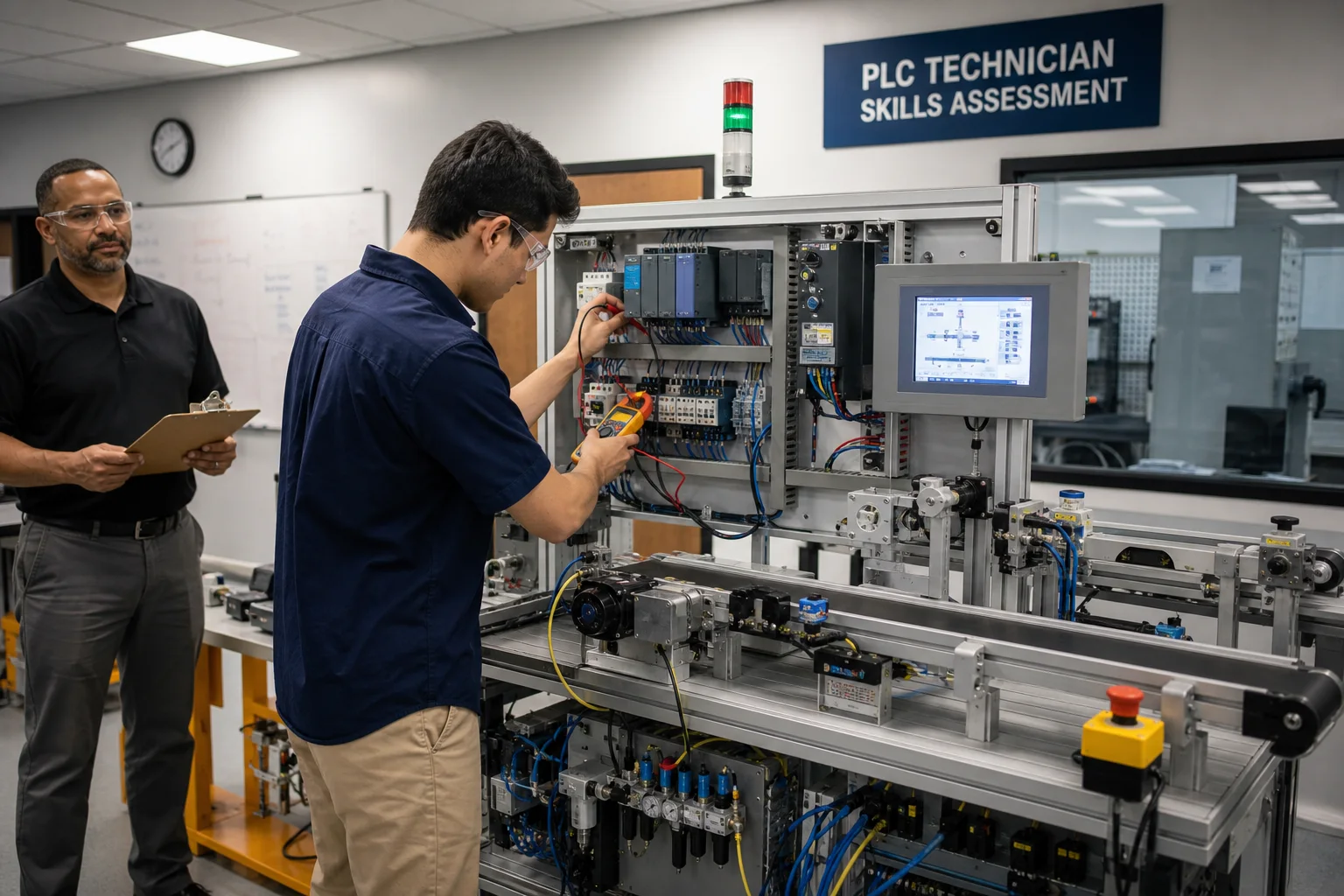
PLC technician skills assessment on a conveyor training cell with PLC, HMI and field devices
06Finish with an applied assessment that connects ladder logic, HMI status, sensors and machine behavior.
Definition

What is a PLC technician certificate?

A PLC technician certificate is a credential that confirms a person can programme and troubleshoot programmable logic controllers at a competent working level. The precise meaning depends on how the certificate was earned — and that distinction matters before you invest any time or money.

The role itself sits between electrical technician and controls engineer. A PLC technician installs controllers, wires I/O modules, edits and debugs existing ladder logic programmes, reads electrical schematics, and commissions equipment against a specification. A controls engineer designs the system from scratch, specifies hardware, and writes complex multi-axis or safety-rated programmes. Most job postings that say "PLC technician" want someone competent in the first set of skills, not necessarily the second.

There are three distinct forms of PLC technician certificate in the market, and conflating them causes real confusion:

  • Course-completion certificate. You finished a course, curriculum, or training programme. The issuing body is the training provider, not an external accreditor. These are common from online platforms, in-house corporate training, and community-college short courses. Our interview-track certificates fall in this category.
  • Industry certification (exam-based). You passed a proctored exam administered by an independent accrediting body. The ISA’s CCST (Certified Control Systems Technician) is the most recognised example. These are harder to earn, carry more weight in regulated industries, and typically require documented work experience as a prerequisite.
  • Employer-internal certification. A plant or OEM certifies you on their specific equipment and procedures. Common in automotive, food and beverage, and pharmaceutical manufacturing. Valid at that employer; not transferable.
Landscape

Who offers PLC technician certificates?

The options range from free to several thousand dollars. Here is an honest overview of each category so you can pick what fits your situation.

ProviderTypeCostProsCons
PLC Simulator (this platform)Interview-track completion certificatePro subscriptionFree to start; hands-on practice, graded assessment, verifiable PDF (issuing needs Pro)Not accredited; carries less formal weight than exam-based credentials
ISA — CCSTIndustry certification (exam-based)$250–$600 USD (plus ~$150 membership)Vendor-neutral, recognized in process industries globallyRequires documented field experience; no beginner entry point
Rockwell Automation (Allen-Bradley)Vendor certification$1 500–$4 000+ USD per courseClear currency in North American discrete manufacturingExpensive; employer sponsorship usually required
Siemens SITRAINVendor certification$1 000–$3 000 EUR per courseEuropean default; strong with Siemens-platform employersPriced for employer-funded learners; TIA Portal install required
Community college certificate programsAcademic certificate$800–$2 500 USD (semester program)Real hardware access; local employer recognition; financial aid eligibleSemester-paced; requires local program availability
Udemy / LinkedIn LearningCompletion certificate$10–$300 USDCheap, flexible, some excellent instructorsNo graded exercises; certificate holds little weight without portfolio

Pricing figures are estimates as of 2026. Verify current pricing directly with each provider before applying. ISA membership and exam fees vary by region and membership status. Rockwell and Siemens prices depend on course length and delivery format.

The pathway

Our PLC technician certificate pathway.

This is a completion certificate, not an accredited industry credential. We state that openly because it matters for your planning. What it gives you is documented evidence that you worked through a structured, graded curriculum — something you can point to in a job application or portfolio alongside your working code.

The five stages below are the strongest route from first practice to assessed evidence. The first three build skill; the fourth and fifth describe the actual certificate requirement. You do not have to clear every catalog item before attempting a track.

  1. 1

    Try one real PLC program without an account

    Run the guided Switch & Light lab in your browser. It proves the editor and simulator fit how you learn before you create an account.

  2. 2

    Build foundations across 12 core lessons

    Learn scan-cycle behavior, contacts, coils, timers, counters, latching and sequencing. A free account unlocks the first 6 lessons per dialect without a trial clock.

  3. 3

    Practice with 170 source-catalogued practice records

    Move from motor control and wiring to interlocks, sequences and process control. Access varies by plan; 32 records are tagged for the free tier.

  4. 4

    Choose one of 6 interview tracks

    Use the job-focused graded assessment that matches the skill you want to prove. Pro unlocks the assessed tracks, structured feedback, and certificate eligibility.

  5. 5

    Pass the track and download its certificate

    After you pass a certificate-eligible track and are on Pro, its result screen provides a dated, verifiable PDF for that specific assessment. Repeat the process for another track when you are ready.

Honest note on accreditation. Some job postings in process industries (oil, gas, pharmaceuticals) require an ISA CCST or equivalent exam-based credential. A platform interview-track certificate will not satisfy those requirements. For most entry-level and mid-level PLC technician roles in discrete manufacturing, however, the distinction is rarely enforced — hiring managers care more about whether you can read a rung and diagnose a fault than which body issued your certificate. Check the actual job listing before you decide which credential to pursue.
Honest assessment

Is a PLC technician certificate worth it?

For entry-level candidates: yes, with a caveat. A PLC technician certificate alone is a weaker signal than working code. If you have finished the pathway but the only evidence you can show is a PDF, you will lose to a candidate who shows up with a GitHub repository full of ladder logic and a video of a motor starting correctly on first power-up. Use the pathway to build the code portfolio, then list the certificate as confirmation you did it in a structured way.

For mid-career upskilling: yes, without the caveat. A hiring manager interviewing someone with five years of plant experience rarely checks accreditation status on an online certificate. What matters is whether the candidate can answer applied questions clearly — and a structured curriculum with graded exercises is one of the most reliable ways to build that depth quickly. Passing a graded interview track documents a narrower, assessed skill in a format that looks clean on a CV.

For contract and freelance work: here the accreditation distinction starts to matter more. Some clients, particularly in regulated industries, want a formal third-party credential. In those cases, pairing a platform completion certificate with an ISA CCST or a Rockwell vendor cert is the right play. Our learning system is a practical preparation tool for those exams; many of the scenario topics (motor control, interlocks, sequencers) map directly to exam content. Read our PLC certification guide for a full breakdown of which exam-based credentials to target for your market.

Time commitment

How long to earn a PLC technician certificate?

The realistic range for our pathway is 40–100 hours, spread over 4–12 weeks of consistent evening and weekend practice. The wide range reflects how much prior background you bring.

Someone with two years of electrical panel-wiring experience will already understand relay logic, I/O addressing, and how contactors work. For them, the fundamentals lessons are fast revision. The scenarios — particularly the multi-step sequencers and PID loops — will still take time, but the total pathway lands closer to 40 hours.

A software developer or IT professional coming in without any controls background will need the full 60–100 hours. The scan-cycle programming model is genuinely different from event-driven or request-response code. The concepts that trip people up most often are: coil evaluation order (it matters which rung is above which), edge detection (why a momentary pushbutton needs an R_TRIG, not just an XIC), and timer re-triggering (why you need to reset a TON before it re-fires on the next cycle). Each of these clicks after a few scenarios — but they do take a few scenarios.

Practical schedule. Two hours an evening, four evenings a week puts you at roughly 8 hours per week. At that pace, you complete the pathway in 5–13 weeks. Most people who start and finish are on a 6–8 week cadence.

For comparison, a community-college PLC certificate program runs a full semester (15–16 weeks) for 3–6 credit hours. Rockwell instructor-led courses are typically 3–5 days in a classroom. The online PLC technician certificate pathway here is faster than either, at the cost of no hardware lab time. Plan to supplement with physical controller access at some point if you are targeting roles that will put you on live plant equipment.

FAQ

Common questions about the PLC technician certificate.

It is free to start: the no-account guided lab, the first 6 core lessons per dialect, and 32 free-tier practice records require no card. Downloadable interview-track certificates are a Pro feature.

Start your PLC technician pathway.

Run the first guided lab without an account. Continue free with 32 free-tier practice records, then upgrade when you are ready for a graded interview track and its certificate.

Related: lessons · quizzes · interview prep · PLC certification guide.

Job-readiness and assessment field guide

PLC technician certificate: readiness checklist

Direct answer

The candidate can connect a named assessment result to the program, measurements and machine behavior that produced it.

Written for technician candidates, employers and instructors comparing evidence of PLC, electrical and troubleshooting skills.

System map / 02

NODE 01observable

Role scope

Competencies across PLC logic, wiring, motors, drives and diagnostics.

NODE 02observable

Skills map

Assessment criteria to observable scenario and fault evidence.

NODE 03observable

Core exercise

Independent completion of a bounded maintenance task.

NODE 04observable

Stretch case

Changed inputs, timing and restart without coaching.

NODE 05observable

Troubleshooting

A hidden fault diagnosed from measurements rather than guesses.

NODE 06observable

Portfolio evidence

Portfolio evidence reviewed alongside supervised physical work.

Real plc technician certificate footage

See this exact skill in the working simulator.

Watch the real browser product respond to the task on this page, then try the same practical workflow yourself. No slides, concept mockups, install, or credit card.

Try this in the browser
PLC Technician Certificate — What It Proves and What It Does Not