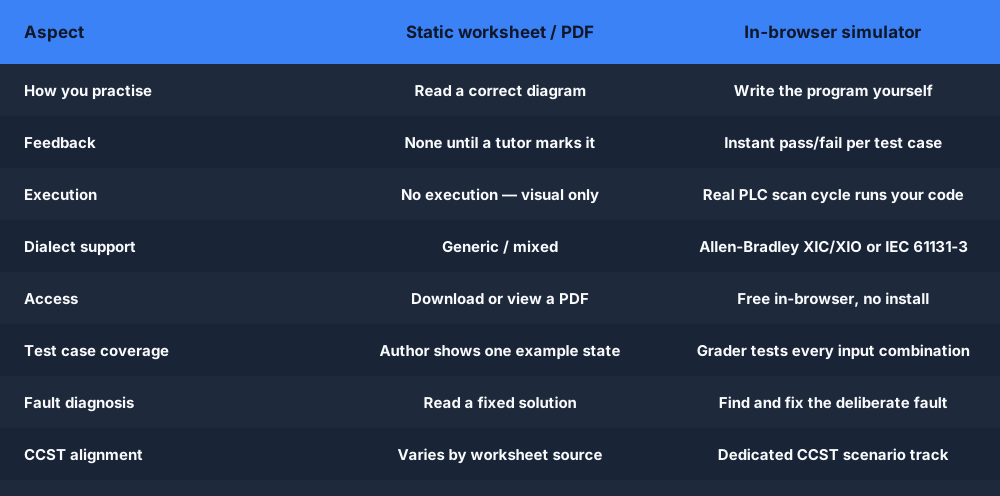
Stop checking your own homework against a PDF answer key. Every exercise here runs against real test cases in your browser — write the logic, hit Run, and find out immediately whether it survives the edge cases.
Join 2800+ learners practicing PLC programming
How practice works
Build your program in ladder logic or structured text, in IEC 61131-3, Allen-Bradley, or Siemens-style syntax. The same editor for every exercise — no software to install.
Your code does not get pattern-matched against a model answer. It executes on a real scan cycle that controls a simulated machine — the tank fills, the motor runs, the conveyor jams.
Hidden test cases force the conditions you would never think to check by hand: stop pressed mid-sequence, sensor chatter, timer overlap. Per-test pass/fail, with failure reasons.
The patterns you practise
Almost every PLC practice exercise reduces to a handful of foundational rung patterns. Learn these six cold and you can build the seal-in circuits, timed sequences, and counting logic behind the entire machine library.
Exercise tracks
Each track is sequenced by difficulty so you always know what to attempt next. Free, Basic, and Pro labels show exactly what each tier unlocks — no surprises behind the paywall.
10 exercises · Difficulty 1–2
From "switch turns on light" to counting five boxes with a CTU. Contacts, coils, AND/OR, NC stop buttons, latching, TON timers — 3 to 7 minutes each.
Browse the track →12 lessons · Difficulty 1–3
A sequenced course in exercise form: button-to-light, E-stop NC contacts, seal-in, SET/RST, edge triggers, TON/TOF, counters, a conveyor-reject integration exercise, and a traffic-light capstone (shared with the machines track).
Browse the track →47 machines · Difficulty 1–5
Full machine projects with physics models — motors, pumps, conveyors, packaging lines, HVAC, brewing. The closest thing to plant work you can do in a tab.
Browse the track →8 exercises · Difficulty 2–4
Someone else broke the program — you diagnose it. NO/NC swaps, broken seal-ins, wrong addresses, stuck inputs, scan-order races, and intermittent bugs.
Browse the track →10 labs · Difficulty 1–4
24 VDC supplies, NPN/PNP sensors, 4–20 mA loops, relay outputs, dual-channel E-stops, RS-485, and industrial Ethernet — wiring before programming.
Browse the track →40 exercises · Difficulty 1–4
Exam-style exercises in the style of the ISA CCST: contacts, timers, diagnostics, safety categories, drive handshakes, HMI tags, and documentation reading.
Browse the track →4 exercises · Difficulty 2–3
Scale a 4–20 mA pressure transmitter, build level alarms with hysteresis, hold a temperature setpoint with deadband, and drive a proportional valve.
Browse the track →The machine track runs from difficulty 1 to 5. Here is the spread — every card is a runnable, auto-graded exercise.
Three-wire control with seal-in, E-stop, and thermal overload.
Photo-eye sort station with counters and reject timing.
Timed signal sequence with chained TON timers and an all-red phase.
Multi-step recipe sequencer with agitator interlock — state-machine practice.
Multi-floor call queue, door timing, and direction priority logic.
Indexing conveyor with filler, capper, and reject — coordinated state machines.
Want worked walkthroughs of the classic problems first? See PLC practice problems with solutions →
Free tier
The free tier is not a teaser. You get the entire 10-exercise beginner track, curriculum lessons 1–6, and these complete exercises — all auto-graded, all in the browser:
$0
Beginner track, curriculum lessons 1–6, and free-tier machine, wiring, and analog exercises.
$12/mo or $99/yr
The broader scenario library — 35 of the 40 core machines — plus all 18 lessons and 12 quizzes.
$29/mo or $249/yr
All tracks: fault-injection, CCST cert prep, all 8 dialects, AI rung assistant, and solution walk-throughs.
No install. No PDF answer keys. No credit card.
Create free account →