Pro
35 min

Mining Crusher Protection Sequence

miningcrusherconveyorprotectionvibrationpermissivesequence

Ready to build this?

Sign up free — no credit card required. This scenario requires the Pro plan.

Sign up to play this scenario →

Already have an account? Log in

Mining Crusher Protection Sequence

Briefing

Commission a primary-crusher train with real startup dependencies. Sound the pre-start warning, prove the discharge conveyor is at speed, start the crusher, then release the feed conveyor only after crusher speed is proven. The process model ramps rotating equipment, builds ore load and generates high vibration when a blocked chute is fed. Any safety, lubrication, guard, blockage or vibration trip must remove every drive and remain latched until a deliberate healthy reset.

Objectives

  • Require E-stop, lubrication, guard and chute permissives before accepting a start
  • Run a one-second pre-start alarm before energising the discharge conveyor
  • Prove discharge speed before the crusher and crusher speed before the feed conveyor
  • Trip the complete train on chute blockage or high vibration
  • Require RESET_PB with every permissive restored before clearing the trip

Hints

  • A latched RUN_BIT lets a momentary start request drive the complete sequence
  • Use the physics feedback tags DISCHARGE_AT_SPEED, CRUSHER_AT_SPEED and HIGH_VIBRATION
  • Drive every motor through NOT TRIP_BIT so the protection path is deterministic

I/O Table

Inputs

START_PB

Crusher train start request

BOOL · %I0.0

STOP_PB

Normal stop request

BOOL · %I0.1

RESET_PB

Trip reset request

BOOL · %I0.2

ESTOP_OK

Emergency-stop safety chain healthy

BOOL · %I0.3

LUBE_PRESSURE_OK

Crusher lubrication pressure healthy

BOOL · %I0.4

GUARD_CLOSED

Crusher guards closed

BOOL · %I0.5

CHUTE_BLOCKED

Blocked-chute switch

BOOL · %I0.6

DISCHARGE_AT_SPEED

Physics: discharge belt at speed

BOOL · %I0.7

CRUSHER_AT_SPEED

Physics: crusher at speed

BOOL · %I1.0

HIGH_VIBRATION

Physics: crusher vibration trip

BOOL · %I1.1

Outputs

PRESTART_ALARM

Audible pre-start warning

BOOL · %Q0.0

DISCHARGE_CONVEYOR

Crusher discharge conveyor

BOOL · %Q0.1

CRUSHER_MOTOR

Primary crusher motor

BOOL · %Q0.2

FEED_CONVEYOR

Ore feed conveyor

BOOL · %Q0.3

TRIP_LAMP

Latched crusher protection trip

BOOL · %Q0.4

Your program will be tested against:

All test cases run automatically when you submit. Assertions are hidden until you pass.

  1. #1Unsafe start is denied

    Missing lubrication pressure latches a trip and prevents all drives

  2. #2Train starts in the safe order

    Warning, discharge conveyor, crusher and feed are sequenced from physical speed feedback

  3. #3Blocked chute trips every drive

    A blockage during production immediately removes feed, crusher and discharge outputs

  4. #4Trip reset requires a healthy plant

    Reset is rejected while the chute remains blocked and accepted after it clears

Ready to build this?

Sign up free — no credit card required. This scenario requires the Pro plan.

Sign up to play this scenario →

Already have an account? Log in

Runnable simulator field guide

Mining crusher protection PLC scenario: test checklist

Direct answer

The learner can separate start permissives, running proof, process protection and emergency stopping, preserve the first trip and prove a controlled restart in the correct equipment order.

Written for mining, bulk-material and controls learners studying how protection inputs govern a crusher, feeder and conveyor sequence.
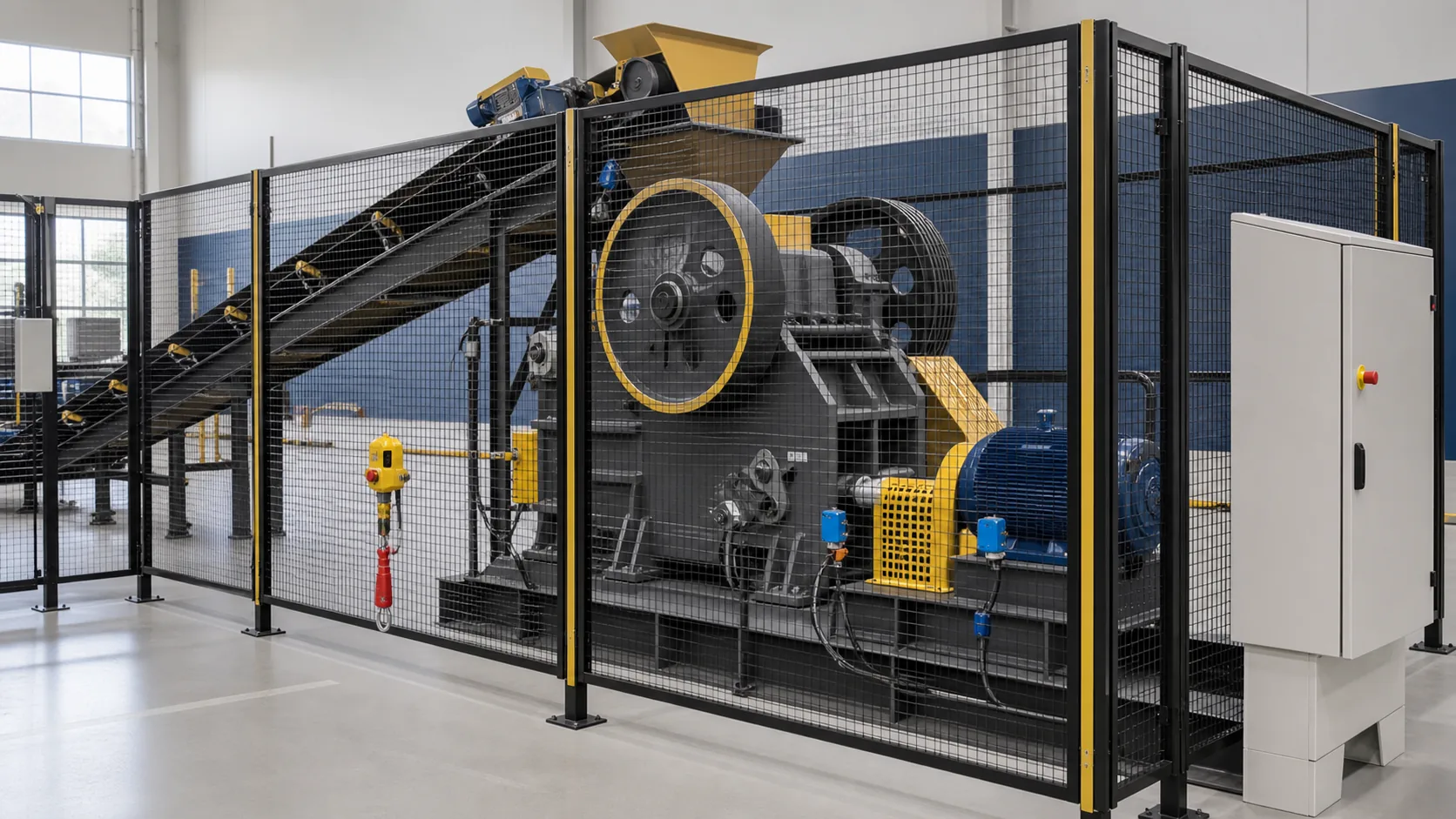
a guarded educational crusher and conveyor cell with pull-cord, blocked-chute, speed, vibration and bearing-temperature protection inputs while studying crusher and conveyor permissives, trip evidence, coast-down and controlled restart
System map / 02

NODE 01observable

Scenario setup

Equipment train, energy sources, guarding, pull cord, blocked chute, zero speed, lubrication, vibration, temperature, motor protection, sequence and alarm history.

NODE 02observable

I/O and state map

Start request through permissive chain and PLC outputs into feeder, conveyor and crusher motion, with independent speed, material and equipment-health feedback.

NODE 03observable

Normal run

Downstream-to-upstream startup, stable running proof, upstream-to-downstream material clearing and deliberate normal shutdown.

NODE 04observable

Boundary run

Blocked chute, belt stopped, high vibration, bearing temperature, lubrication loss, overload, pull-cord trip, sensor discrepancy and power return.

NODE 05observable

Injected fault

The first field, protection, sequence, motor, mechanical, material-flow or feedback boundary that departed from the expected state.

NODE 06observable

Target check

The cause removed, bypasses absent, guards and zones restored and stop/start acceptance cases witnessed under the site procedure.

Answer surface / 07

What interlocks are commonly used on a crusher conveyor?

Examples include downstream running proof, zero-speed detection, pull cords, blocked-chute switches, lubrication state, bearing temperature, vibration, motor protection and guarding. The required set comes from the actual risk and equipment design.

Why should the first crusher trip be preserved?

A cascade may stop several machines and create many secondary alarms. The earliest time-aligned deviation is usually the strongest evidence for locating the initiating cause.