
Runnable simulator field guide
Broken seal-in PLC fault scenario: test checklist
Direct answer
The learner can trace the maintained-command path, distinguish a missing seal-in branch from a field or output fault and prove stop priority plus restart behavior.
Written for pLC beginners and maintenance learners diagnosing start-stop logic that runs only while the Start pushbutton is held.
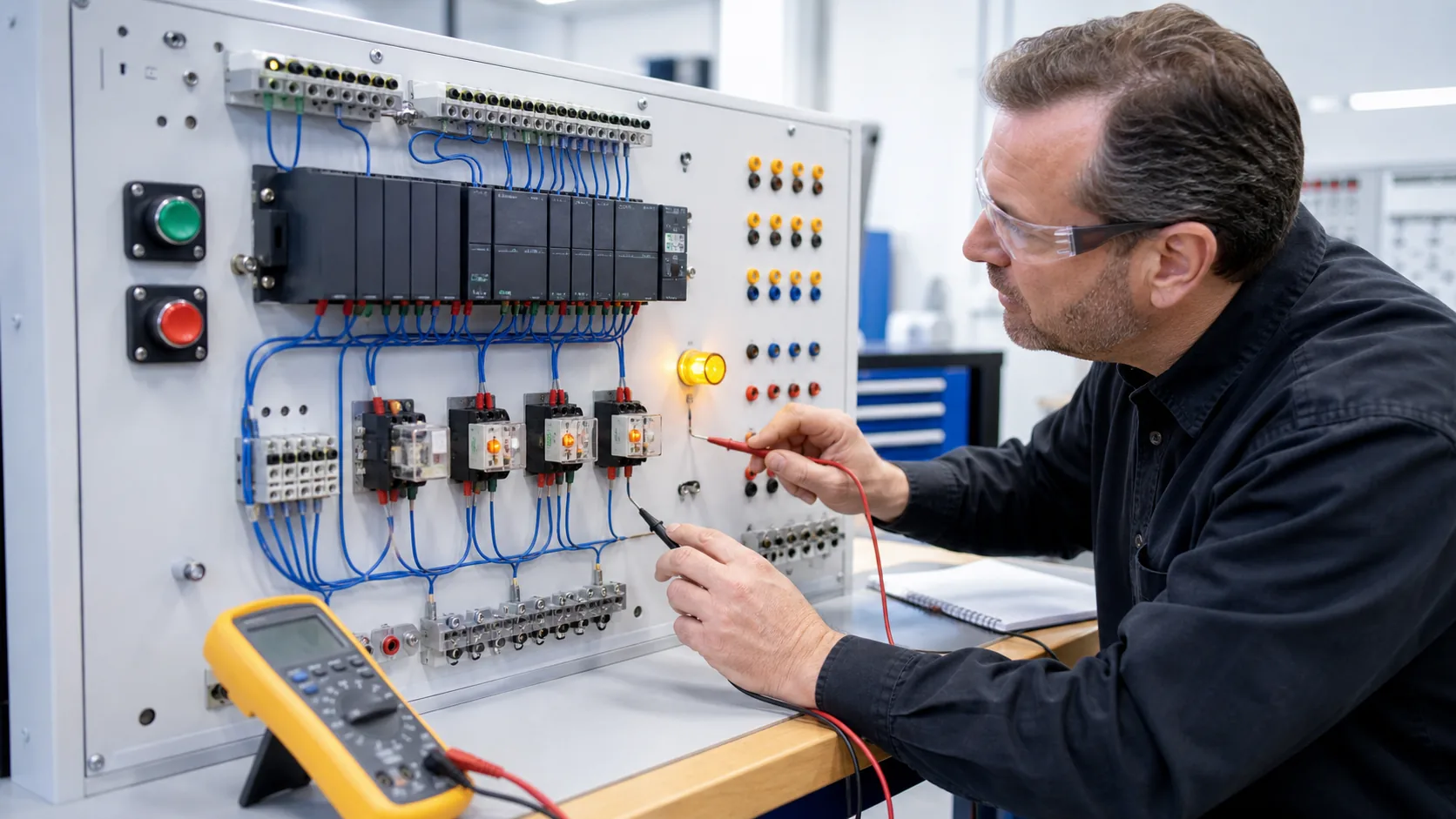
Scenario setup
Initial state, Start and Stop inputs, permissives, maintained request, seal-in branch, final output, running feedback and reset policy.
I/O and state map
Momentary field command through input image, rung branches, maintained state and final output into the modeled contactor and motor response.
Normal run
One deliberate Start pulse maintaining the request after release, followed by Stop removing it with deterministic priority.
Boundary run
Start and Stop together, missing branch, wrong address, output feedback absent, duplicate writer, controller restart and a held input.
Injected fault
An input, branch, maintained-state, final-writer, output-interface or physical-feedback disagreement.
Target check
The corrected case rerun from cold start, running state, stop, permissive loss and power-return conditions.
Why does a PLC motor stop when I release Start?
The momentary path is working but the maintained path is missing, addressed incorrectly, blocked by a condition or overwritten later. Trace the final command owner and the complete seal-in branch.
Should the seal-in contact use the motor output or an internal run request?
Both patterns can be valid when ownership is explicit. An internal request often separates operating intent from the physical output, while feedback should independently prove that the machine responded.