Basic
20 min

Jog / Run Motor Control

motorjogselectorsafetylatching

Ready to build this?

Sign up free — no credit card required. This scenario requires the Basic plan.

Sign up to play this scenario →

Already have an account? Log in

Jog / Run Motor Control scenario preview

Briefing

A classic two-mode motor starter. SELECTOR_RUN_MODE selects between Run mode (latched via RUN_PB) and Jog mode (CONTACTOR energised only while JOG_PB is held). An E-stop or thermal overload latches a fault that blocks operation until STOP_PB is pressed and the fault condition clears. Lamps indicate the current operating mode.

Objectives

  • In RUN mode: RUN_PB latches CONTACTOR (seal-in); STOP_PB drops it
  • In JOG mode: JOG_PB energises CONTACTOR only while held; release drops it
  • ESTOP or OVERLOAD drops CONTACTOR and latches FAULT_LAMP
  • Fault clears only when STOP_PB pressed AND fault condition cleared
  • RUN_LAMP on while CONTACTOR energised in run mode; JOG_LAMP on in jog mode while held

Hints

  • Use SELECTOR_RUN_MODE to gate RUN_PB into the RUN_BIT SET rung
  • In jog mode (SELECTOR_RUN_MODE = false): CONTACTOR := JOG_PB AND /FAULT_BIT
  • FAULT_BIT: S= by /ESTOP OR OVERLOAD; R= when STOP_PB AND ESTOP AND NOT OVERLOAD
  • ESTOP is NC — the safe/healthy state is ESTOP = TRUE

I/O Table

Inputs

RUN_PB

Run push-button (momentary)

BOOL · %I0.0

STOP_PB

Stop push-button (momentary)

BOOL · %I0.1

JOG_PB

Jog push-button (held)

BOOL · %I0.2

SELECTOR_RUN_MODE

Mode selector (true=RUN, false=JOG)

BOOL · %I0.3

ESTOP

E-stop (NC — true=healthy)

BOOL · %I0.4

OVERLOAD

Thermal overload (true=trip)

BOOL · %I0.5

Outputs

CONTACTOR

Motor contactor coil

BOOL · %Q0.0

JOG_LAMP

Jog mode indicator lamp

BOOL · %Q0.1

RUN_LAMP

Run mode running indicator lamp

BOOL · %Q0.2

FAULT_LAMP

Fault indicator lamp

BOOL · %Q0.3

Your program will be tested against:

All test cases run automatically when you submit. Assertions are hidden until you pass.

  1. #1Run mode: RUN_PB seals in CONTACTOR

    In run mode, momentary RUN_PB energises and latches contactor

  2. #2Jog mode: CONTACTOR only while JOG_PB held

    In jog mode, contactor follows JOG_PB exactly

  3. #3E-stop latches fault, cleared by STOP_PB after restore

    E-stop drops contactor and latches fault until STOP_PB + E-stop cleared

  4. #4Thermal overload latches fault, requires overload reset + STOP_PB

    Overload trip drops contactor and latches fault until trip clears and STOP_PB pressed

Ready to build this?

Sign up free — no credit card required. This scenario requires the Basic plan.

Sign up to play this scenario →

Already have an account? Log in

Runnable simulator field guide

Jog-run motor PLC scenario: test checklist

Direct answer

The learner can define ownership and priority for jog, run, stop and feedback and prove that mode changes cannot create an unintended maintained command.

Written for pLC learners implementing hold-to-run jog behavior alongside a maintained production run command.
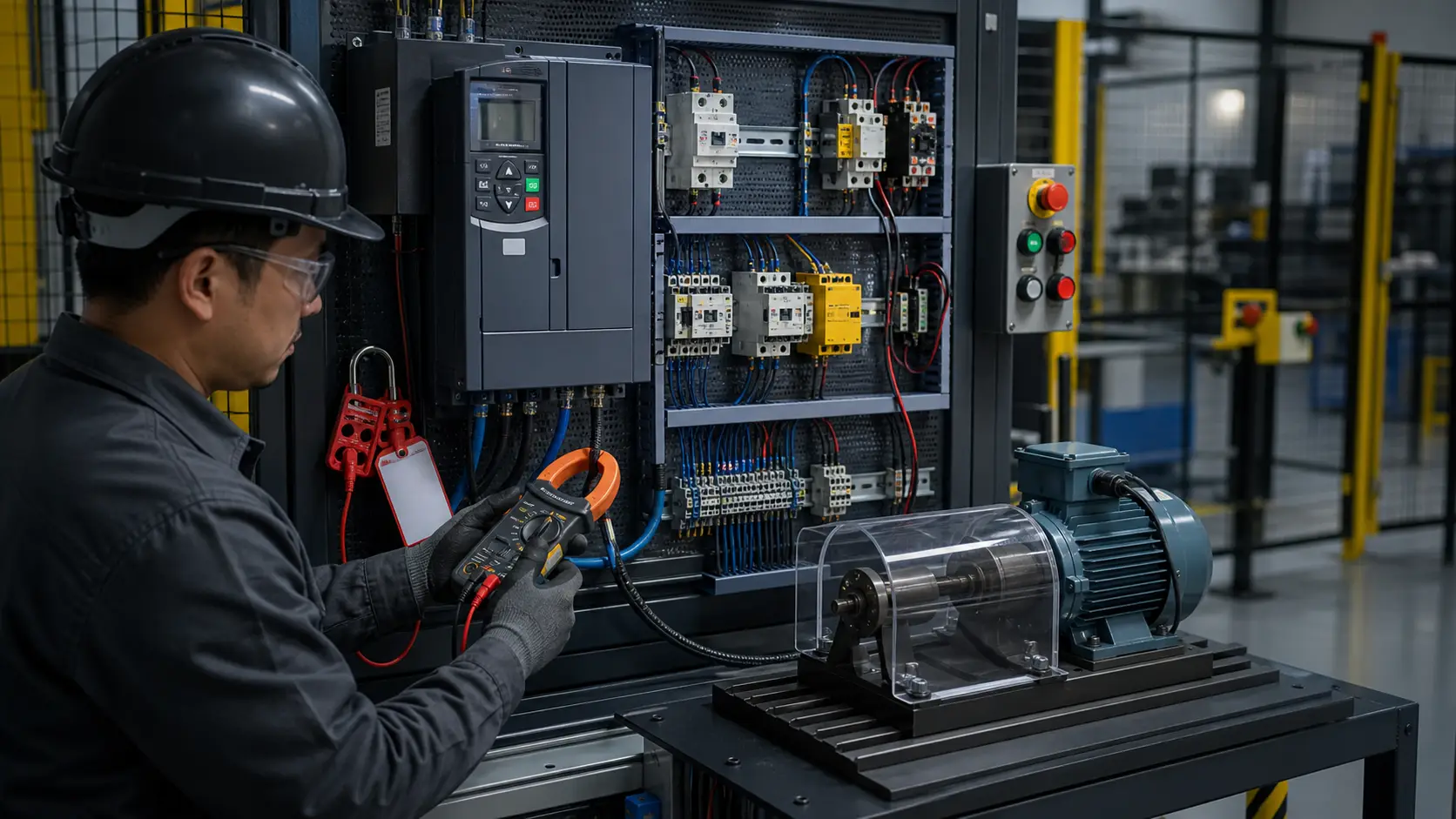
a guarded motor-control training cell used to commission contactors, protection, a variable-frequency drive and independent speed feedback while studying jog versus maintained-run logic, priority and restart behavior
System map / 02

NODE 01observable

Scenario setup

Jog request, maintained run, stop priority, mode selection, seal-in state, permissives, contactor command, feedback, transition policy and restart state.

NODE 02observable

I/O and state map

Operator inputs through mode and priority logic to output command, motor response and independent running feedback.

NODE 03observable

Normal run

Jog operates only while deliberately held, run maintains only under its contract and stop removes both paths.

NODE 04observable

Boundary run

Simultaneous jog and run, mode change while moving, held button, lost feedback, overload, reset, controller restart and power return.

NODE 05observable

Injected fault

An input, mode, priority, latch, permissive, command, starter, feedback or restart mismatch.

NODE 06observable

Target check

The logic embedded in the target machine design and tested with physical controls and protection.

Answer surface / 07

What is the difference between jog and run control?

Jog is commonly hold-to-run for positioning or setup, while run may maintain state until a deliberate stop or other condition removes it.

What should happen if jog and run are pressed together?

The required priority must be explicit and risk-assessed; test the simultaneous case instead of relying on rung order by accident.