PLC Simulator
PLC field notesfree

Free PLC Training Resources That Are Actually Worth Your Time (2026)

A curated list of genuinely free PLC training — YouTube channels, vendor free tiers, open-source tools, and our own free scenarios. Covers what's worth learning for zero budget, which free certificates have real signal, and when paying finally makes sense.

PLC Simulation Software10 min read

The free PLC training that is actually worth your time

Searching free plc courses online with certificate or free plc training will bury you in two kinds of content: high-quality free material from people who know what they're doing, and lead-generation funnels pretending to be free courses. This post is a curated, tested list of the first category and a honest filter for the second.

If you have zero budget and plenty of time, you can learn real PLC programming for free in 2026. It takes more self-discipline than a paid course, but the material exists. This post tells you where.

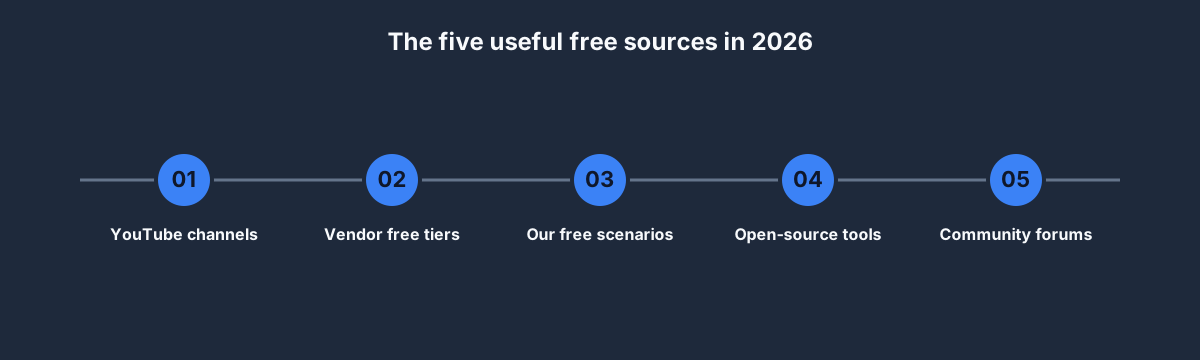
Five genuinely-free sources worth your time
The five useful free sources in 2026

1. YouTube channels

  • RealPars — the gold standard for free PLC video. Hundreds of videos, consistent quality, working engineers behind the camera. Start with their "PLC Fundamentals" playlist.
  • LearnChannel-TV — vendor-neutral, beginner-focused, excellent pacing. Subscribe.
  • Controls & Engineering — solid intermediate material, especially on scan cycle and ladder patterns.
  • Mitsubishi Factory Automation, Omron Industrial Automation, Rockwell Automation — official vendor channels. Quality varies; best for product-specific orientation.

Filter: check the upload date. Anything before 2022 is likely out of date in terms of IDE chrome (TIA Portal and Studio 5000 iterate yearly). Fundamentals don't change.

2. Vendor free tiers and academies

  • Inductive Automation's University of Ignition — free, vendor-issued, genuinely respected in the Ignition ecosystem. Complete the Gold Certification track for a credential recruiters recognise.
  • Rockwell Learning Services — some free content, much paid. The free stuff is solid orientation.
  • Siemens SIOS (Industry Online Support) — official PDFs, videos, and a small free course selection. Searchable.
  • AutomationDirect — free online training around Productivity and Do-more PLCs. Vendor-specific, which is fine if you're targeting that ecosystem.
  • TIA Portal V18/V19 Basic trial — 21 days, enough for the first-program tutorial.
  • Studio 5000 Mini edition — free, but limited to MicroLogix-class hardware.

3. Our free tier

  • Two scenarios (Traffic Light, Motor Start/Stop)
  • Three lessons (PLC Fundamentals, Ladder Logic, Timers & Counters)
  • One quiz (Fundamentals)
  • Junior interview track preview (first track's first scenario)

No time limit, no credit card. Sign up. The free tier is a real product, not a teaser.

4. Open-source tools

  • OpenPLC Runtime + Editor — the best open-source PLC runtime. Deploys to Raspberry Pi, Arduino, Linux. Free, forever.
  • Beremiz — OpenPLC's predecessor, still maintained independently.
  • MatIEC — the IEC 61131-3 compiler underneath OpenPLC.

Our OpenPLC comparison post has the detail on when to use it.

5. Community forums

  • plctalk.net — long-running PLC forum, active helpful community. If you're stuck, search first, ask second.
  • reddit.com/r/PLC — active sub, mix of beginners and working engineers.
  • Automation.com forums — slower but higher signal for specialist topics.
  • Stack Overflow — occasional PLC questions, mostly IEC syntax.

How to filter free content quickly
How to filter free content quickly

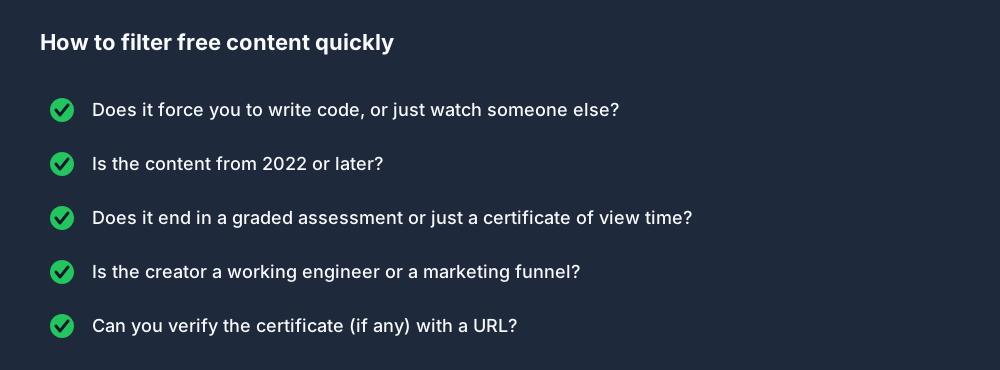
Five questions to ask of any free course before investing hours:

  1. Does it force you to write code? Watching doesn't build skill. If the course has no hands-on component, it's orientation material, not training.
  2. Is the content from 2022 or later? PLC fundamentals are timeless, but IDE tooling isn't. Outdated screenshots make newer students lose patience.
  3. Does it end in a graded assessment? A certificate that says "completed" means you clicked Next 100 times. A certificate that says "passed 40 scenarios" means something.
  4. Is the creator a working engineer? Check their LinkedIn. Funnel-marketer content is polished and superficial; engineer-created content is scrappy and correct.
  5. Can you verify the certificate? A credential with a public verification URL beats a PDF nobody can check.

Courses that miss three of those five aren't necessarily bad — they may still be useful supplements — but they're not a primary learning path.

A completely free 12-week stack
A completely free 12-week learning stack

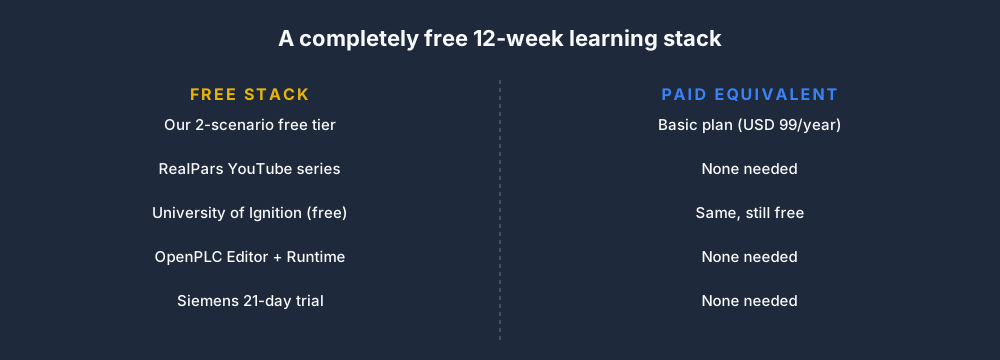
If your budget is genuinely zero, here's a 12-week path:

  • Weeks 1–4: RealPars PLC Fundamentals playlist + our free tier (27 source-tagged practice records; visible access can vary by entitlement and rollout). Aim for two passing programs, a quiz score, and fluent scan-cycle thinking.
  • Weeks 5–8: TIA Portal V18 21-day trial + Siemens SIOS Getting Started PDF. Four weeks to write an S7-1200 project in Siemens dialect. Hits on the TIA IDE specifically.
  • Weeks 9–10: University of Ignition free track. Two weeks for SCADA/HMI fundamentals and a free Ignition Core certification.
  • Weeks 11–12: OpenPLC Editor + a USD 50 Raspberry Pi (this is where the stack breaks "completely free" — you need hardware or equivalent). Deploy one of your earlier programs to real I/O.

Total cost: USD 0 software + USD 50 for a Pi. Total output: two passing browser scenarios, one TIA Portal project, one Ignition certification, one Pi running your code with real sensors.

That's a portfolio worth showing to hiring managers.

When free stops being enough

Three specific moments:

  1. When you want graded feedback on 40+ scenarios. Our free tier gives you two; the Basic plan at USD 99/year unlocks all 40.
  2. When you need interview-specific prep with certificates. Our Pro plan at USD 249/year is the shortest path.
  3. When your target employer requires a specific vendor cert. Rockwell CCP or Siemens ST-PRO — paid classroom programmes.

Until one of those is true, free resources will keep you moving.

Paid courses that are NOT worth it

  • Udemy "Complete PLC Bootcamp 2026" listings from unknown instructors. Almost always rehashed older content. Certificates have near-zero signal.
  • Facebook-ad "PLC Master Class" offerings. High-pressure sales, low educational content.
  • Coursera specialisations without graded assessments. Video-heavy, assessment-light. Free trial is fine; subscription isn't.
  • Any course asking for USD 500+ without real grading. If it's not graded, it's not training at that price point.

FAQ

Is free PLC training as good as paid?

For fundamentals: yes, the free stack above gets you surprisingly far. For graded feedback, interview prep, and structured curriculum: paid is faster and more efficient.

Can I get a free PLC certificate?

Yes. University of Ignition's certifications are free, respected, and verifiable. Many vendors (Rockwell, Siemens, AutomationDirect) offer free introductory certificates. Be skeptical of Udemy-style certificates that mainly signal attendance.

Is Udemy good for PLC training?

Rarely. Quality is wildly variable and certificates carry little weight with hiring managers. Use Udemy for specific-topic reference, not as a primary course.

What's the best free PLC simulator?

Our free tier for curriculum-based learning, OpenPLC for tinker-and-deploy work. Use both. See our OpenPLC comparison post.

How long does free PLC training take?

12 weeks at 8 hours/week, following the stack above. The same time as a paid structured course; slightly more self-discipline required.

Where to start

  1. Today: subscribe to RealPars on YouTube, sign up for our free tier.
  2. Week 1: watch RealPars PLC Fundamentals playlist + complete Traffic Light in our simulator.
  3. Week 4: decide whether you want paid graded feedback. If yes, upgrade to Basic. If no, continue with the free stack.

The only wrong answer is not starting. Everything here is free; the excuse list is empty.

ShareX / TwitterLinkedIn

From reading to running logic

Practice this yourself in the simulator

Start with guided PLC practice in your browser. No install and no credit card required.

Start practising free

Continue learning

Related field notes

All articles
certification
career

PLC Programming Certification Paths: Which One Moves Your Career in 2026

A practitioner's guide to PLC programming certifications — Rockwell CCP, Siemens ST-PRO, TÜV FSE, ISA CAP, Ignition Core, plus the portfolio-based alternatives that hiring managers increasingly prefer. Which paths have ROI, which are tax, and how to combine them.

11 min read
openplc
open source

OpenPLC vs Paid PLC Software: Honest Comparison

Compare OpenPLC with paid PLC software by runtime, editor, hardware support, simulation, learning workflow and cost to choose the right fit.

9 min read
delta
ispsoft

Delta PLC Training (2026): DVP, AS, and AH Series with ISPSoft

A practical Delta PLC training guide — DVP micro-PLCs, AS-series mid-range, AH high-end, all programmed in ISPSoft. Covers IEC 61131-3 support, CANopen and Modbus, and a 6-week self-study path that uses cheap hardware to get you productive.

8 min read

Competency and practice field guide

Free PLC training resources: implementation, evidence and troubleshooting

Direct answer

Free PLC training resources becomes useful when it connects the target role, current skill, weekly time, operating system, hardware access, language and evidence goal with free reference material to guided exercises, runnable simulations, assessments and target-tool transfer, then proves one complete input-logic-output-feedback task documented from requirement to result under normal, boundary, fault and recovery conditions. The objective is a repeatable engineering or learning result, not merely activity inside a page or tool.

This guide is written for self-directed learners comparing free courses, manuals, simulators, exercises and hardware-independent practice before paying for training. The intended result is specific: the reader can assemble a sequenced free study plan, distinguish instruction from practice and retain evidence that supports the next learning step.

System map / 02

Six concepts that control the result

Treat these as connected checkpoints. Each checkpoint has an expected state, an observable state and a boundary to the next part of the system. That structure prevents a software indication from being mistaken for physical proof.

NODE 01observable

Define the operating contract

the target role, current skill, weekly time, operating system, hardware access, language and evidence goal. For a zero-cost PLC learning plan, record the initial condition, actor, requested change, observable result and stopping condition before selecting a tool or implementation.

NODE 02observable

Map the evidence path

free reference material to guided exercises, runnable simulations, assessments and target-tool transfer. Separate request, internal state, output or service, physical or user-visible result and independent feedback so each boundary can be inspected.

NODE 03observable

Prove normal operation

one complete input-logic-output-feedback task documented from requirement to result. Run more than one cycle from a known state and retain the values, timings or artifacts that demonstrate repeatability.

NODE 04observable

Exercise a boundary case

resource disappearance, version drift, unsupported software, weak feedback and missing physical practice. Choose minimum, maximum, simultaneous, delayed or restart conditions that reveal assumptions hidden by the happy path.

NODE 05observable

Diagnose a controlled fault

a concept, syntax, environment, test or transfer gap revealed by a failed exercise. Preserve the first symptom, divide the system at a measurable boundary and change one condition only after predicting the result.

NODE 06observable

Transfer and hand over

a dated portfolio and supervised plan that closes the remaining physical and vendor-specific gaps. Restore normal state, remove temporary changes, repeat affected checks and document which claims remain limited to the learning environment.

Procedure / 03

A six-step practice and commissioning workflow

Run the steps in order the first time. Later, the same structure becomes a diagnostic loop: define the expected condition, observe the boundary, interpret the difference and choose one proving action.

  1. 01

    Write the acceptance case

    Convert the target role, current skill, weekly time, operating system, hardware access, language and evidence goal into initial conditions, one stimulus and observable pass criteria.

    Evidence: Another person can repeat the case without guessing the intended result.

    Avoid: Using page completion or an animation as the acceptance criterion.

  2. 02

    Build the map

    Document free reference material to guided exercises, runnable simulations, assessments and target-tool transfer and name who owns each state or decision.

    Evidence: Every request and result has a source, destination and useful inspection point.

    Avoid: Using the same value as command, status and independent feedback.

  3. 03

    Run the baseline

    Apply one complete input-logic-output-feedback task documented from requirement to result from a clean start and record the expected evidence.

    Evidence: Repeated runs produce the same bounded result.

    Avoid: Changing several parameters before a baseline exists.

  4. 04

    Challenge assumptions

    Test resource disappearance, version drift, unsupported software, weak feedback and missing physical practice without changing the acceptance contract.

    Evidence: Limits, timing and restart behavior reach defined states.

    Avoid: Testing only one ideal sequence.

  5. 05

    Isolate one failure

    Introduce or analyse a concept, syntax, environment, test or transfer gap revealed by a failed exercise and locate the first disagreement.

    Evidence: The proving action distinguishes the leading hypotheses.

    Avoid: Resetting, forcing or replacing before evidence is retained.

  6. 06

    Close the evidence loop

    Complete a dated portfolio and supervised plan that closes the remaining physical and vendor-specific gaps and repeat the affected regression cases.

    Evidence: A learner completes the surface by explaining the result, passing a changed case and identifying what still requires supervised target-equipment practice.

    Avoid: Treating an acknowledged message or one successful rerun as handover.

Diagnostic matrix / 04

Symptoms, proving points and next actions

The table is a reasoning aid, not a parts-replacement chart. Preserve the initial symptom, inspect the named boundary and use the interpretation to choose the next controlled test. Site safety procedures and equipment manuals remain authoritative.

Diagnostic symptoms, inspection points, interpretations and next actions for Free PLC training resources: implementation, evidence and troubleshooting
Observed symptomInspectInterpretationNext proving action
The expected result is unclearRequirement, initial state, actor, stimulus, units and pass conditionThe learner, instructor and assessor may be solving different versions of the task.Rewrite one observable acceptance case before continuing.
Internal state changes but the outcome does notRequest, final owner, output or service boundary and independent feedbackA software or interface indication proves intent at one layer, not the complete outcome.Trace the first boundary after the changing state.
Normal case passes but an edge case failsLimits, timing, simultaneous events, reset and restart assumptionsThe implementation contains a hidden assumption exposed by the changed condition.Add the failed boundary as a permanent regression case.
The failure disappears after resetOriginal symptom, histories, diagnostics, timestamps and active causeReset changed evidence or state without proving the initiating cause.Reproduce under a controlled condition and preserve pre/post-event data.
Simulator and target disagreeModel boundary, software version, task timing, I/O behavior, data types and configurationA learning model and the intended target do not share one of the recorded assumptions.Reduce the case and verify against current target documentation.
The result cannot be explainedPrediction, observation, proving action, alternative hypotheses and limitationsActivity occurred but the evidence is not yet transferable or reviewable.Have the learner defend the signal path and repeat a changed case.

Product evidence / 05

What the browser practice can actually demonstrate

The browser platform can retain programs, scenario results, attempts and observable machine state so practice is attached to evidence rather than seat time alone.

Where simulation stops

Free resources change and may require accounts, operating systems or hardware. Always verify current access and never treat course completion as authorization for live work.

Commissioning notebook / 06

Six cases that turn the concepts into evidence

Use these as written briefs rather than click-through instructions. For every case, state the expected condition before acting, retain the first useful observation and explain why the final result proves the requirement. A different program or component choice can still be correct when it produces the same bounded behavior and evidence.

Case 01

predict → observe → prove

Prove define the operating contract

Engineering context. the target role, current skill, weekly time, operating system, hardware access, language and evidence goal. For a zero-cost PLC learning plan, record the initial condition, actor, requested change, observable result and stopping condition before selecting a tool or implementation. Begin with a written normal condition and identify which request, state, physical result or communication value will provide independent confirmation. Do not begin by changing the configuration; the initial state is part of the evidence and should remain reproducible.

Controlled setup. Use the “Write the acceptance case” stage of the workflow: convert the target role, current skill, weekly time, operating system, hardware access, language and evidence goal into initial conditions, one stimulus and observable pass criteria. The acceptance record should show this result: another person can repeat the case without guessing the intended result. Record initial conditions, the exact stimulus and the observation point so another learner can repeat the case without relying on your memory.

Fault challenge. Introduce or analyse “The expected result is unclear” as one bounded deviation. Inspect requirement, initial state, actor, stimulus, units and pass condition The working interpretation is that the learner, instructor and assessor may be solving different versions of the task. The next proving action is to rewrite one observable acceptance case before continuing. Change only one condition before observing the result, and preserve timestamps or measurements where timing matters.

Review and recovery. The most common trap here is using page completion or an animation as the acceptance criterion. After restoring the cause, repeat the normal case and at least one stop, timeout, disconnect or restart boundary relevant to this topic. Remove temporary forces and bypasses, return the model to a known state and retain the evidence that both operation and recovery are deliberate.

Explain it aloud: What should I learn first about a zero-cost PLC learning plan? A defensible short answer is: Start with the operating contract and evidence path: the target role, current skill, weekly time, operating system, hardware access, language and evidence goal, followed by free reference material to guided exercises, runnable simulations, assessments and target-tool transfer. Add advanced features only after the baseline is predictable.

Case 02

predict → observe → prove

Prove map the evidence path

Engineering context. free reference material to guided exercises, runnable simulations, assessments and target-tool transfer. Separate request, internal state, output or service, physical or user-visible result and independent feedback so each boundary can be inspected. Begin with a written normal condition and identify which request, state, physical result or communication value will provide independent confirmation. Do not begin by changing the configuration; the initial state is part of the evidence and should remain reproducible.

Controlled setup. Use the “Build the map” stage of the workflow: document free reference material to guided exercises, runnable simulations, assessments and target-tool transfer and name who owns each state or decision. The acceptance record should show this result: every request and result has a source, destination and useful inspection point. Record initial conditions, the exact stimulus and the observation point so another learner can repeat the case without relying on your memory.

Fault challenge. Introduce or analyse “Internal state changes but the outcome does not” as one bounded deviation. Inspect request, final owner, output or service boundary and independent feedback The working interpretation is that a software or interface indication proves intent at one layer, not the complete outcome. The next proving action is to trace the first boundary after the changing state. Change only one condition before observing the result, and preserve timestamps or measurements where timing matters.

Review and recovery. The most common trap here is using the same value as command, status and independent feedback. After restoring the cause, repeat the normal case and at least one stop, timeout, disconnect or restart boundary relevant to this topic. Remove temporary forces and bypasses, return the model to a known state and retain the evidence that both operation and recovery are deliberate.

Explain it aloud: How do I practise a zero-cost PLC learning plan effectively? A defensible short answer is: Use short cases with known initial conditions, a written prediction, one action and an observable result. Then alter a boundary or fault and explain why the evidence changed.

Case 03

predict → observe → prove

Prove prove normal operation

Engineering context. one complete input-logic-output-feedback task documented from requirement to result. Run more than one cycle from a known state and retain the values, timings or artifacts that demonstrate repeatability. Begin with a written normal condition and identify which request, state, physical result or communication value will provide independent confirmation. Do not begin by changing the configuration; the initial state is part of the evidence and should remain reproducible.

Controlled setup. Use the “Run the baseline” stage of the workflow: apply one complete input-logic-output-feedback task documented from requirement to result from a clean start and record the expected evidence. The acceptance record should show this result: repeated runs produce the same bounded result. Record initial conditions, the exact stimulus and the observation point so another learner can repeat the case without relying on your memory.

Fault challenge. Introduce or analyse “Normal case passes but an edge case fails” as one bounded deviation. Inspect limits, timing, simultaneous events, reset and restart assumptions The working interpretation is that the implementation contains a hidden assumption exposed by the changed condition. The next proving action is to add the failed boundary as a permanent regression case. Change only one condition before observing the result, and preserve timestamps or measurements where timing matters.

Review and recovery. The most common trap here is changing several parameters before a baseline exists. After restoring the cause, repeat the normal case and at least one stop, timeout, disconnect or restart boundary relevant to this topic. Remove temporary forces and bypasses, return the model to a known state and retain the evidence that both operation and recovery are deliberate.

Explain it aloud: What counts as proof of competence? A defensible short answer is: A repeatable artifact or system result plus an explanation of the signal path is stronger than time spent, screenshots or a copied answer. Physical competence requires separate supervised evidence.

Case 04

predict → observe → prove

Prove exercise a boundary case

Engineering context. resource disappearance, version drift, unsupported software, weak feedback and missing physical practice. Choose minimum, maximum, simultaneous, delayed or restart conditions that reveal assumptions hidden by the happy path. Begin with a written normal condition and identify which request, state, physical result or communication value will provide independent confirmation. Do not begin by changing the configuration; the initial state is part of the evidence and should remain reproducible.

Controlled setup. Use the “Challenge assumptions” stage of the workflow: test resource disappearance, version drift, unsupported software, weak feedback and missing physical practice without changing the acceptance contract. The acceptance record should show this result: limits, timing and restart behavior reach defined states. Record initial conditions, the exact stimulus and the observation point so another learner can repeat the case without relying on your memory.

Fault challenge. Introduce or analyse “The failure disappears after reset” as one bounded deviation. Inspect original symptom, histories, diagnostics, timestamps and active cause The working interpretation is that reset changed evidence or state without proving the initiating cause. The next proving action is to reproduce under a controlled condition and preserve pre/post-event data. Change only one condition before observing the result, and preserve timestamps or measurements where timing matters.

Review and recovery. The most common trap here is testing only one ideal sequence. After restoring the cause, repeat the normal case and at least one stop, timeout, disconnect or restart boundary relevant to this topic. Remove temporary forces and bypasses, return the model to a known state and retain the evidence that both operation and recovery are deliberate.

Explain it aloud: Why test faults and restart behavior? A defensible short answer is: Because a concept, syntax, environment, test or transfer gap revealed by a failed exercise or resource disappearance, version drift, unsupported software, weak feedback and missing physical practice can expose assumptions that never appear during ideal startup and steady operation.

Case 05

predict → observe → prove

Prove diagnose a controlled fault

Engineering context. a concept, syntax, environment, test or transfer gap revealed by a failed exercise. Preserve the first symptom, divide the system at a measurable boundary and change one condition only after predicting the result. Begin with a written normal condition and identify which request, state, physical result or communication value will provide independent confirmation. Do not begin by changing the configuration; the initial state is part of the evidence and should remain reproducible.

Controlled setup. Use the “Isolate one failure” stage of the workflow: introduce or analyse a concept, syntax, environment, test or transfer gap revealed by a failed exercise and locate the first disagreement. The acceptance record should show this result: the proving action distinguishes the leading hypotheses. Record initial conditions, the exact stimulus and the observation point so another learner can repeat the case without relying on your memory.

Fault challenge. Introduce or analyse “Simulator and target disagree” as one bounded deviation. Inspect model boundary, software version, task timing, I/O behavior, data types and configuration The working interpretation is that a learning model and the intended target do not share one of the recorded assumptions. The next proving action is to reduce the case and verify against current target documentation. Change only one condition before observing the result, and preserve timestamps or measurements where timing matters.

Review and recovery. The most common trap here is resetting, forcing or replacing before evidence is retained. After restoring the cause, repeat the normal case and at least one stop, timeout, disconnect or restart boundary relevant to this topic. Remove temporary forces and bypasses, return the model to a known state and retain the evidence that both operation and recovery are deliberate.

Explain it aloud: Can browser practice replace official software or hardware? A defensible short answer is: No. It can build concepts and diagnostic reasoning. Exact firmware, I/O electrical behavior, networking, safety and commissioning require current official tools, documentation and target equipment.

Case 06

predict → observe → prove

Prove transfer and hand over

Engineering context. a dated portfolio and supervised plan that closes the remaining physical and vendor-specific gaps. Restore normal state, remove temporary changes, repeat affected checks and document which claims remain limited to the learning environment. Begin with a written normal condition and identify which request, state, physical result or communication value will provide independent confirmation. Do not begin by changing the configuration; the initial state is part of the evidence and should remain reproducible.

Controlled setup. Use the “Close the evidence loop” stage of the workflow: complete a dated portfolio and supervised plan that closes the remaining physical and vendor-specific gaps and repeat the affected regression cases. The acceptance record should show this result: a learner completes the surface by explaining the result, passing a changed case and identifying what still requires supervised target-equipment practice. Record initial conditions, the exact stimulus and the observation point so another learner can repeat the case without relying on your memory.

Fault challenge. Introduce or analyse “The result cannot be explained” as one bounded deviation. Inspect prediction, observation, proving action, alternative hypotheses and limitations The working interpretation is that activity occurred but the evidence is not yet transferable or reviewable. The next proving action is to have the learner defend the signal path and repeat a changed case. Change only one condition before observing the result, and preserve timestamps or measurements where timing matters.

Review and recovery. The most common trap here is treating an acknowledged message or one successful rerun as handover. After restoring the cause, repeat the normal case and at least one stop, timeout, disconnect or restart boundary relevant to this topic. Remove temporary forces and bypasses, return the model to a known state and retain the evidence that both operation and recovery are deliberate.

Explain it aloud: How should progress be documented? A defensible short answer is: Keep the requirement, initial state, program or configuration, observed values, fault hypothesis, proving action, recovery result and a concise limitations statement.

Answer surface / 07

Questions people ask about Free PLC training resources

These concise answers define the operating, training and product boundaries most often missed in broad summaries. The full workflow and diagnostic table above provide the evidence behind them.

What should I learn first about a zero-cost PLC learning plan?

Start with the operating contract and evidence path: the target role, current skill, weekly time, operating system, hardware access, language and evidence goal, followed by free reference material to guided exercises, runnable simulations, assessments and target-tool transfer. Add advanced features only after the baseline is predictable.

How do I practise a zero-cost PLC learning plan effectively?

Use short cases with known initial conditions, a written prediction, one action and an observable result. Then alter a boundary or fault and explain why the evidence changed.

What counts as proof of competence?

A repeatable artifact or system result plus an explanation of the signal path is stronger than time spent, screenshots or a copied answer. Physical competence requires separate supervised evidence.

Why test faults and restart behavior?

Because a concept, syntax, environment, test or transfer gap revealed by a failed exercise or resource disappearance, version drift, unsupported software, weak feedback and missing physical practice can expose assumptions that never appear during ideal startup and steady operation.

Can browser practice replace official software or hardware?

No. It can build concepts and diagnostic reasoning. Exact firmware, I/O electrical behavior, networking, safety and commissioning require current official tools, documentation and target equipment.

How should progress be documented?

Keep the requirement, initial state, program or configuration, observed values, fault hypothesis, proving action, recovery result and a concise limitations statement.

What should I do when the answer differs from a guide?

Check assumptions, version, units and initial state first. Reduce the case, compare one boundary at a time and prefer current primary documentation for target-specific behavior.

When is a a zero-cost PLC learning plan exercise finished?

A learner completes the surface by explaining the result, passing a changed case and identifying what still requires supervised target-equipment practice.