PLC Simulator
PLC field notescertification

PLC Programming Certification Paths: Which One Moves Your Career in 2026

A practitioner's guide to PLC programming certifications — Rockwell CCP, Siemens ST-PRO, TÜV FSE, ISA CAP, Ignition Core, plus the portfolio-based alternatives that hiring managers increasingly prefer. Which paths have ROI, which are tax, and how to combine them.

PLC Simulation Software11 min read

PLC programming certification paths in 2026

Searching plc programming certification in 2026 returns a confusing mix of vendor-run classroom programmes at the top, generic "PLC Technician Certificate" offerings in the middle, and Udemy "PLC Master Class Certificate" ads at the bottom. They're not interchangeable. Hiring-manager signal varies by an order of magnitude between them.

This is the longer companion to our PLC certification guide — focused specifically on which path to pick based on what you're trying to achieve.

Five realistic paths
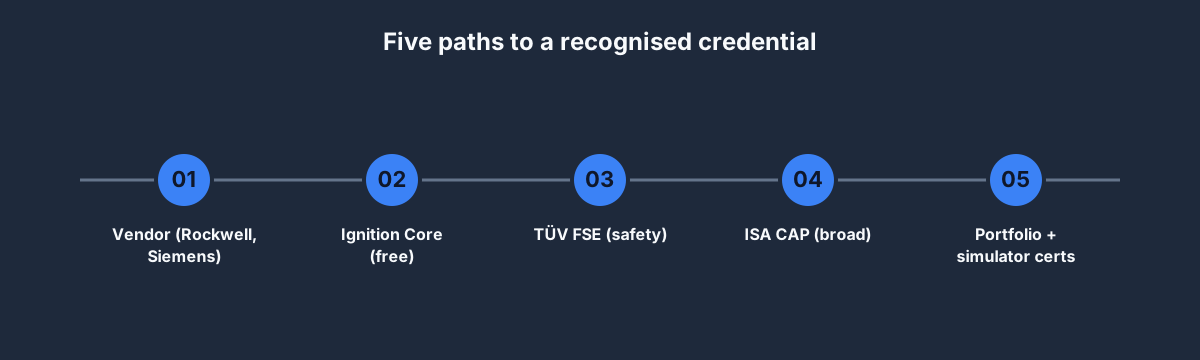
Five paths to a recognised credential

Path 1 — Vendor classroom (Rockwell CCP or Siemens ST-PRO)

  • Cost: USD 2,100–2,500 per course. Most vendors have 3–4 levels.
  • Format: 5-day intensive classroom, real hardware.
  • Signal: strong within the vendor's ecosystem; weaker across vendors.
  • Best for: engineers at plants that standardised on that vendor, especially where promotion or job security depends on the formal credential.

Detailed coverage in our Allen-Bradley training and Siemens PLC training posts.

Path 2 — Inductive Automation's Ignition Core Certification

  • Cost: Free (training and exam).
  • Format: Online video course + proctored online exam.
  • Signal: strong within the Ignition / SCADA world; growing recognition elsewhere.
  • Best for: anyone targeting SCADA/HMI roles, or any PLC role where Ignition is in the stack.

The 2026 gold standard for "free certification that actually counts."

Path 3 — TÜV FSE (Functional Safety Engineer)

  • Cost: USD 2,500–3,500 for training + exam.
  • Format: 3–5 day course + written exam.
  • Signal: strong internationally, especially in European process and automotive industries.
  • Best for: engineers targeting safety-specialist roles. Commands USD 10,000–20,000/year salary premium.

Details in our safety PLCs post.

Path 4 — ISA CAP (Certified Automation Professional)

  • Cost: USD 400 exam fee + self-study materials (USD 200).
  • Format: Self-study, proctored written exam covering automation broadly.
  • Signal: respected, especially in process industries.
  • Best for: experienced engineers (5+ years) looking for a broad automation credential rather than a vendor-specific one.

ISA also offers CST (Certified Specialist) sub-credentials for narrower focus.

Path 5 — Portfolio + simulator certificates

  • Cost: USD 99–249/year on our platform (or free on the 2-scenario tier).
  • Format: Graded scenarios, interview-track completion, downloadable PDFs.
  • Signal: fastest-growing in 2026 because verifiable by URL.
  • Best for: career switchers, bootcamp graduates, anyone who needs to prove competence fast without a five-figure classroom budget.

Our PLC certification guide covers how hiring-manager attitudes are shifting.

Certification ROI ranked
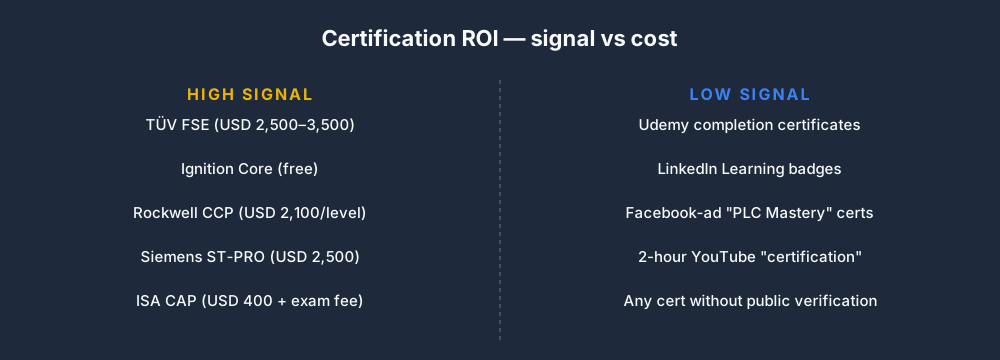
Certification ROI — signal vs cost

Our ranked view — high-signal certifications on the left, low-signal on the right:

High signal (worth the investment):

  • TÜV FSE — genuinely specialist, genuinely pays more
  • Ignition Core — free, respected, verifiable
  • Rockwell CCP / Siemens ST-PRO — strong in-ecosystem
  • ISA CAP — broad automation recognition
  • Portfolio with public URL — increasing signal, lowest cost

Low signal (avoid or treat as supplements only):

  • Udemy completion certificates — near-zero
  • LinkedIn Learning badges — marginal, and only on LinkedIn itself
  • "PLC Master Class" Facebook-ad certifications — red flag
  • 2-hour YouTube "certification" courses — not a thing
  • Any certificate without public verification URL — hard to trust

Picking based on your goal
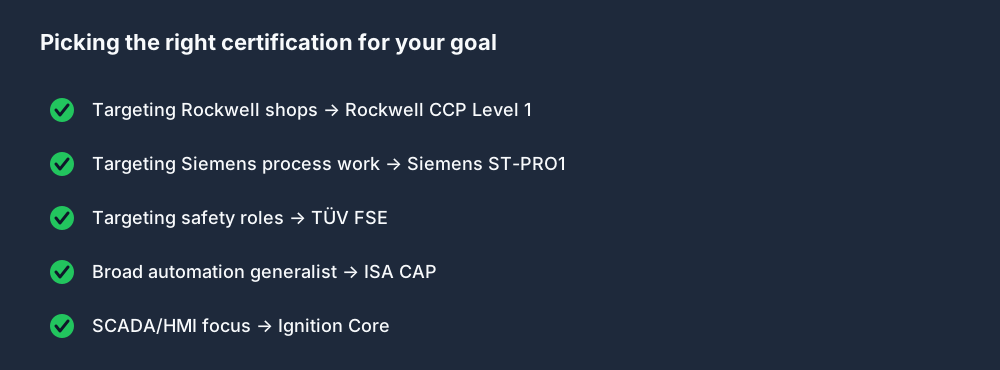
Picking the right certification for your goal

Match your certification to your target job:

  • Rockwell shop (North American automotive, pharma, discrete manufacturing) → Rockwell CCP Level 1 first, then Level 2 if your employer pays.
  • Siemens shop (European automotive, process, heavy manufacturing) → Siemens ST-PRO1 first.
  • Safety specialist role → TÜV FSE. Nothing else substitutes.
  • SCADA / HMI engineer → Ignition Core, then our PLC+SCADA curriculum.
  • Broad automation generalist → ISA CAP + a vendor cert for whichever vendor your region uses most.
  • Career switcher without employer funding → portfolio via our Pro plan + one targeted vendor cert only when you have a specific job in play.

The hidden trap: "Technician Certificate" programmes

Many regional institutes sell "PLC Technician Certificate" programmes for USD 800–2,000. Quality varies widely. Before enrolling, check:

  • Accreditation: is the institute accredited by a recognised body? Unaccredited institute certificates carry low signal.
  • Graded assessments: does the programme end in a real test or just completion?
  • Graduate outcomes: do they publish placement rates? Ask for specific employers.
  • Industry advisory: does the curriculum involve working engineers or just salespeople?

If two of those are weak, skip. Use the USD 1,500 for our Pro plan plus a vendor course if needed.

How hiring managers actually weigh certifications in 2026

Based on conversations with controls-team leaders across a dozen industries:

  • Portfolio URL > any certificate — takes 10 minutes to evaluate, directly shows skill.
  • Vendor cert at the specific shop they run — meaningful.
  • TÜV FSE for safety roles — meaningful.
  • Ignition Core for Ignition shops — meaningful.
  • Generic "PLC certificate" from an institute they've never heard of — tolerated but not weighted.
  • Udemy certificate — anti-signal. Sometimes flagged as "willing to accept low-quality credentials."

The shift from certificates to portfolios is the single biggest change in PLC hiring this decade.

A recommended stack

For someone starting in 2026 targeting their first PLC job:

  1. Tier 0 (mandatory): Portfolio via our Pro plan. Six interview-track certificates + 40 scenario PDFs.
  2. Tier 1 (optional, if targeting vendor): one vendor cert — Rockwell CCP 1 or Siemens ST-PRO1.
  3. Tier 2 (optional, if targeting SCADA): free Ignition Core certification.
  4. Later (after 3+ years experience): ISA CAP or TÜV FSE depending on specialisation direction.

Total cost for year 1 job-readiness: USD 249 on our Pro plan + USD 2,100 optional vendor cert = USD 0–2,349 depending on employer reimbursement.

FAQ

Which PLC certification is best?

Depends on goal. TÜV FSE for safety, Ignition Core for SCADA, Rockwell CCP for North American manufacturing, Siemens ST-PRO for European markets, ISA CAP for generalist recognition, portfolio for everything else.

Is there a free PLC programming certification?

Yes, several. Ignition Core (Inductive Automation), some Rockwell free-tier certifications on Rockwell Learning Services, and our Pro plan's interview-track certificates (paid, but low-cost relative to alternatives).

How much do PLC certifications cost?

Free (Ignition Core) to USD 3,500 (TÜV FSE). Most vendor certs are USD 2,000–2,500. Our simulator's portfolio certificates come with the USD 249/year Pro plan.

Do PLC certifications expire?

Vendor certs usually: 2–3 year renewal cycle. Safety (TÜV FSE): similar. ISA CAP: 3-year renewal with continuing education. Portfolio evidence: never expires — it's what you did.

Which PLC certification pays the most salary premium?

TÜV FSE (safety): USD 10,000–20,000/year premium because the role is genuinely specialist. Vendor certs don't reliably pay premia; they gate specific roles.

Where to start

  1. Self-fund: portfolio first. Sign up for our Pro plan, work 40 scenarios, collect 6 interview-track certificates. USD 249/year, no classroom cost.
  2. Employer-funded: vendor cert first. Take Rockwell CCP or Siemens ST-PRO on someone else's dime. Supplement with free Ignition Core if SCADA is in scope.
  3. Specialist path: TÜV FSE later. Once you have 2+ years experience, add safety as a specialty.

Certifications follow skill. Skill comes from writing programs that pass tests. Start with the portfolio; the paper comes after.

ShareX / TwitterLinkedIn

From reading to running logic

Practice this yourself in the simulator

Start with guided PLC practice in your browser. No install and no credit card required.

Start practising free

Continue learning

Related field notes

All articles
free
training

Free PLC Training Resources That Are Actually Worth Your Time (2026)

A curated list of genuinely free PLC training — YouTube channels, vendor free tiers, open-source tools, and our own free scenarios. Covers what's worth learning for zero budget, which free certificates have real signal, and when paying finally makes sense.

10 min read
certification
exam prep

How to Pass the ISA CCST Exam: A 30-Day Study Plan

A practical 30-day study plan for the ISA Certified Control Systems Technician (CCST) exam — what topics it covers, recommended resources, and how to use a PLC simulator to practise the programming sections.

10 min read
interview
career

20 PLC Programming Interview Questions (and How to Answer Them)

The 20 most common PLC programming interview questions with detailed example answers — covering scan cycle, ladder logic, timers, faults, and vendor-specific topics. For junior to intermediate candidates.

11 min read

Job-readiness and assessment field guide

PLC programming certification paths: implementation, evidence and troubleshooting

Direct answer

PLC programming certification paths becomes useful when it connects target role and region, issuer, prerequisites, curriculum, assessment format, practical work, proctoring, recognition, renewal, cost and employer demand with career task through required knowledge, runnable skill, supervised practice, assessment result, portfolio artifact and independent verification, then proves one representative programming and diagnostic task completed and defended beyond the credential exam under normal, boundary, fault and recovery conditions. The objective is a repeatable engineering or learning result, not merely activity inside a page or tool.

This guide is written for students, technicians and employers comparing completion certificates, vendor credentials, academic programmes, trade pathways and demonstrable project evidence. The intended result is specific: the reader can match a credential to target role, issuer, assessment depth, recognition, cost, renewal and the practical evidence still required.

adult learners and an instructor using PLC racks, laptops and a miniature process in a vocational automation lab while studying PLC credential, vendor training and portfolio selection
The physical context keeps PLC credential, vendor training and portfolio selection tied to declared inputs, owned decisions, observable results and evidence that another person can verify.

System map / 02

Six concepts that control the result

Treat these as connected checkpoints. Each checkpoint has an expected state, an observable state and a boundary to the next part of the system. That structure prevents a software indication from being mistaken for physical proof.

NODE 01observable

Define the operating contract

target role and region, issuer, prerequisites, curriculum, assessment format, practical work, proctoring, recognition, renewal, cost and employer demand. For PLC credential, vendor training and portfolio selection, record the initial condition, actor, requested change, observable result and stopping condition before selecting a tool or implementation.

NODE 02observable

Map the evidence path

career task through required knowledge, runnable skill, supervised practice, assessment result, portfolio artifact and independent verification. Separate request, internal state, output or service, physical or user-visible result and independent feedback so each boundary can be inspected.

NODE 03observable

Prove normal operation

one representative programming and diagnostic task completed and defended beyond the credential exam. Run more than one cycle from a known state and retain the values, timings or artifacts that demonstrate repeatability.

NODE 04observable

Exercise a boundary case

marketing confusion, outdated exam, memorized questions, weak hands-on work, expired credential, regional mismatch and unsupported salary claim. Choose minimum, maximum, simultaneous, delayed or restart conditions that reveal assumptions hidden by the happy path.

NODE 05observable

Diagnose a controlled fault

a role, issuer, curriculum, assessment, practical, recognition, renewal, cost or evidence mismatch. Preserve the first symptom, divide the system at a measurable boundary and change one condition only after predicting the result.

NODE 06observable

Transfer and hand over

credential claims verified at the primary issuer and combined with current projects and supervised target-platform practice. Restore normal state, remove temporary changes, repeat affected checks and document which claims remain limited to the learning environment.

Procedure / 03

A six-step practice and commissioning workflow

Run the steps in order the first time. Later, the same structure becomes a diagnostic loop: define the expected condition, observe the boundary, interpret the difference and choose one proving action.

  1. 01

    Write the acceptance case

    Convert target role and region, issuer, prerequisites, curriculum, assessment format, practical work, proctoring, recognition, renewal, cost and employer demand into initial conditions, one stimulus and observable pass criteria.

    Evidence: Another person can repeat the case without guessing the intended result.

    Avoid: Using page completion or an animation as the acceptance criterion.

  2. 02

    Build the map

    Document career task through required knowledge, runnable skill, supervised practice, assessment result, portfolio artifact and independent verification and name who owns each state or decision.

    Evidence: Every request and result has a source, destination and useful inspection point.

    Avoid: Using the same value as command, status and independent feedback.

  3. 03

    Run the baseline

    Apply one representative programming and diagnostic task completed and defended beyond the credential exam from a clean start and record the expected evidence.

    Evidence: Repeated runs produce the same bounded result.

    Avoid: Changing several parameters before a baseline exists.

  4. 04

    Challenge assumptions

    Test marketing confusion, outdated exam, memorized questions, weak hands-on work, expired credential, regional mismatch and unsupported salary claim without changing the acceptance contract.

    Evidence: Limits, timing and restart behavior reach defined states.

    Avoid: Testing only one ideal sequence.

  5. 05

    Isolate one failure

    Introduce or analyse a role, issuer, curriculum, assessment, practical, recognition, renewal, cost or evidence mismatch and locate the first disagreement.

    Evidence: The proving action distinguishes the leading hypotheses.

    Avoid: Resetting, forcing or replacing before evidence is retained.

  6. 06

    Close the evidence loop

    Complete credential claims verified at the primary issuer and combined with current projects and supervised target-platform practice and repeat the affected regression cases.

    Evidence: Preparation is complete when the candidate can explain a result, diagnose a changed case and state the limits of the evidence without memorized vendor claims.

    Avoid: Treating an acknowledged message or one successful rerun as handover.

Diagnostic matrix / 04

Symptoms, proving points and next actions

The table is a reasoning aid, not a parts-replacement chart. Preserve the initial symptom, inspect the named boundary and use the interpretation to choose the next controlled test. Site safety procedures and equipment manuals remain authoritative.

Diagnostic symptoms, inspection points, interpretations and next actions for PLC programming certification paths: implementation, evidence and troubleshooting
Observed symptomInspectInterpretationNext proving action
The expected result is unclearRequirement, initial state, actor, stimulus, units and pass conditionThe candidate, mentor and hiring reviewer may be solving different versions of the task.Rewrite one observable acceptance case before continuing.
Internal state changes but the outcome does notRequest, final owner, output or service boundary and independent feedbackA software or interface indication proves intent at one layer, not the complete outcome.Trace the first boundary after the changing state.
Normal case passes but an edge case failsLimits, timing, simultaneous events, reset and restart assumptionsThe implementation contains a hidden assumption exposed by the changed condition.Add the failed boundary as a permanent regression case.
The failure disappears after resetOriginal symptom, histories, diagnostics, timestamps and active causeReset changed evidence or state without proving the initiating cause.Reproduce under a controlled condition and preserve pre/post-event data.
Simulator and target disagreeModel boundary, software version, task timing, I/O behavior, data types and configurationA learning model and the intended target do not share one of the recorded assumptions.Reduce the case and verify against current target documentation.
The result cannot be explainedPrediction, observation, proving action, alternative hypotheses and limitationsActivity occurred but the evidence is not yet transferable or reviewable.Have the learner defend the signal path and repeat a changed case.

Product evidence / 05

What the browser practice can actually demonstrate

The platform can turn interview topics into runnable exercises, fault logs and portfolio artifacts that demonstrate reasoning without claiming employment or certification outcomes.

Where simulation stops

No single online certificate guarantees a job, licensure, trade status, electrical authorization or universal vendor competence.

Commissioning notebook / 06

Six cases that turn the concepts into evidence

Use these as written briefs rather than click-through instructions. For every case, state the expected condition before acting, retain the first useful observation and explain why the final result proves the requirement. A different program or component choice can still be correct when it produces the same bounded behavior and evidence.

Case 01

predict → observe → prove

Prove define the operating contract

Engineering context. target role and region, issuer, prerequisites, curriculum, assessment format, practical work, proctoring, recognition, renewal, cost and employer demand. For PLC credential, vendor training and portfolio selection, record the initial condition, actor, requested change, observable result and stopping condition before selecting a tool or implementation. Begin with a written normal condition and identify which request, state, physical result or communication value will provide independent confirmation. Do not begin by changing the configuration; the initial state is part of the evidence and should remain reproducible.

Controlled setup. Use the “Write the acceptance case” stage of the workflow: convert target role and region, issuer, prerequisites, curriculum, assessment format, practical work, proctoring, recognition, renewal, cost and employer demand into initial conditions, one stimulus and observable pass criteria. The acceptance record should show this result: another person can repeat the case without guessing the intended result. Record initial conditions, the exact stimulus and the observation point so another learner can repeat the case without relying on your memory.

Fault challenge. Introduce or analyse “The expected result is unclear” as one bounded deviation. Inspect requirement, initial state, actor, stimulus, units and pass condition The working interpretation is that the candidate, mentor and hiring reviewer may be solving different versions of the task. The next proving action is to rewrite one observable acceptance case before continuing. Change only one condition before observing the result, and preserve timestamps or measurements where timing matters.

Review and recovery. The most common trap here is using page completion or an animation as the acceptance criterion. After restoring the cause, repeat the normal case and at least one stop, timeout, disconnect or restart boundary relevant to this topic. Remove temporary forces and bypasses, return the model to a known state and retain the evidence that both operation and recovery are deliberate.

Explain it aloud: Which PLC certification is best? A defensible short answer is: The best path depends on target employer, controller ecosystem, region and job tasks. Compare issuer recognition, practical assessment, cost, renewal and required experience.

Case 02

predict → observe → prove

Prove map the evidence path

Engineering context. career task through required knowledge, runnable skill, supervised practice, assessment result, portfolio artifact and independent verification. Separate request, internal state, output or service, physical or user-visible result and independent feedback so each boundary can be inspected. Begin with a written normal condition and identify which request, state, physical result or communication value will provide independent confirmation. Do not begin by changing the configuration; the initial state is part of the evidence and should remain reproducible.

Controlled setup. Use the “Build the map” stage of the workflow: document career task through required knowledge, runnable skill, supervised practice, assessment result, portfolio artifact and independent verification and name who owns each state or decision. The acceptance record should show this result: every request and result has a source, destination and useful inspection point. Record initial conditions, the exact stimulus and the observation point so another learner can repeat the case without relying on your memory.

Fault challenge. Introduce or analyse “Internal state changes but the outcome does not” as one bounded deviation. Inspect request, final owner, output or service boundary and independent feedback The working interpretation is that a software or interface indication proves intent at one layer, not the complete outcome. The next proving action is to trace the first boundary after the changing state. Change only one condition before observing the result, and preserve timestamps or measurements where timing matters.

Review and recovery. The most common trap here is using the same value as command, status and independent feedback. After restoring the cause, repeat the normal case and at least one stop, timeout, disconnect or restart boundary relevant to this topic. Remove temporary forces and bypasses, return the model to a known state and retain the evidence that both operation and recovery are deliberate.

Explain it aloud: Do I need PLC certification to get a PLC job? A defensible short answer is: Not always. Employers may value qualifications, vendor training and experience differently; demonstrable programming and diagnostic evidence can strengthen any path.

Case 03

predict → observe → prove

Prove prove normal operation

Engineering context. one representative programming and diagnostic task completed and defended beyond the credential exam. Run more than one cycle from a known state and retain the values, timings or artifacts that demonstrate repeatability. Begin with a written normal condition and identify which request, state, physical result or communication value will provide independent confirmation. Do not begin by changing the configuration; the initial state is part of the evidence and should remain reproducible.

Controlled setup. Use the “Run the baseline” stage of the workflow: apply one representative programming and diagnostic task completed and defended beyond the credential exam from a clean start and record the expected evidence. The acceptance record should show this result: repeated runs produce the same bounded result. Record initial conditions, the exact stimulus and the observation point so another learner can repeat the case without relying on your memory.

Fault challenge. Introduce or analyse “Normal case passes but an edge case fails” as one bounded deviation. Inspect limits, timing, simultaneous events, reset and restart assumptions The working interpretation is that the implementation contains a hidden assumption exposed by the changed condition. The next proving action is to add the failed boundary as a permanent regression case. Change only one condition before observing the result, and preserve timestamps or measurements where timing matters.

Review and recovery. The most common trap here is changing several parameters before a baseline exists. After restoring the cause, repeat the normal case and at least one stop, timeout, disconnect or restart boundary relevant to this topic. Remove temporary forces and bypasses, return the model to a known state and retain the evidence that both operation and recovery are deliberate.

Explain it aloud: What should I learn first about PLC credential, vendor training and portfolio selection? A defensible short answer is: Start with the operating contract and evidence path: target role and region, issuer, prerequisites, curriculum, assessment format, practical work, proctoring, recognition, renewal, cost and employer demand, followed by career task through required knowledge, runnable skill, supervised practice, assessment result, portfolio artifact and independent verification. Add advanced features only after the baseline is predictable.

Case 04

predict → observe → prove

Prove exercise a boundary case

Engineering context. marketing confusion, outdated exam, memorized questions, weak hands-on work, expired credential, regional mismatch and unsupported salary claim. Choose minimum, maximum, simultaneous, delayed or restart conditions that reveal assumptions hidden by the happy path. Begin with a written normal condition and identify which request, state, physical result or communication value will provide independent confirmation. Do not begin by changing the configuration; the initial state is part of the evidence and should remain reproducible.

Controlled setup. Use the “Challenge assumptions” stage of the workflow: test marketing confusion, outdated exam, memorized questions, weak hands-on work, expired credential, regional mismatch and unsupported salary claim without changing the acceptance contract. The acceptance record should show this result: limits, timing and restart behavior reach defined states. Record initial conditions, the exact stimulus and the observation point so another learner can repeat the case without relying on your memory.

Fault challenge. Introduce or analyse “The failure disappears after reset” as one bounded deviation. Inspect original symptom, histories, diagnostics, timestamps and active cause The working interpretation is that reset changed evidence or state without proving the initiating cause. The next proving action is to reproduce under a controlled condition and preserve pre/post-event data. Change only one condition before observing the result, and preserve timestamps or measurements where timing matters.

Review and recovery. The most common trap here is testing only one ideal sequence. After restoring the cause, repeat the normal case and at least one stop, timeout, disconnect or restart boundary relevant to this topic. Remove temporary forces and bypasses, return the model to a known state and retain the evidence that both operation and recovery are deliberate.

Explain it aloud: How do I practise PLC credential, vendor training and portfolio selection effectively? A defensible short answer is: Use short cases with known initial conditions, a written prediction, one action and an observable result. Then alter a boundary or fault and explain why the evidence changed.

Case 05

predict → observe → prove

Prove diagnose a controlled fault

Engineering context. a role, issuer, curriculum, assessment, practical, recognition, renewal, cost or evidence mismatch. Preserve the first symptom, divide the system at a measurable boundary and change one condition only after predicting the result. Begin with a written normal condition and identify which request, state, physical result or communication value will provide independent confirmation. Do not begin by changing the configuration; the initial state is part of the evidence and should remain reproducible.

Controlled setup. Use the “Isolate one failure” stage of the workflow: introduce or analyse a role, issuer, curriculum, assessment, practical, recognition, renewal, cost or evidence mismatch and locate the first disagreement. The acceptance record should show this result: the proving action distinguishes the leading hypotheses. Record initial conditions, the exact stimulus and the observation point so another learner can repeat the case without relying on your memory.

Fault challenge. Introduce or analyse “Simulator and target disagree” as one bounded deviation. Inspect model boundary, software version, task timing, I/O behavior, data types and configuration The working interpretation is that a learning model and the intended target do not share one of the recorded assumptions. The next proving action is to reduce the case and verify against current target documentation. Change only one condition before observing the result, and preserve timestamps or measurements where timing matters.

Review and recovery. The most common trap here is resetting, forcing or replacing before evidence is retained. After restoring the cause, repeat the normal case and at least one stop, timeout, disconnect or restart boundary relevant to this topic. Remove temporary forces and bypasses, return the model to a known state and retain the evidence that both operation and recovery are deliberate.

Explain it aloud: What counts as proof of competence? A defensible short answer is: A repeatable artifact or system result plus an explanation of the signal path is stronger than time spent, screenshots or a copied answer. Physical competence requires separate supervised evidence.

Case 06

predict → observe → prove

Prove transfer and hand over

Engineering context. credential claims verified at the primary issuer and combined with current projects and supervised target-platform practice. Restore normal state, remove temporary changes, repeat affected checks and document which claims remain limited to the learning environment. Begin with a written normal condition and identify which request, state, physical result or communication value will provide independent confirmation. Do not begin by changing the configuration; the initial state is part of the evidence and should remain reproducible.

Controlled setup. Use the “Close the evidence loop” stage of the workflow: complete credential claims verified at the primary issuer and combined with current projects and supervised target-platform practice and repeat the affected regression cases. The acceptance record should show this result: preparation is complete when the candidate can explain a result, diagnose a changed case and state the limits of the evidence without memorized vendor claims. Record initial conditions, the exact stimulus and the observation point so another learner can repeat the case without relying on your memory.

Fault challenge. Introduce or analyse “The result cannot be explained” as one bounded deviation. Inspect prediction, observation, proving action, alternative hypotheses and limitations The working interpretation is that activity occurred but the evidence is not yet transferable or reviewable. The next proving action is to have the learner defend the signal path and repeat a changed case. Change only one condition before observing the result, and preserve timestamps or measurements where timing matters.

Review and recovery. The most common trap here is treating an acknowledged message or one successful rerun as handover. After restoring the cause, repeat the normal case and at least one stop, timeout, disconnect or restart boundary relevant to this topic. Remove temporary forces and bypasses, return the model to a known state and retain the evidence that both operation and recovery are deliberate.

Explain it aloud: Why test faults and restart behavior? A defensible short answer is: Because a role, issuer, curriculum, assessment, practical, recognition, renewal, cost or evidence mismatch or marketing confusion, outdated exam, memorized questions, weak hands-on work, expired credential, regional mismatch and unsupported salary claim can expose assumptions that never appear during ideal startup and steady operation.

Answer surface / 07

Questions people ask about PLC programming certification paths

These concise answers define the operating, training and product boundaries most often missed in broad summaries. The full workflow and diagnostic table above provide the evidence behind them.

Which PLC certification is best?

The best path depends on target employer, controller ecosystem, region and job tasks. Compare issuer recognition, practical assessment, cost, renewal and required experience.

Do I need PLC certification to get a PLC job?

Not always. Employers may value qualifications, vendor training and experience differently; demonstrable programming and diagnostic evidence can strengthen any path.

What should I learn first about PLC credential, vendor training and portfolio selection?

Start with the operating contract and evidence path: target role and region, issuer, prerequisites, curriculum, assessment format, practical work, proctoring, recognition, renewal, cost and employer demand, followed by career task through required knowledge, runnable skill, supervised practice, assessment result, portfolio artifact and independent verification. Add advanced features only after the baseline is predictable.

How do I practise PLC credential, vendor training and portfolio selection effectively?

Use short cases with known initial conditions, a written prediction, one action and an observable result. Then alter a boundary or fault and explain why the evidence changed.

What counts as proof of competence?

A repeatable artifact or system result plus an explanation of the signal path is stronger than time spent, screenshots or a copied answer. Physical competence requires separate supervised evidence.

Why test faults and restart behavior?

Because a role, issuer, curriculum, assessment, practical, recognition, renewal, cost or evidence mismatch or marketing confusion, outdated exam, memorized questions, weak hands-on work, expired credential, regional mismatch and unsupported salary claim can expose assumptions that never appear during ideal startup and steady operation.

Can browser practice replace official software or hardware?

No. It can build concepts and diagnostic reasoning. Exact firmware, I/O electrical behavior, networking, safety and commissioning require current official tools, documentation and target equipment.

How should progress be documented?

Keep the requirement, initial state, program or configuration, observed values, fault hypothesis, proving action, recovery result and a concise limitations statement.

Continue the signal path / 08

Related practice and reference pages