Pro
10 min

CCST 28 — Servo Home Sequence

ccstmotionservohomingsequence

Ready to build this?

Sign up free — no credit card required. This scenario requires the Pro plan.

Sign up to play this scenario →

Already have an account? Log in

CCST 28 — Servo Home Sequence scenario preview

Briefing

Implement a simple homing sequence: jog SERVO_JOG_CMD until HOME_SWITCH activates, then clear SERVO_JOG_CMD and assert HOMED.

Objectives

  • Assert SERVO_JOG_CMD while not yet homed
  • Stop jog and set HOMED when HOME_SWITCH activates
  • HOMED latches TRUE until RESET_CMD

Hints

  • HOMED latches on HOME_SWITCH and clears on RESET_CMD
  • SERVO_JOG_CMD := NOT HOMED

I/O Table

Inputs

HOME_SWITCH

Home limit switch

BOOL · %I0.0

RESET_CMD

Reset/rehome command

BOOL · %I0.1

Outputs

SERVO_JOG_CMD

Servo jog command

BOOL · %Q0.0

HOMED

Homed status

BOOL · %Q0.1

Your program will be tested against:

All test cases run automatically when you submit. Assertions are hidden until you pass.

  1. #1Jogs before homed

    Jogs before homed

  2. #2Stops jog on home switch

    Stops jog on home switch

Ready to build this?

Sign up free — no credit card required. This scenario requires the Pro plan.

Sign up to play this scenario →

Already have an account? Log in

Job-readiness and assessment field guide

CCST practical 028 assessment: readiness checklist

Direct answer

The candidate can identify document assumptions, predict key states, compare measurements and defend a repair with repeatable functional evidence.

Written for controls candidates translating a diagram and functional description into a safe, testable diagnostic plan.
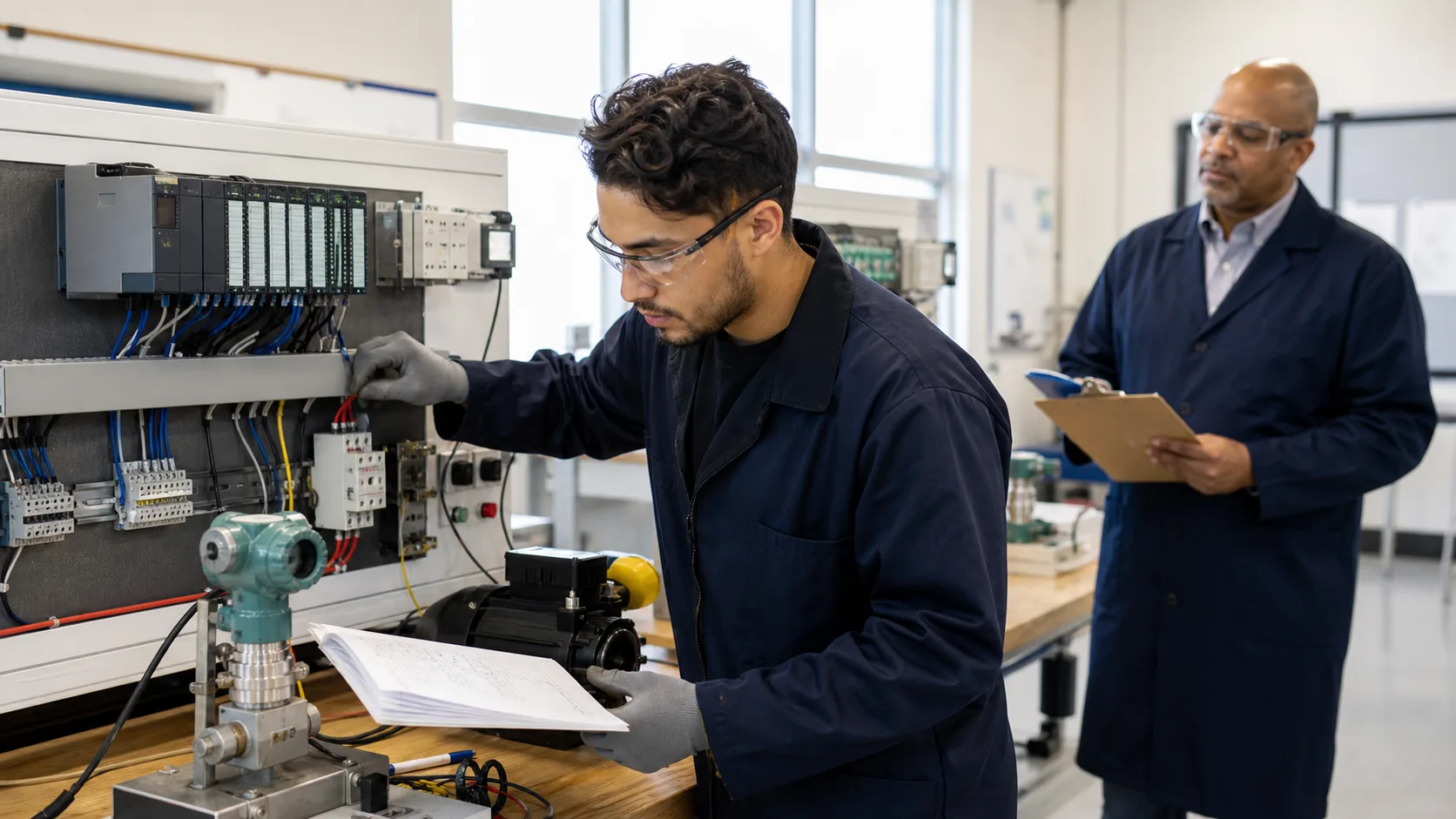
a controls technician completing a supervised practical assessment on generic PLC, motor-control and instrumentation equipment while studying control-document interpretation, predicted measurements and functional proving
System map / 02

NODE 01observable

Role scope

Document revision, equipment state, energy boundary, symbols, terminal identity, expected values, operating mode, symptom and acceptance criteria.

NODE 02observable

Skills map

Functional requirement through drawing, field devices, conductors, controller I/O, logic, outputs, equipment response and retained test record.

NODE 03observable

Core exercise

The candidate predicts and observes a complete normal path before isolating the declared abnormal state.

NODE 04observable

Stretch case

Outdated drawing, ambiguous terminal, wrong mode, backfeed, intermittent connection, retained command, power return and undocumented modification.

NODE 05observable

Troubleshooting

A requirement, document, field, wiring, I/O, program, output, equipment or feedback mismatch.

NODE 06observable

Portfolio evidence

The record reviewed against current controlled documents, procedures and certification-body objectives.

Answer surface / 07

How should a candidate use a control drawing during diagnosis?

Confirm revision and operating state, mark the expected signal path, predict values at safe test points and compare evidence from source toward the first disagreement.

What proves a repair is complete?

Remove temporary changes, restore configuration, repeat normal and relevant fault cases, verify stop and restart behavior and retain an explainable record.