Pro
8 min

CCST 33 — Mode Selector (Auto/Manual)

ccstHMImodeautomanualMUX

Ready to build this?

Sign up free — no credit card required. This scenario requires the Pro plan.

Sign up to play this scenario →

Already have an account? Log in

CCST 33 — Mode Selector (Auto/Manual) scenario preview

Briefing

An HMI MODE_SELECT bit (0=Manual, 1=Auto) controls which source commands the CONVEYOR output. In Auto mode, use AUTO_START; in Manual use MANUAL_START.

Objectives

  • CONVEYOR := AUTO_START when MODE_SELECT = TRUE
  • CONVEYOR := MANUAL_START when MODE_SELECT = FALSE
  • Implement a mode-select MUX

Hints

  • Write a two-row truth table: MODE_SELECT chooses which command is allowed to reach CONVEYOR; the unselected command must have no effect.
  • IF MODE_SELECT THEN CONVEYOR := AUTO_START; ELSE CONVEYOR := MANUAL_START; END_IF

I/O Table

Inputs

MODE_SELECT

Mode (TRUE=Auto)

BOOL · %I0.0

AUTO_START

Auto start signal

BOOL · %I0.1

MANUAL_START

Manual start button

BOOL · %I0.2

Outputs

CONVEYOR

Conveyor output

BOOL · %Q0.0

Your program will be tested against:

All test cases run automatically when you submit. Assertions are hidden until you pass.

  1. #1Auto mode uses AUTO_START

    Auto mode uses AUTO_START

  2. #2Manual mode uses MANUAL_START

    Manual mode uses MANUAL_START

  3. #3In auto, manual button has no effect

    In auto, manual button has no effect

Ready to build this?

Sign up free — no credit card required. This scenario requires the Pro plan.

Sign up to play this scenario →

Already have an account? Log in

Job-readiness and assessment field guide

CCST 033 Auto Manual selector practice: readiness checklist

Direct answer

The candidate can define one final owner, expose mode and permissive state and test transfer without duplicated writes or unexpected motion.

Written for controls candidates diagnosing selector logic in which automatic sequence and manual commands compete for one final output.
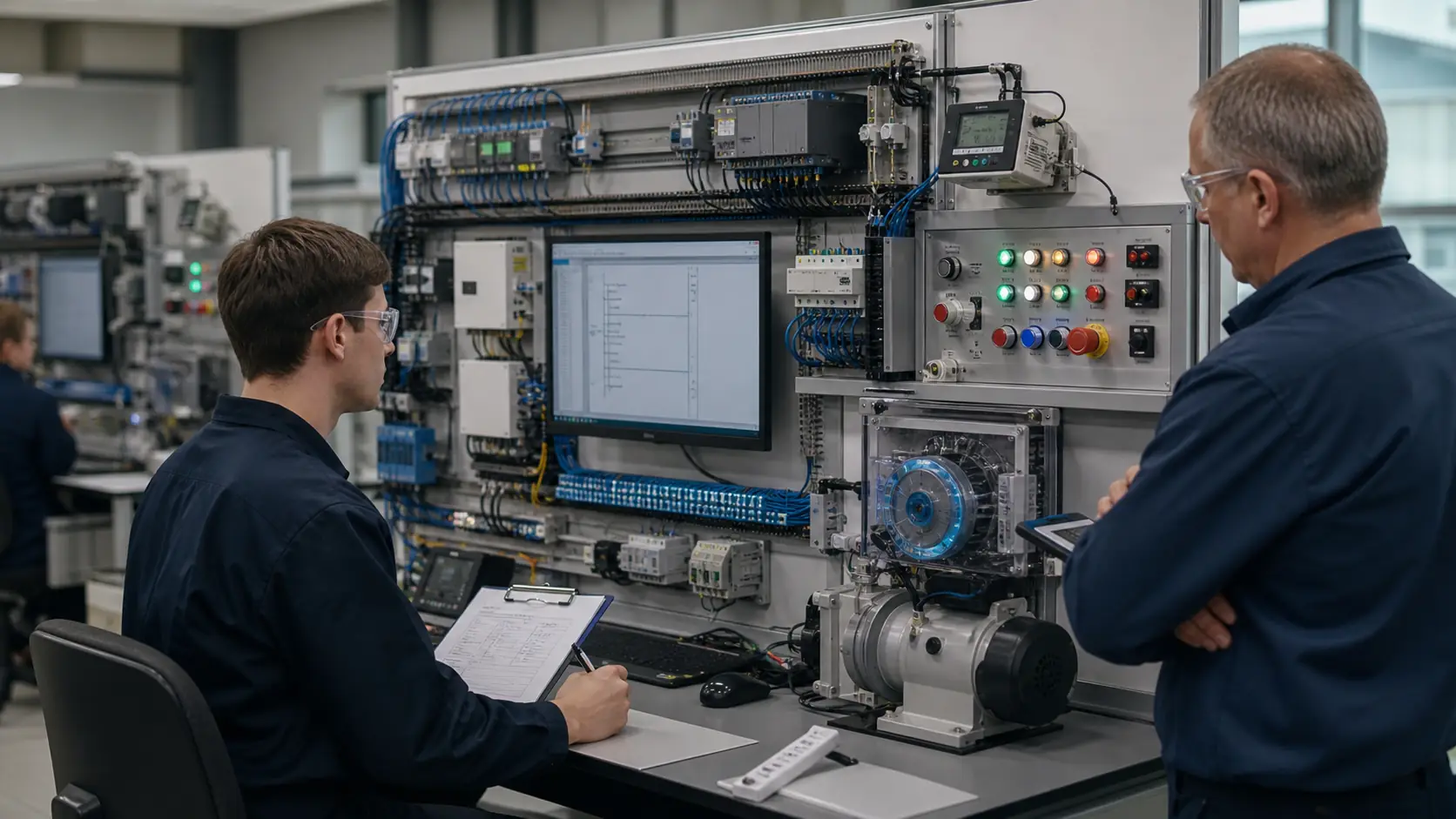
a controls technician completing an evidence-led practical assessment on a generic PLC, alarm, motor and instrumentation bench while studying Auto Manual mode arbitration, command ownership, bumpless transfer and safe-state evidence
System map / 02

NODE 01observable

Role scope

Selector source, mode state, authority, automatic request, manual request, permissives, final arbitration, output, feedback and transition policy.

NODE 02observable

Skills map

Operator or key selector through input state and mode memory into command arbitration, final output owner, actuator response and feedback.

NODE 03observable

Core exercise

Automatic and manual operation each meeting the same protective permissives with deterministic transitions and visible mode indication.

NODE 04observable

Stretch case

Selector between states, both requests true, transfer while running, lost feedback, duplicated output, controller restart, local remote conflict and stale HMI.

NODE 05observable

Troubleshooting

A selector, mode, authority, request, permissive, arbitration, final-writer, output, feedback or transition mismatch.

NODE 06observable

Portfolio evidence

The mode philosophy reviewed against operating procedures and retested on the exact HMI, controller and equipment.

Answer surface / 07

How should Auto and Manual PLC logic be structured?

Keep mode and authority explicit, route automatic and manual requests into one arbitration point and give the physical output one final owner with common protective conditions.

What is bumpless Auto Manual transfer?

It is a controlled transition that avoids an unintended command step or motion by reconciling internal state, current output and process feedback before ownership changes.