PLC Simulator
PLC field notescertification

How to Pass the ISA CCST Exam: A 30-Day Study Plan

A practical 30-day study plan for the ISA Certified Control Systems Technician (CCST) exam — what topics it covers, recommended resources, and how to use a PLC simulator to practise the programming sections.

PLC Simulation Software10 min read

The ISA Certified Control Systems Technician (CCST) certification is one of the most respected credentials in industrial automation. It is vendor-neutral — unlike manufacturer-specific certifications from Rockwell, Siemens, or Mitsubishi — which means it is recognised regardless of which brand of PLC your employer runs.

This guide is a practical 30-day study plan for candidates who are working while studying. It is realistic rather than optimistic. If you have never worked with PLCs before, give yourself 60–90 days, not 30.
How to pass the ISA CCST exam — a 30-day study plan

Disclosure: This study plan covers the CCST Level I exam (Instrumentation and Control). The PLC simulator covers the automation and control systems topics but is not an official ISA preparation tool and does not replicate ISA exam questions. The practice you get here is representative of the type of thinking the exam requires.

What the CCST Exam Tests

The ISA CCST Level I exam covers:

  • Measurement — pressure, level, temperature, flow, analytical measurements
  • Control systems — PLC basics, DCS basics, control loops, PID tuning
  • Troubleshooting — loop troubleshooting, signal tracing, instrument maintenance
  • Calibration — instrument calibration, loop calibration, error calculation
  • Safety — SIS basics, hazardous area classification

The exam is 110 multiple-choice questions over 3 hours. Passing score is typically 70%.

The five domains and the kind of topics under each are summarised below — the weightings shown are illustrative planning estimates, not official ISA figures.
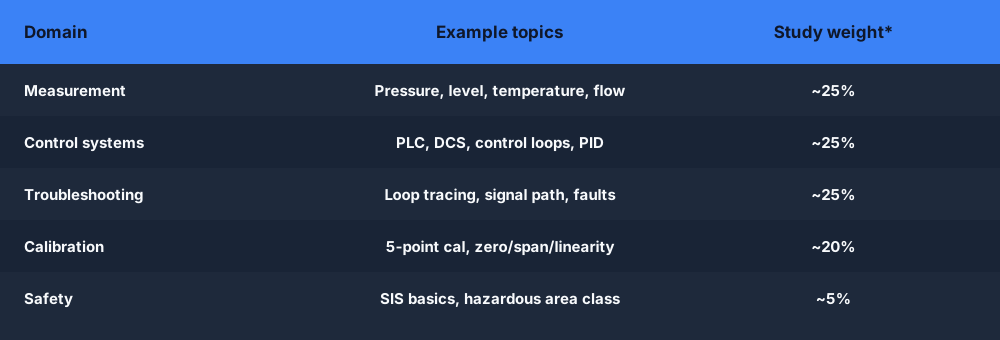
ISA CCST Level I exam domains and example topics with illustrative study weights

The PLC and control loop content (20–25% of the exam) is where a simulator can meaningfully help. The calibration and measurement theory requires textbook study.
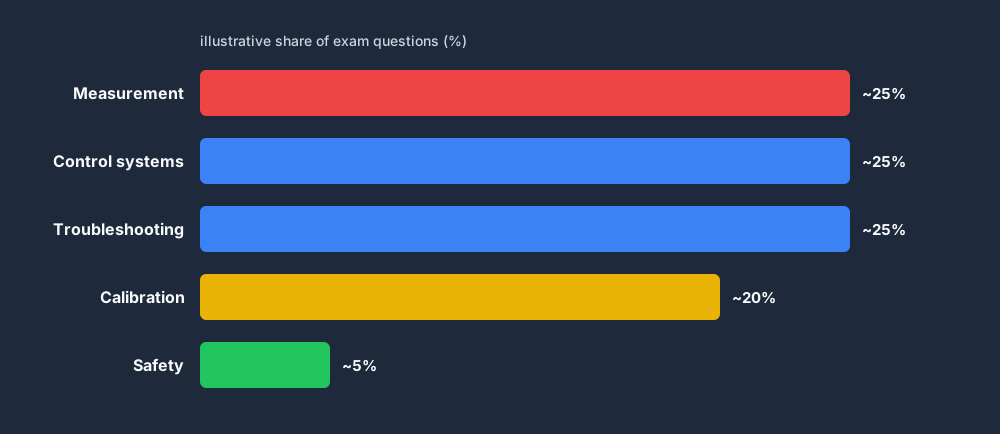
Illustrative weighting of CCST exam topics across measurement, control, troubleshooting, calibration and safety

30-Day Study Plan

The plan splits into four themed weeks, each building on the last before exam readiness.
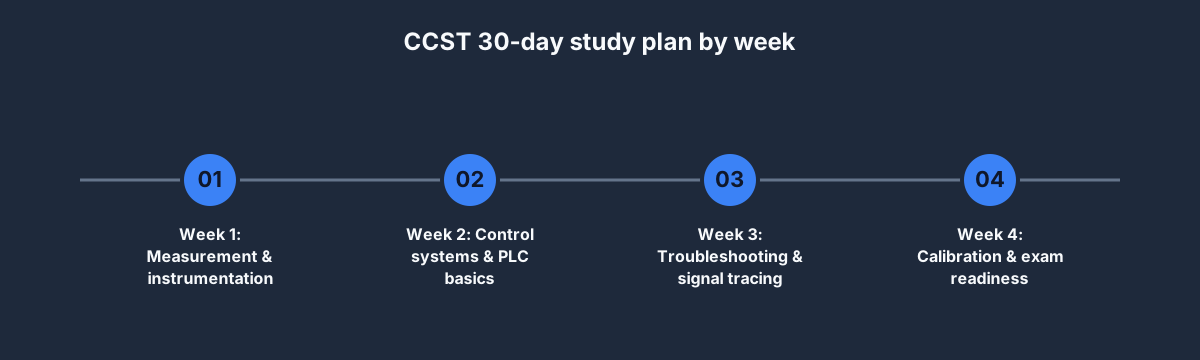
CCST 30-day study plan timeline by week

Week 1: Measurement and Instrumentation Foundations (Days 1–7)

Days 1–2: Pressure measurement

  • Gauge, absolute, differential, vacuum pressure
  • Bourdon tube, capacitive, piezoelectric transmitters
  • 4–20 mA current loop wiring and failure modes

Days 3–4: Level measurement

  • Differential pressure method (DP cells)
  • Float, ultrasonic, guided wave radar
  • Bubbler systems

Days 5–6: Temperature measurement

  • Thermocouple types (J, K, T, E), cold junction compensation
  • RTD (Pt100, Pt1000), 2-wire vs 3-wire vs 4-wire
  • Pyrometers

Day 7: Flow measurement

  • Orifice plate, venturi, Coriolis, magnetic, ultrasonic
  • Bernoulli equation basics
  • Practice: Complete the Analog I/O lesson in the curriculum — covers 4–20 mA scaling, which appears directly on the exam.

Week 2: Control Systems and PLC Basics (Days 8–14)

Days 8–9: PLC fundamentals

  • CPU, I/O modules, power supply, backplane
  • Input and output card types
  • Scan cycle (essential — re-read The PLC Scan Cycle Explained)
  • Practice: Complete PLC Fundamentals (Lesson 1) and Ladder Logic Basics (Lesson 2) in the simulator

Days 10–11: Ladder logic programming

  • Contacts, coils, timers, counters, comparators
  • Seal-in rungs, latching coils, edge detection
  • Practice: Complete Lessons 3 and 4 (Timers & Counters, Seal-in Rungs) in the simulator

Days 12–13: PID control theory

  • Proportional, integral, derivative explained
  • Process gain, integral time, derivative time
  • Open-loop vs closed-loop
  • Practice: The PID Control lesson in the curriculum covers practical PID tuning

Day 14: DCS vs PLC

  • When each system is used
  • Safety instrumented systems (SIS) basics
  • Fieldbus protocols: HART, Foundation Fieldbus, Profibus

Week 3: Troubleshooting and Signal Tracing (Days 15–21)

Days 15–17: Loop troubleshooting methodology

  • Split-range troubleshooting (isolate the signal path)
  • Checking 4–20 mA loops with a HART communicator
  • Milliamp source/sink testing

Days 18–19: PLC fault-finding

  • Input not responding: field device fault vs wiring fault vs PLC fault
  • Output not responding: same diagnostic tree
  • Using force mode (with caution)
  • Practice: The fault injection module in the simulator — diagnose 3 injected wiring faults. See the fault diagnosis page.

Days 20–21: Alarm management basics

  • Alarm priority levels (ISA 18.2)
  • Deadbanding and alarm suppression
  • Trip testing

Week 4: Calibration + Exam Readiness (Days 22–28)

Days 22–24: Calibration fundamentals

  • As-found / as-left documentation
  • Five-point calibration (0%, 25%, 50%, 75%, 100%)
  • Error types: zero error, span error, linearity error
  • Calibration interval concepts

Days 25–26: Hazardous area classification

  • Zone 0, 1, 2 (IEC) vs Division 1, 2 (NEC/NFPA 70)
  • Intrinsic safety, flameproof, increased safety concepts

Days 27–28: Full practice exam + review

  • ISA sells official CCST practice exams. Take one in a timed 3-hour block.
  • Review every incorrect answer against your study notes.

The overall arc — study, practise in a simulator, then prove readiness on a timed mock — looks like this:
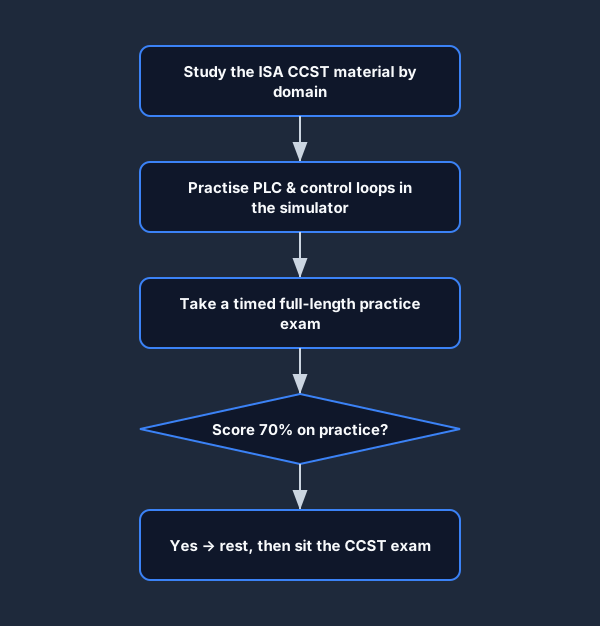
Flowchart from CCST preparation through simulator practice to sitting the exam

Days 29–30: Rest and consolidation

Take at least one full day off before the exam. Review your weak areas in the morning before the exam, then stop. Fatigue impairs recall; rest improves it.

Key Resources

  • Primary: ISA's own CCST Study Guide (purchase from isa.org)
  • Supplementary: ISA-5.1 Instrumentation Symbols and Identification (free PDF preview)
  • Simulator: PLC Simulation Software for the hands-on PLC and control loop practice
  • Practice exam: ISA CCST Practice Exam Kit (sold separately on isa.org)
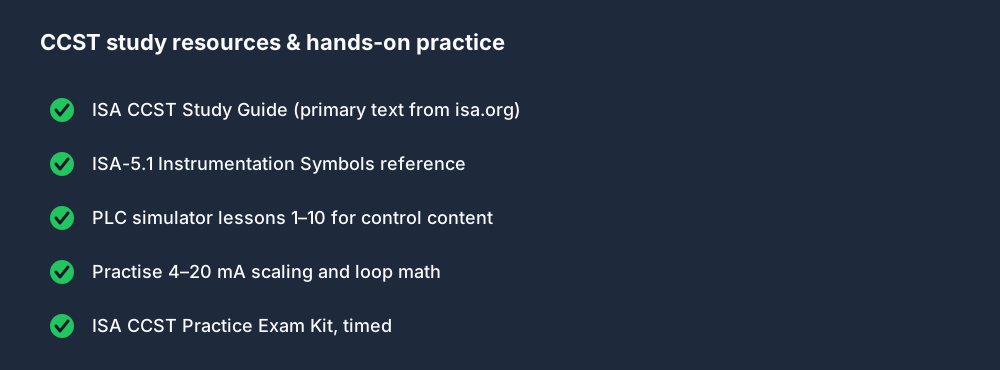
Checklist of CCST study resources and hands-on simulator practice

Common Reasons Candidates Fail

  1. Underestimating measurement theory — many candidates from a PLC background skip the instrumentation fundamentals. The exam is split roughly equally between measurement, control, troubleshooting, and calibration. Skipping measurement theory means starting with a 25% disadvantage.

  2. Confusing PLC scan cycle concepts — questions about what happens when an input changes mid-scan, or whether a coil set on rung 20 is visible to a contact on rung 5 in the same scan, trip up many candidates. This is covered extensively in the scan cycle guide.

  3. Weak 4–20 mA arithmetic — expect 5–10 questions asking you to calculate output current for a given process variable, scale a 4–20 mA signal to engineering units, or identify a fault from the milliamp reading.

  4. Not practising under timed conditions — 3 hours for 110 questions is 1.6 minutes per question. If you have never practised under time pressure, the exam feels faster than you expect.

Keep these exam-day habits in mind to protect your pacing and score:
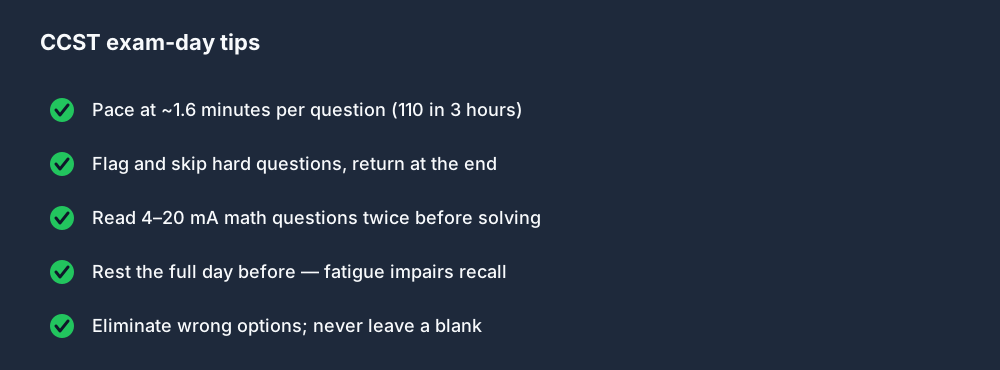
Checklist of CCST exam-day tips for the timed multiple-choice exam


Practise the PLC and control loop sections in the simulator. Lessons 1–10 of the curriculum cover exactly the PLC content tested on the CCST exam — with live exercises, not passive reading.

Start the free curriculum →

ShareX / TwitterLinkedIn

From reading to running logic

Practice this yourself in the simulator

Start with guided PLC practice in your browser. No install and no credit card required.

Start practising free

Continue learning

Related field notes

All articles
interview
career

20 PLC Programming Interview Questions (and How to Answer Them)

The 20 most common PLC programming interview questions with detailed example answers — covering scan cycle, ladder logic, timers, faults, and vendor-specific topics. For junior to intermediate candidates.

11 min read
certification
career

PLC Programming Certification Paths: Which One Moves Your Career in 2026

A practitioner's guide to PLC programming certifications — Rockwell CCP, Siemens ST-PRO, TÜV FSE, ISA CAP, Ignition Core, plus the portfolio-based alternatives that hiring managers increasingly prefer. Which paths have ROI, which are tax, and how to combine them.

11 min read
fault diagnosis
debugging

What Is Fault Injection in PLC Training? (And Why It Makes Better Technicians)

Fault injection inserts hidden wiring faults, logic errors, or sensor failures into a running PLC simulation. Learn how it works, what types of faults it covers, and why it is more effective than reading about fault-finding.

7 min read

Job-readiness and assessment field guide

Rockwell-oriented CCST exam preparation: implementation, evidence and troubleshooting

Direct answer

Rockwell-oriented CCST exam preparation becomes useful when it connects current ccst level and domain outline, eligibility, measurement, calibration, loop checking, documentation, control, maintenance, safety and test conditions with exam objective through concept review, worked calculation, practical scenario, explanation, error analysis and dated readiness evidence, then proves one representative instrumentation or control problem solved correctly and defended without relying on memorized interface clicks under normal, boundary, fault and recovery conditions. The objective is a repeatable engineering or learning result, not merely activity inside a page or tool.

This guide is written for controls technicians preparing for the ISA Certified Control Systems Technician assessment while working in Rockwell-oriented environments. The intended result is specific: the candidate can map the current examination domains to practical evidence, diagnose changed cases and separate ISA certification scope from any vendor product workflow.

a diverse group of adult automation learners explaining practical PLC evidence to an instructor beside a physical training cell while studying CCST exam domains, practical reasoning and vendor context
The scene keeps CCST exam domains, practical reasoning and vendor context connected to a declared operating condition, observable evidence, safe boundaries and a result another person can reproduce.

System map / 02

Six concepts that control the result

Treat these as connected checkpoints. Each checkpoint has an expected state, an observable state and a boundary to the next part of the system. That structure prevents a software indication from being mistaken for physical proof.

NODE 01observable

Define the operating contract

current CCST level and domain outline, eligibility, measurement, calibration, loop checking, documentation, control, maintenance, safety and test conditions. For CCST exam domains, practical reasoning and vendor context, record the initial condition, actor, requested change, observable result and stopping condition before selecting a tool or implementation.

NODE 02observable

Map the evidence path

exam objective through concept review, worked calculation, practical scenario, explanation, error analysis and dated readiness evidence. Separate request, internal state, output or service, physical or user-visible result and independent feedback so each boundary can be inspected.

NODE 03observable

Prove normal operation

one representative instrumentation or control problem solved correctly and defended without relying on memorized interface clicks. Run more than one cycle from a known state and retain the values, timings or artifacts that demonstrate repeatability.

NODE 04observable

Exercise a boundary case

unit conversion, range and span, live zero, fail direction, drawing interpretation, vendor terminology, time pressure and incomplete information. Choose minimum, maximum, simultaneous, delayed or restart conditions that reveal assumptions hidden by the happy path.

NODE 05observable

Diagnose a controlled fault

a concept, units, instrument, loop, logic, procedure, safety, documentation, vendor-assumption or exam-strategy mismatch. Preserve the first symptom, divide the system at a measurable boundary and change one condition only after predicting the result.

NODE 06observable

Transfer and hand over

readiness checked against the current ISA guide, official policies and supervised physical calibration and control-system practice. Restore normal state, remove temporary changes, repeat affected checks and document which claims remain limited to the learning environment.

Procedure / 03

A six-step practice and commissioning workflow

Run the steps in order the first time. Later, the same structure becomes a diagnostic loop: define the expected condition, observe the boundary, interpret the difference and choose one proving action.

  1. 01

    Write the acceptance case

    Convert current ccst level and domain outline, eligibility, measurement, calibration, loop checking, documentation, control, maintenance, safety and test conditions into initial conditions, one stimulus and observable pass criteria.

    Evidence: Another person can repeat the case without guessing the intended result.

    Avoid: Using page completion or an animation as the acceptance criterion.

  2. 02

    Build the map

    Document exam objective through concept review, worked calculation, practical scenario, explanation, error analysis and dated readiness evidence and name who owns each state or decision.

    Evidence: Every request and result has a source, destination and useful inspection point.

    Avoid: Using the same value as command, status and independent feedback.

  3. 03

    Run the baseline

    Apply one representative instrumentation or control problem solved correctly and defended without relying on memorized interface clicks from a clean start and record the expected evidence.

    Evidence: Repeated runs produce the same bounded result.

    Avoid: Changing several parameters before a baseline exists.

  4. 04

    Challenge assumptions

    Test unit conversion, range and span, live zero, fail direction, drawing interpretation, vendor terminology, time pressure and incomplete information without changing the acceptance contract.

    Evidence: Limits, timing and restart behavior reach defined states.

    Avoid: Testing only one ideal sequence.

  5. 05

    Isolate one failure

    Introduce or analyse a concept, units, instrument, loop, logic, procedure, safety, documentation, vendor-assumption or exam-strategy mismatch and locate the first disagreement.

    Evidence: The proving action distinguishes the leading hypotheses.

    Avoid: Resetting, forcing or replacing before evidence is retained.

  6. 06

    Close the evidence loop

    Complete readiness checked against the current isa guide, official policies and supervised physical calibration and control-system practice and repeat the affected regression cases.

    Evidence: Preparation is complete when the candidate can explain a result, diagnose a changed case and state the limits of the evidence without memorized vendor claims.

    Avoid: Treating an acknowledged message or one successful rerun as handover.

Diagnostic matrix / 04

Symptoms, proving points and next actions

The table is a reasoning aid, not a parts-replacement chart. Preserve the initial symptom, inspect the named boundary and use the interpretation to choose the next controlled test. Site safety procedures and equipment manuals remain authoritative.

Diagnostic symptoms, inspection points, interpretations and next actions for Rockwell-oriented CCST exam preparation: implementation, evidence and troubleshooting
Observed symptomInspectInterpretationNext proving action
The expected result is unclearRequirement, initial state, actor, stimulus, units and pass conditionThe candidate, mentor and hiring reviewer may be solving different versions of the task.Rewrite one observable acceptance case before continuing.
Internal state changes but the outcome does notRequest, final owner, output or service boundary and independent feedbackA software or interface indication proves intent at one layer, not the complete outcome.Trace the first boundary after the changing state.
Normal case passes but an edge case failsLimits, timing, simultaneous events, reset and restart assumptionsThe implementation contains a hidden assumption exposed by the changed condition.Add the failed boundary as a permanent regression case.
The failure disappears after resetOriginal symptom, histories, diagnostics, timestamps and active causeReset changed evidence or state without proving the initiating cause.Reproduce under a controlled condition and preserve pre/post-event data.
Simulator and target disagreeModel boundary, software version, task timing, I/O behavior, data types and configurationA learning model and the intended target do not share one of the recorded assumptions.Reduce the case and verify against current target documentation.
The result cannot be explainedPrediction, observation, proving action, alternative hypotheses and limitationsActivity occurred but the evidence is not yet transferable or reviewable.Have the learner defend the signal path and repeat a changed case.

Product evidence / 05

What the browser practice can actually demonstrate

The platform can turn interview topics into runnable exercises, fault logs and portfolio artifacts that demonstrate reasoning without claiming employment or certification outcomes.

Where simulation stops

This independent study guide has no inside exam content, cannot guarantee a passing score and does not replace the current ISA handbook, eligibility rules or official preparation materials.

Commissioning notebook / 06

Six cases that turn the concepts into evidence

Use these as written briefs rather than click-through instructions. For every case, state the expected condition before acting, retain the first useful observation and explain why the final result proves the requirement. A different program or component choice can still be correct when it produces the same bounded behavior and evidence.

Case 01

predict → observe → prove

Prove define the operating contract

Engineering context. current CCST level and domain outline, eligibility, measurement, calibration, loop checking, documentation, control, maintenance, safety and test conditions. For CCST exam domains, practical reasoning and vendor context, record the initial condition, actor, requested change, observable result and stopping condition before selecting a tool or implementation. Begin with a written normal condition and identify which request, state, physical result or communication value will provide independent confirmation. Do not begin by changing the configuration; the initial state is part of the evidence and should remain reproducible.

Controlled setup. Use the “Write the acceptance case” stage of the workflow: convert current ccst level and domain outline, eligibility, measurement, calibration, loop checking, documentation, control, maintenance, safety and test conditions into initial conditions, one stimulus and observable pass criteria. The acceptance record should show this result: another person can repeat the case without guessing the intended result. Record initial conditions, the exact stimulus and the observation point so another learner can repeat the case without relying on your memory.

Fault challenge. Introduce or analyse “The expected result is unclear” as one bounded deviation. Inspect requirement, initial state, actor, stimulus, units and pass condition The working interpretation is that the candidate, mentor and hiring reviewer may be solving different versions of the task. The next proving action is to rewrite one observable acceptance case before continuing. Change only one condition before observing the result, and preserve timestamps or measurements where timing matters.

Review and recovery. The most common trap here is using page completion or an animation as the acceptance criterion. After restoring the cause, repeat the normal case and at least one stop, timeout, disconnect or restart boundary relevant to this topic. Remove temporary forces and bypasses, return the model to a known state and retain the evidence that both operation and recovery are deliberate.

Explain it aloud: Is the CCST exam a Rockwell certification? A defensible short answer is: No. CCST is administered by ISA and covers control-systems technician competence; Rockwell tools may appear in a candidate’s work context but do not define the credential.

Case 02

predict → observe → prove

Prove map the evidence path

Engineering context. exam objective through concept review, worked calculation, practical scenario, explanation, error analysis and dated readiness evidence. Separate request, internal state, output or service, physical or user-visible result and independent feedback so each boundary can be inspected. Begin with a written normal condition and identify which request, state, physical result or communication value will provide independent confirmation. Do not begin by changing the configuration; the initial state is part of the evidence and should remain reproducible.

Controlled setup. Use the “Build the map” stage of the workflow: document exam objective through concept review, worked calculation, practical scenario, explanation, error analysis and dated readiness evidence and name who owns each state or decision. The acceptance record should show this result: every request and result has a source, destination and useful inspection point. Record initial conditions, the exact stimulus and the observation point so another learner can repeat the case without relying on your memory.

Fault challenge. Introduce or analyse “Internal state changes but the outcome does not” as one bounded deviation. Inspect request, final owner, output or service boundary and independent feedback The working interpretation is that a software or interface indication proves intent at one layer, not the complete outcome. The next proving action is to trace the first boundary after the changing state. Change only one condition before observing the result, and preserve timestamps or measurements where timing matters.

Review and recovery. The most common trap here is using the same value as command, status and independent feedback. After restoring the cause, repeat the normal case and at least one stop, timeout, disconnect or restart boundary relevant to this topic. Remove temporary forces and bypasses, return the model to a known state and retain the evidence that both operation and recovery are deliberate.

Explain it aloud: How should I prepare for the CCST exam? A defensible short answer is: Start from the current official domain outline, diagnose weak domains, practise calculations and scenarios, then explain answers and safety boundaries.

Case 03

predict → observe → prove

Prove prove normal operation

Engineering context. one representative instrumentation or control problem solved correctly and defended without relying on memorized interface clicks. Run more than one cycle from a known state and retain the values, timings or artifacts that demonstrate repeatability. Begin with a written normal condition and identify which request, state, physical result or communication value will provide independent confirmation. Do not begin by changing the configuration; the initial state is part of the evidence and should remain reproducible.

Controlled setup. Use the “Run the baseline” stage of the workflow: apply one representative instrumentation or control problem solved correctly and defended without relying on memorized interface clicks from a clean start and record the expected evidence. The acceptance record should show this result: repeated runs produce the same bounded result. Record initial conditions, the exact stimulus and the observation point so another learner can repeat the case without relying on your memory.

Fault challenge. Introduce or analyse “Normal case passes but an edge case fails” as one bounded deviation. Inspect limits, timing, simultaneous events, reset and restart assumptions The working interpretation is that the implementation contains a hidden assumption exposed by the changed condition. The next proving action is to add the failed boundary as a permanent regression case. Change only one condition before observing the result, and preserve timestamps or measurements where timing matters.

Review and recovery. The most common trap here is changing several parameters before a baseline exists. After restoring the cause, repeat the normal case and at least one stop, timeout, disconnect or restart boundary relevant to this topic. Remove temporary forces and bypasses, return the model to a known state and retain the evidence that both operation and recovery are deliberate.

Explain it aloud: What should I learn first about CCST exam domains, practical reasoning and vendor context? A defensible short answer is: Start with the operating contract and evidence path: current ccst level and domain outline, eligibility, measurement, calibration, loop checking, documentation, control, maintenance, safety and test conditions, followed by exam objective through concept review, worked calculation, practical scenario, explanation, error analysis and dated readiness evidence. Add advanced features only after the baseline is predictable.

Case 04

predict → observe → prove

Prove exercise a boundary case

Engineering context. unit conversion, range and span, live zero, fail direction, drawing interpretation, vendor terminology, time pressure and incomplete information. Choose minimum, maximum, simultaneous, delayed or restart conditions that reveal assumptions hidden by the happy path. Begin with a written normal condition and identify which request, state, physical result or communication value will provide independent confirmation. Do not begin by changing the configuration; the initial state is part of the evidence and should remain reproducible.

Controlled setup. Use the “Challenge assumptions” stage of the workflow: test unit conversion, range and span, live zero, fail direction, drawing interpretation, vendor terminology, time pressure and incomplete information without changing the acceptance contract. The acceptance record should show this result: limits, timing and restart behavior reach defined states. Record initial conditions, the exact stimulus and the observation point so another learner can repeat the case without relying on your memory.

Fault challenge. Introduce or analyse “The failure disappears after reset” as one bounded deviation. Inspect original symptom, histories, diagnostics, timestamps and active cause The working interpretation is that reset changed evidence or state without proving the initiating cause. The next proving action is to reproduce under a controlled condition and preserve pre/post-event data. Change only one condition before observing the result, and preserve timestamps or measurements where timing matters.

Review and recovery. The most common trap here is testing only one ideal sequence. After restoring the cause, repeat the normal case and at least one stop, timeout, disconnect or restart boundary relevant to this topic. Remove temporary forces and bypasses, return the model to a known state and retain the evidence that both operation and recovery are deliberate.

Explain it aloud: How do I practise CCST exam domains, practical reasoning and vendor context effectively? A defensible short answer is: Use short cases with known initial conditions, a written prediction, one action and an observable result. Then alter a boundary or fault and explain why the evidence changed.

Case 05

predict → observe → prove

Prove diagnose a controlled fault

Engineering context. a concept, units, instrument, loop, logic, procedure, safety, documentation, vendor-assumption or exam-strategy mismatch. Preserve the first symptom, divide the system at a measurable boundary and change one condition only after predicting the result. Begin with a written normal condition and identify which request, state, physical result or communication value will provide independent confirmation. Do not begin by changing the configuration; the initial state is part of the evidence and should remain reproducible.

Controlled setup. Use the “Isolate one failure” stage of the workflow: introduce or analyse a concept, units, instrument, loop, logic, procedure, safety, documentation, vendor-assumption or exam-strategy mismatch and locate the first disagreement. The acceptance record should show this result: the proving action distinguishes the leading hypotheses. Record initial conditions, the exact stimulus and the observation point so another learner can repeat the case without relying on your memory.

Fault challenge. Introduce or analyse “Simulator and target disagree” as one bounded deviation. Inspect model boundary, software version, task timing, I/O behavior, data types and configuration The working interpretation is that a learning model and the intended target do not share one of the recorded assumptions. The next proving action is to reduce the case and verify against current target documentation. Change only one condition before observing the result, and preserve timestamps or measurements where timing matters.

Review and recovery. The most common trap here is resetting, forcing or replacing before evidence is retained. After restoring the cause, repeat the normal case and at least one stop, timeout, disconnect or restart boundary relevant to this topic. Remove temporary forces and bypasses, return the model to a known state and retain the evidence that both operation and recovery are deliberate.

Explain it aloud: What counts as proof of competence? A defensible short answer is: A repeatable artifact or system result plus an explanation of the signal path is stronger than time spent, screenshots or a copied answer. Physical competence requires separate supervised evidence.

Case 06

predict → observe → prove

Prove transfer and hand over

Engineering context. readiness checked against the current ISA guide, official policies and supervised physical calibration and control-system practice. Restore normal state, remove temporary changes, repeat affected checks and document which claims remain limited to the learning environment. Begin with a written normal condition and identify which request, state, physical result or communication value will provide independent confirmation. Do not begin by changing the configuration; the initial state is part of the evidence and should remain reproducible.

Controlled setup. Use the “Close the evidence loop” stage of the workflow: complete readiness checked against the current isa guide, official policies and supervised physical calibration and control-system practice and repeat the affected regression cases. The acceptance record should show this result: preparation is complete when the candidate can explain a result, diagnose a changed case and state the limits of the evidence without memorized vendor claims. Record initial conditions, the exact stimulus and the observation point so another learner can repeat the case without relying on your memory.

Fault challenge. Introduce or analyse “The result cannot be explained” as one bounded deviation. Inspect prediction, observation, proving action, alternative hypotheses and limitations The working interpretation is that activity occurred but the evidence is not yet transferable or reviewable. The next proving action is to have the learner defend the signal path and repeat a changed case. Change only one condition before observing the result, and preserve timestamps or measurements where timing matters.

Review and recovery. The most common trap here is treating an acknowledged message or one successful rerun as handover. After restoring the cause, repeat the normal case and at least one stop, timeout, disconnect or restart boundary relevant to this topic. Remove temporary forces and bypasses, return the model to a known state and retain the evidence that both operation and recovery are deliberate.

Explain it aloud: Why test faults and restart behavior? A defensible short answer is: Because a concept, units, instrument, loop, logic, procedure, safety, documentation, vendor-assumption or exam-strategy mismatch or unit conversion, range and span, live zero, fail direction, drawing interpretation, vendor terminology, time pressure and incomplete information can expose assumptions that never appear during ideal startup and steady operation.

Answer surface / 07

Questions people ask about Rockwell-oriented CCST exam preparation

These concise answers define the operating, training and product boundaries most often missed in broad summaries. The full workflow and diagnostic table above provide the evidence behind them.

Is the CCST exam a Rockwell certification?

No. CCST is administered by ISA and covers control-systems technician competence; Rockwell tools may appear in a candidate’s work context but do not define the credential.

How should I prepare for the CCST exam?

Start from the current official domain outline, diagnose weak domains, practise calculations and scenarios, then explain answers and safety boundaries.

What should I learn first about CCST exam domains, practical reasoning and vendor context?

Start with the operating contract and evidence path: current ccst level and domain outline, eligibility, measurement, calibration, loop checking, documentation, control, maintenance, safety and test conditions, followed by exam objective through concept review, worked calculation, practical scenario, explanation, error analysis and dated readiness evidence. Add advanced features only after the baseline is predictable.

How do I practise CCST exam domains, practical reasoning and vendor context effectively?

Use short cases with known initial conditions, a written prediction, one action and an observable result. Then alter a boundary or fault and explain why the evidence changed.

What counts as proof of competence?

A repeatable artifact or system result plus an explanation of the signal path is stronger than time spent, screenshots or a copied answer. Physical competence requires separate supervised evidence.

Why test faults and restart behavior?

Because a concept, units, instrument, loop, logic, procedure, safety, documentation, vendor-assumption or exam-strategy mismatch or unit conversion, range and span, live zero, fail direction, drawing interpretation, vendor terminology, time pressure and incomplete information can expose assumptions that never appear during ideal startup and steady operation.

Can browser practice replace official software or hardware?

No. It can build concepts and diagnostic reasoning. Exact firmware, I/O electrical behavior, networking, safety and commissioning require current official tools, documentation and target equipment.

How should progress be documented?

Keep the requirement, initial state, program or configuration, observed values, fault hypothesis, proving action, recovery result and a concise limitations statement.