Pro
7 min

CCST 22 — Two-Hand Control

ccstsafetytwo-handpress

Ready to build this?

Sign up free — no credit card required. This scenario requires the Pro plan.

Sign up to play this scenario →

Already have an account? Log in

CCST 22 — Two-Hand Control scenario preview

Briefing

This logic exercise models one AND-condition used in two-hand control: PRESS_CYCLE is true only while both inputs are true. It is not a safety-rated Type III implementation. Real two-hand control also requires certified devices and logic, simultaneity timing, anti-tie-down, release/reinitiation behavior, safety distance, and validation.

Objectives

  • PRESS_CYCLE is TRUE only when both LEFT_HAND and RIGHT_HAND are TRUE at the same time
  • If either is released, PRESS_CYCLE drops immediately
  • Explain why this simplified AND rung must not be used as a real safety function

Hints

  • First prove that either single button leaves PRESS_CYCLE false; only the combined state may pass this simulation check.
  • PRESS_CYCLE := LEFT_HAND AND RIGHT_HAND

I/O Table

Inputs

LEFT_HAND

Left-hand button

BOOL · %I0.0

RIGHT_HAND

Right-hand button

BOOL · %I0.1

Outputs

PRESS_CYCLE

Press cycle output

BOOL · %Q0.0

Your program will be tested against:

All test cases run automatically when you submit. Assertions are hidden until you pass.

  1. #1Cycle when both held

    Cycle when both held

  2. #2Drops when right released

    Drops when right released

Ready to build this?

Sign up free — no credit card required. This scenario requires the Pro plan.

Sign up to play this scenario →

Already have an account? Log in

Job-readiness and assessment field guide

CCST 022 two-hand control practice: readiness checklist

Direct answer

The candidate can define the timing window, require both deliberate inputs, reject held or staggered states and prove release plus restart behavior.

Written for controls candidates studying the behavioral requirements of a two-hand control example in a bounded learning environment.
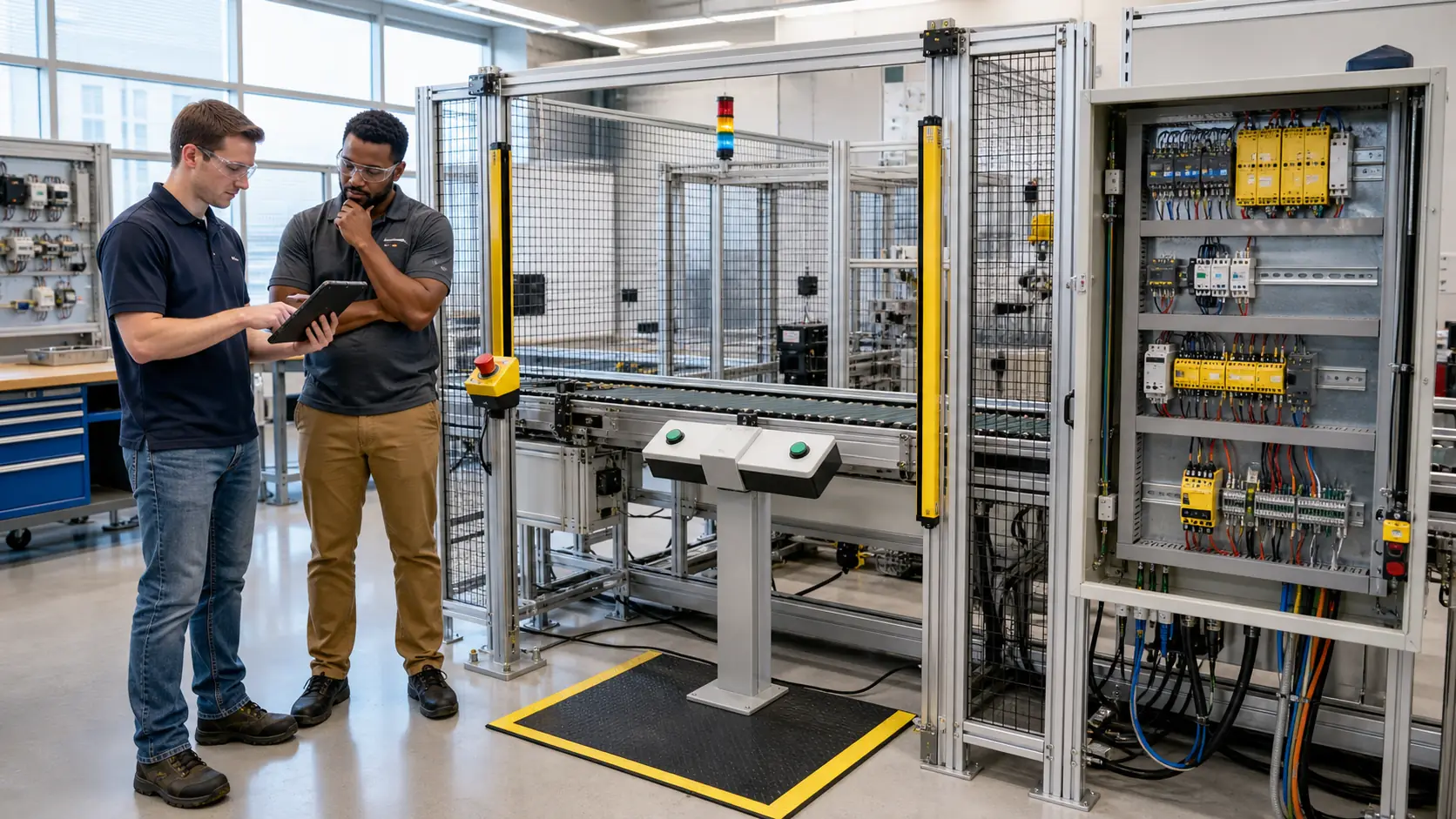
a guarded machine-safety training cell with an emergency stop, two-hand station, safety mat, light curtain and inspectable relay panel while studying two-hand control simultaneity, anti-tie-down, release and safe-cycle evidence
System map / 02

NODE 01observable

Role scope

Hazard boundary, two independent actuators, simultaneity window, anti-tie-down state, output request, completion, release and restart policy.

NODE 02observable

Skills map

Left and right inputs through channel state, timing comparison, cycle latch, machine request, feedback, completion and release confirmation.

NODE 03observable

Core exercise

Both controls actuated within the window, maintained through the required portion and released before the next permitted cycle.

NODE 04observable

Stretch case

One control held, staggered actuation, contact bounce, channel discrepancy, early release, aborted cycle, restart and power return.

NODE 05observable

Troubleshooting

An actuator, input channel, time window, anti-tie-down state, output request, completion, release or restart mismatch.

NODE 06observable

Portfolio evidence

The real safeguard selected and validated from risk assessment, applicable standards, exact hardware and stopping-performance evidence.

Answer surface / 07

What is anti-tie-down in two-hand control?

It prevents a new cycle when one actuator is already held, bypassed or not released. Both controls must follow the declared neutral-to-actuated sequence.

Is simple PLC AND logic enough for two-hand safety?

No. A production safeguard requires risk-based architecture, diagnostics, timing, placement, stopping-performance and validation beyond a normal PLC AND expression.