Free
8 min

Lesson 6 — SET/RST Latching

curriculumlessonset-rstlatch

Ready to build this?

Sign up free — no credit card required. This scenario is included in the free tier.

Sign up to play this scenario →

Already have an account? Log in

Not ready to sign up? Run a live lab now — no signup →

Lesson 6 — SET/RST Latching scenario preview

Briefing

SET (S=) and RESET (R=) coils are the explicit latch instructions. S= turns a bit on and it stays on even if the rung goes false. R= turns it off and it stays off. Two rungs, clean and readable — no feedback branch needed.

Objectives

  • START pulse sets MOTOR (stays on)
  • STOP pulse resets MOTOR (stays off)

Hints

  • Rung 1: | START | S= MOTOR ; — this latches MOTOR on.
  • Rung 2: | STOP | R= MOTOR ; — this resets MOTOR.

I/O Table

Inputs

START

Momentary start push-button (NO)

BOOL · %I0.0

STOP

Momentary stop push-button (NO)

BOOL · %I0.1

Outputs

MOTOR

Motor contactor coil

BOOL · %Q0.0

Your program will be tested against:

All test cases run automatically when you submit. Assertions are hidden until you pass.

  1. #1START pulse sets MOTOR

    Brief START → MOTOR on and stays on

  2. #2STOP pulse resets MOTOR

    While running, brief STOP → MOTOR off

Ready to build this?

Sign up free — no credit card required. This scenario is included in the free tier.

Sign up to play this scenario →

Already have an account? Log in

Not ready to sign up? Run a live lab now — no signup →

Competency and practice field guide

PLC set-reset curriculum scenario: practice plan

Direct answer

The learner can explain who sets and resets a bit, define simultaneous priority and prove stop, fault, restart and power-return behavior.

Written for pLC learners using latched state deliberately instead of creating hidden or conflicting memory.
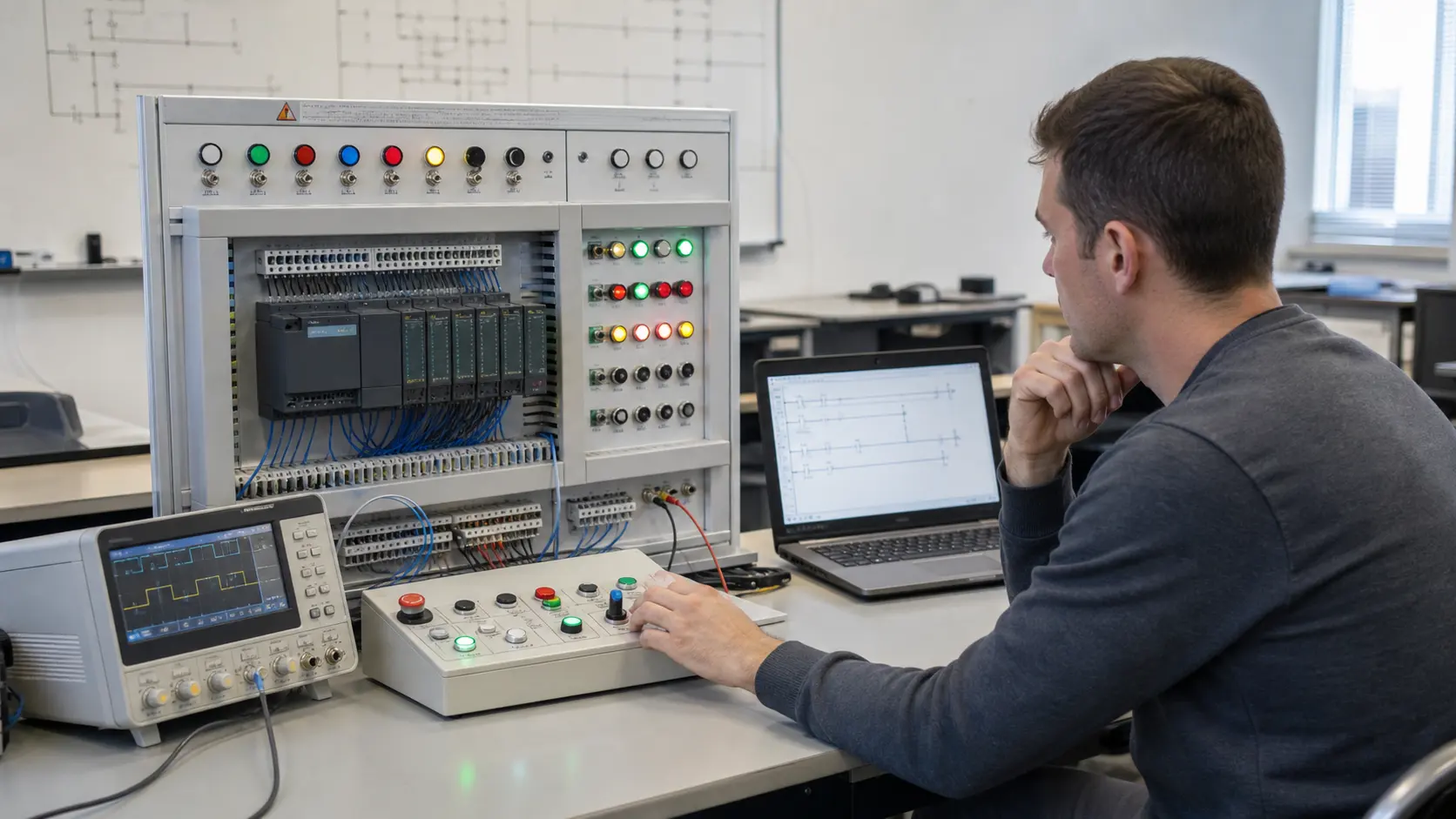
a PLC logic and scan-cycle training station with observable inputs, outputs, timing traces and program state used to prove execution behavior while studying SET and RESET state ownership, priority, startup and recovery behavior
System map / 02

NODE 01observable

Scope

Latched state purpose, set conditions, reset conditions, priority, retentive class, startup initialization, consumers and physical feedback.

NODE 02observable

Signal path

Operator or process event through set-reset evaluation, stored state, output arbitration, equipment response and independent feedback.

NODE 03observable

Baseline practice

The state sets once under the intended event, remains only as required and resets through every declared stop or completion path.

NODE 04observable

Edge cases

Set and reset together, held condition, missing reset, fault during latch, manual mode, task restart, download, power cycle and stale feedback.

NODE 05observable

Fault practice

An event, rung-order, priority, state-owner, retention, reset-path, output-consumer or feedback mismatch.

NODE 06observable

Transfer to the job

The pattern verified against official platform behavior and reviewed so protective removal of energy remains independent.

Answer surface / 07

Which should have priority, SET or RESET?

Choose from the risk and operating requirement, implement that priority explicitly and test the simultaneous case; stop or fault reset commonly needs dominant behavior.

Why are PLC latches difficult to troubleshoot?

Their current value depends on prior events and possibly restart behavior, so the active set and reset paths may not explain how the state was created.