
Competency and practice field guide
PLC off-delay timer curriculum scenario: practice plan
Direct answer
The learner can predict when the output remains true after the enabling condition falls and prove equality, re-enable and restart cases.
Written for pLC learners comparing off-delay behavior with on-delay and retentive timing patterns.
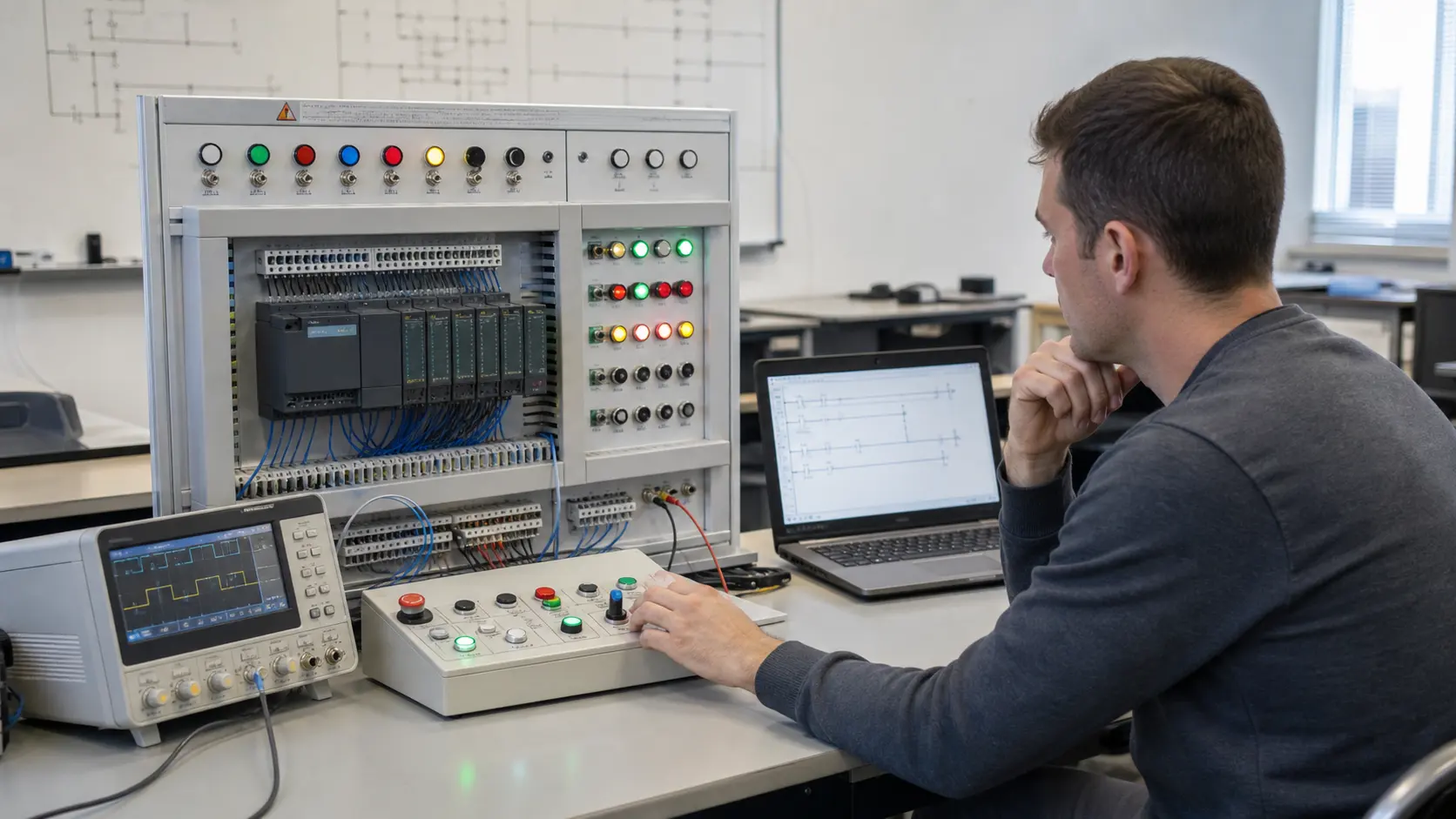
Scope
Input condition, preset, accumulated time, output or done state, timing base, scan period, re-enable behavior, startup and reset semantics.
Signal path
Sampled condition through timer state update to output instruction, modeled device response and timestamped acceptance evidence.
Baseline practice
The output is active while enabled and remains active for the declared delay after a clean falling transition before turning off once.
Edge cases
Zero preset, equality boundary, re-enable during timing, scan jitter, task pause, power cycle, retained state, held input and preset change.
Fault practice
An input, timer type, preset, time-base, scan, status-bit, consumer, restart or reset mismatch.
Transfer to the job
The timer recreated and tested in official software against the intended controller and task configuration.
What does a TOF timer do in a PLC?
An off-delay timer keeps its output condition active for a configured interval after the enabling condition changes from true to false.
What happens if a TOF is re-enabled before the delay expires?
Common implementations restore or maintain the active output and reset timing state, but verify the exact controller instruction semantics.