Central plant
Boiler purge and flame proving, pump duty, valves, heat exchange and plant alarms.
Program HVAC zones, central plant, access control and alarms in one browser lab. Then open the full 3D building-automation floor and trace every sensor, actuator, permissive and failure back to PLC logic.
One curriculum, connected systems
The page deliberately combines building automation systems training and building management system training into one canonical learning path. Search wording changes; the underlying control work does not.
Boiler purge and flame proving, pump duty, valves, heat exchange and plant alarms.
Four editable VAV zones with analog position, airflow and temperature feedback.
Garage doors, barriers, traffic lamps and elevator landing calls in one environment.
PLC cabinet, HMI, remote I/O and industrial Ethernet props with generated tags.
Each scenario has requirements, visible I/O and objective checks. Use those constrained exercises to learn the pattern; use the Sandbox to combine the systems.
Concept guides
Two plain-language guides explain the ideas behind the exercises. Neither needs an account.
The new building-automation starter is assembled from reusable, PBR-textured components with typed I/O and code-native motion. It is a real editable scene, not a fixed background render.
Public viewer is free. Guided 3D starts on Basic; composing and saving custom 3D scenes is Pro.
151 real-time factory components
Load the interactive viewer when you are ready to orbit the models.
Loads 3D only after your click
This is a control-logic and troubleshooting environment. It can make BAS sequences visible and repeatable, but it cannot certify a technician, commission a production BACnet network or replace supervised work on live equipment.
Best conversion path
Free visitors can inspect the public component library. Guided BAS exercises start in the training plans. Pro unlocks composing and saving the complete custom 3D floor.
Compare training plansCompetency and practice field guide
Direct answer
The learner can trace an occupancy or environmental demand through mode logic, equipment sequence, proof, loop response, alarm and operator display.
Written for hVAC technicians, electricians and controls learners studying air handlers, pumps, boilers, chillers, zones, sensors, actuators, alarms and BAS supervision.
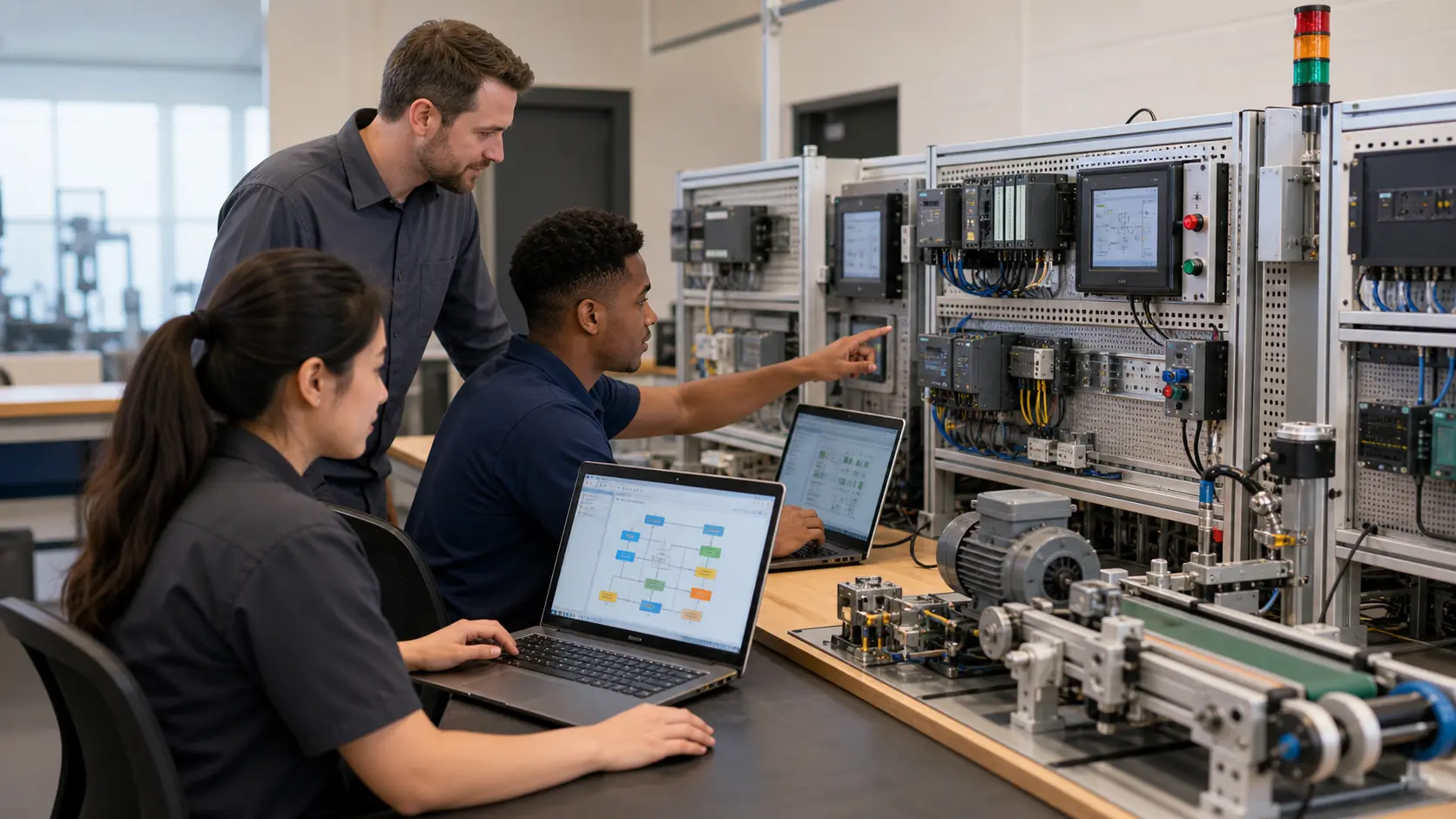
Building use, equipment, occupancy modes, setpoints, sensors, actuators, interlocks, safeties, alarms, trends and operator tasks.
Zone or plant demand through BAS logic, equipment command, physical proof, environmental response and supervisory display.
Occupied startup, stable operation, mode change and controlled shutdown of one representative system.
Freeze protection, smoke interface, lost airflow, failed valve or damper, sensor bias, utility loss and restart.
A mode, schedule, permissive, command, proof, loop, instrument, network or process-response fault.
The sequence compared with approved design documents and commissioned on the actual BAS and equipment.
Begin with equipment purpose, mode and signal paths before programming: demand, permissives, command, proof, environmental response, alarm and safe shutdown.
You can learn sequence reasoning, I/O, alarms, trends and diagnosis in simulation, but target controllers, networks, field devices and life-safety interfaces still need supervised practice.