← Back to all lessons
Fault 3
Pro

Fault 3 — Rail Short at the Terminal Block

What you'll learn

**Symptom:** the line operator reports the conveyor contactor never pulled in this morning — the panel went dark on the load side. You walk over: the PSU's own indicator LED is on, but the contactor coil is silent and every downstream load is dead. None of the wiring looks scorched; nothing's tripped.

Lab time: ~7 minutes.

Lesson briefing

Rail Short at the Terminal Block

Symptom: the line operator reports the conveyor contactor never pulled in this morning — the panel went dark on the load side. You walk over: the PSU's own indicator LED is on, but the contactor coil is silent and every downstream load is dead. None of the wiring looks scorched; nothing's tripped.

An apprentice was on this panel yesterday — they may have stripped a feed wire a little aggressively at the terminal block. A stray strand across two adjacent terminal-block slots is enough to drop a rail.

Reach for the multimeter on the toolbar. Continuity mode is your friend here — you're hunting for a beep where there shouldn't be one. Voltage mode confirms the symptom; continuity mode finds the bridge.

Hints

Hint 1

Start at the load. Probe across the contactor coil (A1 vs A2) in voltage mode — the coil is wired to sit at +24 V at rest. What do you read?

Hint 2

Sign up to unlock the full hint sequence.

Hint 3

Sign up to unlock the full hint sequence.

This lesson uses 5 placed components on the lab canvas. Components are vendor-neutral (no proprietary trademarks); the wiring rules apply to any equivalent industrial part.

Sign up to preview

Create a free account to preview this Pro lab; upgrade to open the interactive circuit.

Sign up to preview →
You might also like

Competency and practice field guide

Control-rail short fault lesson: practice plan

Direct answer

The learner can preserve the protection state, divide the de-energized circuit into bounded sections and distinguish a rail short from an open supply or overloaded branch.

Written for electrical and maintenance learners diagnosing a low-voltage control circuit that loses power or opens protection because of a terminal-block short.

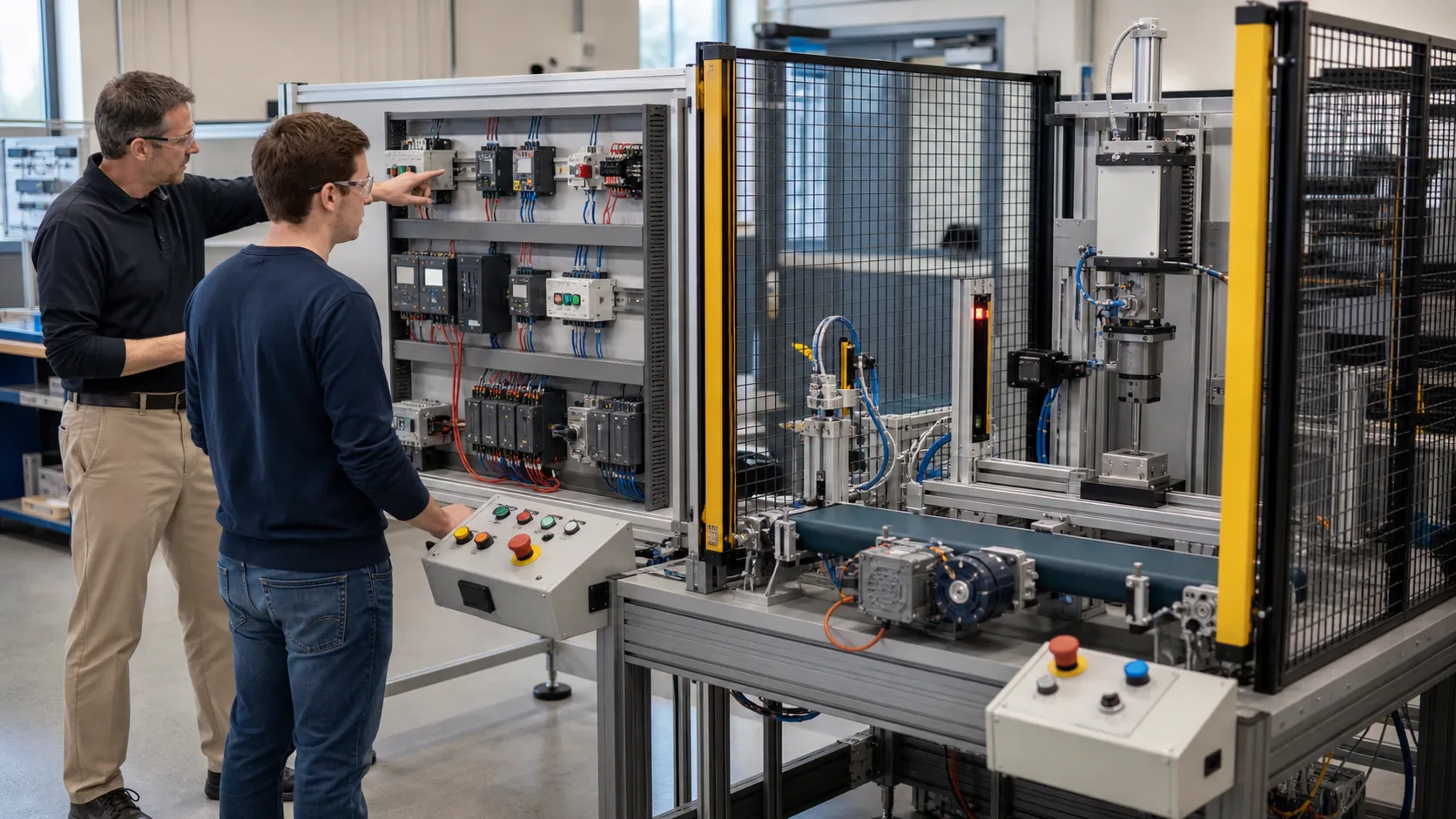
a guarded motor-control and machine-safety training cell used to prove starter, drive, interlock, stop, feedback and restart behavior while studying 24 VDC rail short, protection state and safe fault localization
System map / 02

NODE 01observable

Scope

Control-power source, protective device, positive and return rails, terminal groups, branch loads, conductor routing, normal resistance expectations, isolation points, safe state and restoration criteria.

NODE 02observable

Signal path

Source through protection and distribution terminals to branch loads and return while a short path drives excess current and changes voltage and protective state.

NODE 03observable

Baseline practice

The healthy circuit supplies all declared branches with stable voltage and protection remains set under representative load.

NODE 04observable

Edge cases

Solid short, intermittent conductor contact, pinched wire, failed load, wrong jumper, shared return, overloaded branch, replacement fuse and power return.

NODE 05observable

Fault practice

A source, protective-device, rail, terminal, conductor, branch, load, return or restoration mismatch.

NODE 06observable

Transfer to the job

The isolated circuit inspected and tested by qualified personnel using exact drawings, ratings and employer procedures.

Answer surface / 07

What happens when a 24 VDC control rail is shorted?

Current rises according to source and fault impedance until current limiting or protection acts, often collapsing rail voltage and stopping multiple control branches.

Should you replace a fuse before finding the short?

Do not repeatedly replace protection without diagnosing the cause; isolate under the approved procedure and prove the faulted branch first.