Free
4 min

Beginner 06 — Latch the start (SET coil)

beginnerfundamentalsset-coillatch

Ready to build this?

Sign up free — no credit card required. This scenario is included in the free tier.

Sign up to play this scenario →

Already have an account? Log in

Not ready to sign up? Run a live lab now — no signup →

Beginner 06 — Latch the start (SET coil) scenario preview

Briefing

Now we fix stage 4. A SET coil (S=) latches a bit on. Pulse START once — the LIGHT turns on and stays on, even after you release the button. That's how real machines work: you tap the start button, the motor runs. You don't stand there holding the button down all day.

Objectives

  • A brief START pulse turns LIGHT on
  • LIGHT stays on after START is released

Hints

  • Use a SET coil instead of a normal coil. In IEC: | START | S= LIGHT ;
  • Once a SET coil fires, the bit stays on until something resets it. We add the reset in the next scenario.
  • Check program grades the observed latch behavior. A seal-in branch such as START OR LIGHT is also valid, even though SET is the reference pattern taught here.

I/O Table

Inputs

START

Momentary start push-button (NO)

BOOL · %I0.0

Outputs

LIGHT

Indicator lamp

BOOL · %Q0.0

Your program will be tested against:

All test cases run automatically when you submit. Assertions are hidden until you pass.

  1. #1Pulse START → LIGHT latches on

    A momentary START sets LIGHT and it stays on after release

  2. #2Idle → LIGHT off

    Without ever pressing START, LIGHT stays off

Ready to build this?

Sign up free — no credit card required. This scenario is included in the free tier.

Sign up to play this scenario →

Already have an account? Log in

Not ready to sign up? Run a live lab now — no signup →

Runnable simulator field guide

PLC latch and start scenario: test checklist

Direct answer

The learner can explain who owns maintained state, prove stop priority and test held, simultaneous, reset and power-return conditions.

Written for pLC beginners learning seal-in branches or set-reset state and the conditions required for deliberate stopping and restart.
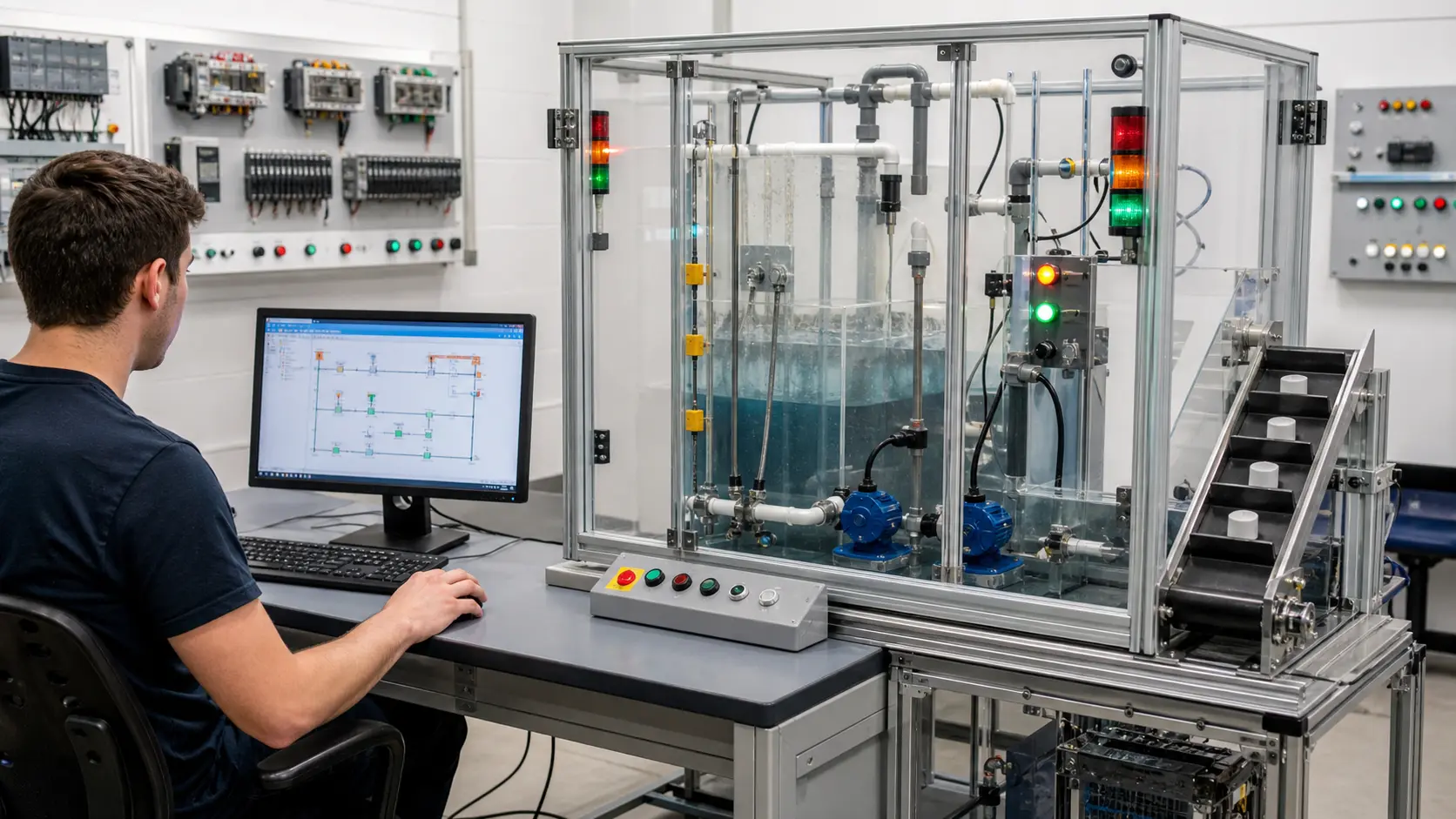
a browser PLC workstation connected to a guarded pump, level and conveyor training rig for repeatable control cases while studying maintained start state, stop priority and reset behavior
System map / 02

NODE 01observable

Scenario setup

Start request, stop condition, maintained-state owner, seal contact or set-reset pair, permissives, feedback, reset authority and restart policy.

NODE 02observable

I/O and state map

Momentary command through rung or state instruction, maintained bit, final output, physical response, independent feedback and deliberate stop path.

NODE 03observable

Normal run

Start pulse establishes the required state, release preserves it and stop reliably removes it over repeated cycles.

NODE 04observable

Boundary run

Start and stop together, held start, held reset, lost permissive, failed feedback, duplicate writer, download and power return.

NODE 05observable

Injected fault

A command, priority, branch, state-owner, reset, retentive, output, feedback or restart mismatch.

NODE 06observable

Target check

The chosen pattern tested on the exact target controller with physical interlocks and machine acceptance cases.

Answer surface / 07

What is a latch in PLC programming?

It is maintained state that remains after the initiating condition changes until a defined reset or stop path clears it.

Should start or stop have priority?

Most start-stop contracts give stop priority, but the required simultaneous-input behavior must be written and tested for the machine.