What you'll learn
Connect a Type 4 light curtain to a safety relay using two independent OSSD channels, then use a safety output contact to interrupt a contactor coil. Functional earth drains interference; it is not the 0 V operating return.
Lab time: ~22 minutes.
Lesson briefing
Safety Light Curtain with Dual OSSD
Connect a Type 4 light curtain to a safety relay using two independent OSSD channels, then use a safety output contact to interrupt a contactor coil. Functional earth drains interference; it is not the 0 V operating return.
The device in the real world
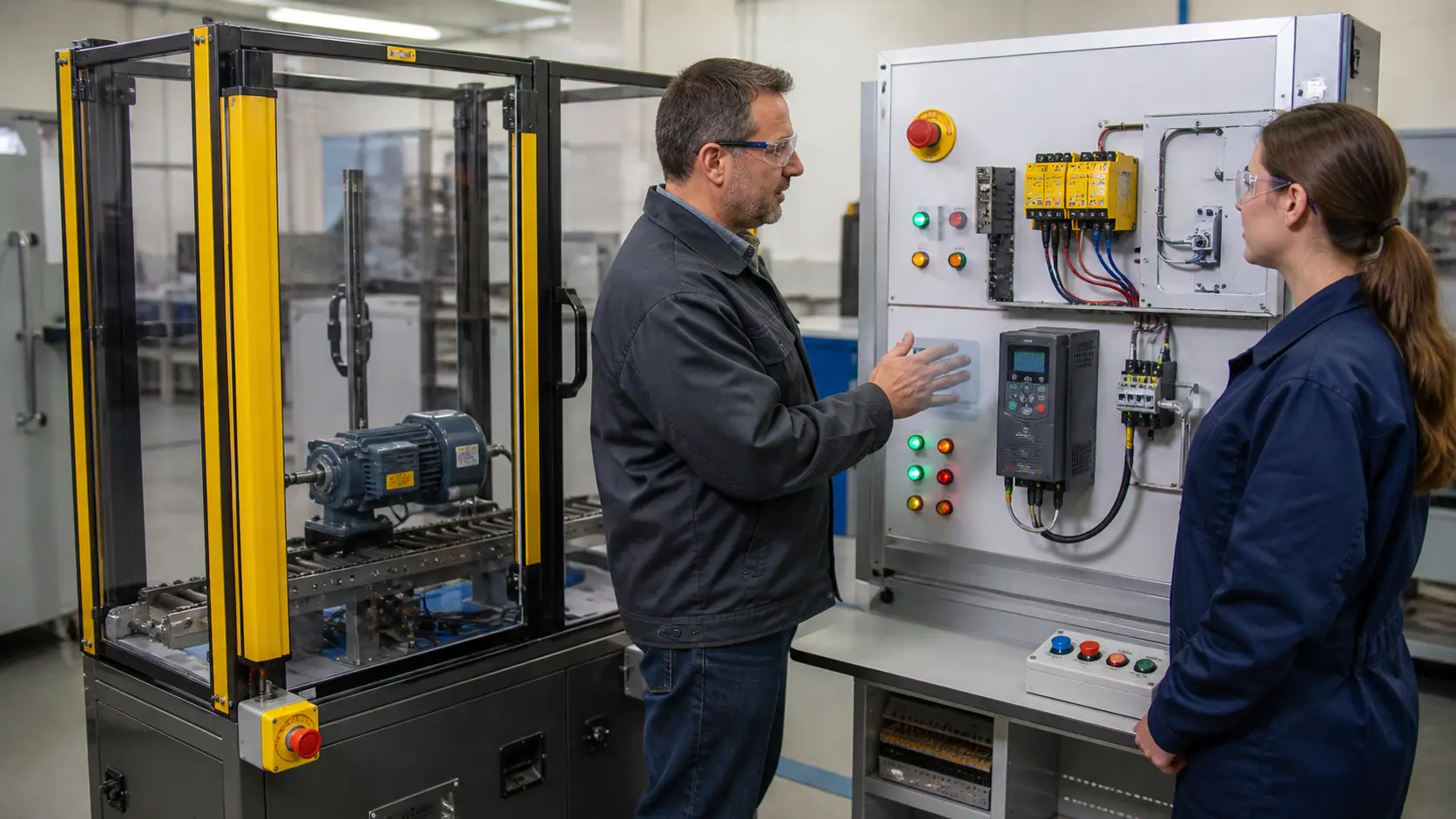
A light curtain guards the opening to a press, a palletiser or a robot cell with a row of invisible beams. A Type 4 device has two safety outputs, OSSD1 and OSSD2, that pulse themselves to prove they are healthy. The safety relay compares both channels and only then closes its own contacts, which feed the contactor that powers the hazard. A reset button lets a person restore the circuit after the beam is cleared.
Why it is wired this way
OSSD1 and OSSD2 are pulsed semiconductor safety outputs. The OSSD outputs and the safety relay together check both channels for agreement and monitor for shorts to supply, 0 V or each other. A real Category 3 or 4 stop function would use redundant, monitored (force-guided) contactors; one contactor is shown here for clarity. Never parallel the two outputs into one ordinary PLC input.
Worked example
With the beams clear, both OSSD outputs sit at 24 V, so the relay can be reset. The operator reaches in and breaks a beam: both outputs fall to 0 V within a few milliseconds, the relay drops, its 13 to 14 contacts open and the contactor coil loses its supply, so torque is removed. If a wire shorts OSSD1 to 24 V, the relay sees the two channels disagree, refuses to reset and stays safe. Wire the lab by giving the curtain its supply, then the two OSSD cables to separate inputs, then the reset loop, then the output to the coil.
Common mistakes
- Joining OSSD1 and OSSD2 together into one input, which destroys the two-channel check.
- Using the functional earth terminal as a 0 V return.
- Wiring the reset button in series with the safety output instead of the monitored reset input.
- Running the OSSD cables in the same duct as motor leads.
What you can now do
You can connect a dual-channel light curtain to a safety relay and explain what each channel, the reset loop and the output contact do.
Commissioning standard
Check the beam path, both channels and the reset action using the manufacturer's test procedure before the machine is allowed to run.
Training material. Follow your site procedures, local electrical code and the manufacturer's instructions. Lockout/tagout and a qualified person are required for real equipment.
Hints
Give the light curtain its own +24 V and 0 V supply plus FE bond.
Sign up to unlock the full hint sequence.
Sign up to unlock the full hint sequence.
This lesson uses 7 placed components on the lab canvas. Components are vendor-neutral (no proprietary trademarks); the wiring rules apply to any equivalent industrial part.
Sign up to preview
Create a free account to preview this Pro lab; upgrade to open the interactive circuit.
Sign up to preview →